


Bringing down debt-to-GDP ratio will be govt's core focus: Sitharaman
The finance minister stressed that fiscal management remains a priority and must be consistently upheld year after year
 "sitharaman")
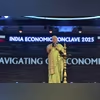
The finance minister praised the services sector for contributing around 60 per cent of GDP growth. Photo: Nirmala Sitharaman Office
Listen to This Article
Union Finance Minister Nirmala Sitharaman on Wednesday said that reducing the debt-to-gross domestic product (GDP) ratio will be the government's "core focus" in the next financial year.
Speaking at the Times Network’s India Economic Conclave, Sitharaman said it is crucial to bring down the debt-to-GDP ratio, which crossed 60 per cent during the Covid period. “It is already coming down, but we need to reduce it further, and this will be a core focus in the next financial year,” she said.
The finance minister also urged states to focus on lowering their debt-to-GDP ratios. Citing data and Reserve Bank of India (RBI) documents, she said there are areas where debt levels are a cause for concern, without naming specific states.
“Unless the stock of debt that is accumulating at higher interest rates is brought down to acceptable levels, it will be difficult to achieve the Viksit Bharat goal,” she added.
Sitharaman said the government is also working to deepen the bond market to allow more funds to flow in. She noted that the discipline shown by the Union government through stable policies under Prime Minister Narendra Modi’s leadership has helped achieve this. “A stable government has provided the confidence to sit in the higher chair and negotiate,” she said.
Also Read

 "Pension, NPS")
 "India Bangladesh")
 "Vikram Bhatt")
 "homebound")
 "Donald Trump")
The finance minister stressed that fiscal management remains a priority and must be consistently upheld year after year.
Trade is not fair, tariffs being weaponised
Stating that India contributes about 25 per cent to global trade, Sitharaman said the country needs to negotiate carefully amid the current geopolitical situation. “Trade is not fair, trade is not free. People say you are a tariff king, but tariffs are now being weaponised. India’s intention was never to weaponise tariffs,” she said.
“We do have to protect our economy and safeguard our industries, but today, weaponisation is happening without criticism. New players are coming up with tariff barriers, and there is no questioning them. This seems to be the new normal. India will have to negotiate its way carefully through this,” she added.
Praises growth in services sector
The finance minister praised the services sector for contributing around 60 per cent of GDP growth. However, she noted that services are not limited to information technology (IT) alone. Sectors such as tourism and hospitality also need to contribute. “The government is working to ensure facilities are available for every sector to grow at its own pace and also scale up to global standards,” Sitharaman said. She also highlighted the need to focus on how manufacturing is picking up.
On providing impetus to the private sector, Sitharaman said it is important to support and help private enterprises scale up so they can create more jobs and add to GDP. She noted that the reduction in corporate tax rates was critical and necessary.
Welcoming the growth of global capability centres (GCCs) and data centres, she said energy security is essential to support this expansion. “The government is working on nuclear energy and building small modular reactors. This will be supported in a big way so that India can rely on it as a clean source of energy, apart from other renewable sources,” she said.
Entrepreneurial capability needs support
Sitharaman also emphasised the need to support entrepreneurial capability wherever it exists, including in smaller towns and villages. She said entrepreneurship has accelerated in smaller towns across the country, supporting local economies while aspiring to meet global demand. The government has focused on strengthening regional talent to promote exports, she said.
“Wherever the entrepreneurial spirit exists, we should back it. We are working to provide strength and facilities so that entrepreneurs can grow,” Sitharaman said, adding that the credit footprint of Indians has expanded, enabling more people to access bank credit directly.
She also said India is navigating geo-economic challenges effectively and that critics should acknowledge this. “Covid or no Covid, India’s people stayed resilient, and that resilience should be celebrated,” she said.
More From This Section
 "oil, crude oil,")
 "exports, imports, trade")
 "FMCG, SHOPS")
 "Crown Prince of Jordan Hussein bin Abdullahal-Hashimi (right) drove Prime Minister Narendra Modi to the Jordan Museum during his visit to Amman, Jordan, on Tuesday (Photo: PTI)")
 "Tax collections, taxes")
Topics : Nirmala Sitharaman Finance minister Finance Ministry Debt GDP GDP growth private sector services manufacturing BS Web Reports
Don't miss the most important news and views of the day. Get them on our Telegram channel
First Published: Dec 17 2025 | 12:53 PM IST