


Strong domestic growth will attract foreign investments: RBI Governor
The six-member Reserve Bank of India's Monetary Policy Committee had revised its growth forecast for the current financial year to 7.3 per cent in December from 6.8 per cent in October
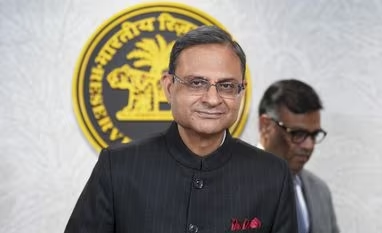 "Sanjay Malhotra, RBI, RBI Governor")
(Photo:PTI)
Listen to This Article
Strong domestic growth will continue to draw foreign investment into the Indian economy, Reserve Bank of India (RBI) Governor Sanjay Malhotra said on Tuesday. He said this was reflected in recent free trade agreements and investment commitments by large technology companies.
“We have been the fastest-growing economy for several years among major economies. The demand for capital, therefore, for the Indian economy — Indian as well as foreign — is going to remain because we are growing, and we are growing at a healthy pace. So yes, there should be more such investments. However, it’s not a linear path,” Malhotra said in an interview with television news channel NDTV Profit.
The six-member RBI monetary policy committee (MPC) revised its growth forecast for the current financial year (2025–26) to 7.3 per cent in December, up from 6.8 per cent in October. The inflation forecast was revised down to 2 per cent from 2.6 per cent. The MPC has cut the policy repo rate by 125 basis points (bps) in 2025 to spur growth.
On the foreign exchange (forex) market, Malhotra said India’s macroeconomic fundamentals remain strong, with high growth, low inflation, and adequate forex reserves of about $690 billion. The current account deficit is manageable, leaving the external position comfortable overall.
He said currency movements are not linear and tend to fluctuate over time. Over the longer term, the rupee has depreciated by around 3 per cent on average, which is considered normal given India’s relatively higher inflation compared with advanced economies. While the currency has weakened by about 5 per cent in 2025, this follows a smaller depreciation of roughly 2.5 per cent earlier, keeping the longer-term average broadly in line with historical trends and market fundamentals.
Also Read

 "RBI")
 "Reserve Bank of India (RBI) Deputy Governor T Rabi Sankar | photo: KAMLESH PEDNEKAR")
 "RBI")
 "Shirish Chandra Murmu, deputy governor, RBI")
 "datanomics")
“The average is more or less around 3.5 per cent. It’s not going to be a linear movement. But it is broadly where market forces suggest it should be,” he said.
On the transmission of the 125-bp rate cut in 2025, the governor said transmission is still underway and continues to evolve. Government bond yields have declined, though not uniformly across the curve. While transmission has been stronger at the shorter end due to policy actions, pass-through at the longer end has been more limited and not on a one-to-one basis.
“Yields have come down. They have not come down on a one-to-one basis at the longer end. But at the shorter end, yields have declined as a result of our policy action. At the long end, transmission will be much lower because of the nature of transmission. Overall, transmission is still happening. It’s still evolving,” he said.
More From This Section
 "GDP")
 "Russian oil")
 "Vegetable oil, oil imports tax")
 "free trade agreements")
 "artificial intelligence, AI Models")
Don't miss the most important news and views of the day. Get them on our Telegram channel
First Published: Jan 13 2026 | 9:54 PM IST