


After Japan, PM Modi lands in China to meet Xi, Putin at SCO Summit
PM Modi concludes Japan visit with 13 agreements, heads to the SCO Summit in China to meet Xi Jinping and Vladimir Putin. India, China focus on ties amid global strains
 "Modi, Narendra Modi")
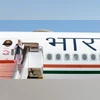
Prime Minister Narendra Modi on Saturday left for China to attend the Shanghai Cooperation Organisation (SCO) Summit in Tianjin, following the conclusion of his two-day official visit to Japan.(Photo: PTI)
Listen to This Article
Prime Minister Narendra Modi on Saturday landed in China - his first visit in seven years - to attend the annual Shanghai Cooperation Organisation (SCO) Summit in Tianjin, following the conclusion of his two-day official visit to Japan. "Landed in Tianjin, China. Looking forward to deliberations at the SCO Summit and meeting various world leaders," the prime minister said in a social media post, shortly after arriving here from Japan in the second and final leg of his two-nation trip. He also put out tweets in Chinese, highlighting the welcome he received from Indian expatriates in that country.
Landed in Tianjin, China. Looking forward to deliberations at the SCO Summit and meeting various world leaders. pic.twitter.com/gBcEYYNMFO
— Narendra Modi (@narendramodi) August 30, 2025
PM Modi to attend SCO Summit in China
With the Japan leg concluded, PM Modi will now participate in the SCO Summit on August 31 and September 1. PM Modi and China's President Xi Jinping are expected to take stock of economic ties and deliberate on steps to further normalise relations that came under severe strain following the Galwan border flare-up in 2020.
The summit is also significant as it takes place in the backdrop of recent strains in India-US ties, following the Trump administration's imposition of 50 per cent tariffs on Indian exports, including a 25 per cent levy linked to New Delhi’s imports of Russian crude. Ahead of his trip to Tianjin, PM Modi said it is important for India and China to work together to bring stability to the world economic order.
Also Read

 "Xiao He, humanoid robot at SCO summit")
 "Modi, Xi Jinping")
 "Narendra Modi")
 "India's prime minister Narendra Modi")
 "Modi, Narendra Modi")
President Xi will also be host Russian President Vladimir Putin at the Tianjin meeting.
During his visit, the Prime Minister is scheduled to hold bilateral talks with both leaders on the sidelines of the summit. He is also likely to hold bilateral talks with a number of other leaders on the sidelines of the SCO summit.
What is the SCO Summit?
The SCO, founded in 2001, has evolved into one of the world’s largest regional groupings with 10 member states: India, China, Russia, Pakistan, Kazakhstan, Kyrgyzstan, Tajikistan, Uzbekistan, Iran and Belarus. India became a full member in 2017 and has since chaired both the Council of Heads of Government (2020) and the Council of Heads of State (2022–23).
Ahead of his departure, PM Modi said India remains an “active and constructive member” of the SCO.
India-China bilateral ties
The visit also comes after efforts by both India and China earlier this month to restore normalcy in bilateral ties, including agreements to restart direct flights, resume cross-border trade through traditional Himalayan passes, and ease visa access for business and tourism. Following Chinese Foreign Minister Wang Yi's wide-ranging talks with External Affairs Minister S Jaishankar and National Security Advisor Ajit Doval last fortnight, both sides announced a series of measures for a "stable, cooperative and forward-looking" relationship.
Russian President Putin to visit India
On Friday, Kremlin foreign policy aide Yuri Ushakov confirmed that the Russian president would be visiting India in December. Putin is expected to meet with PM Modi in Tianjin to discuss the preparations for his upcoming visit.
“Right after the SCO Plus meeting (on September 1), our president will meet Indian Prime Minister Modi,” Ushakov said. This year marks the 15th anniversary of the declaration of the India-Russia strategic partnership in December 2010.
PM Modi concludes Japan visit, signs 13 agreements
During his Tokyo visit, India and Japan signed 13 agreements and declarations, covering areas from defence cooperation to space exploration, and laid out a 10-year roadmap to strengthen economic partnership. Japan committed to investing 10 trillion yen (about Rs 60,000 crore) in India over the next decade, while both sides agreed to deepen collaboration in sectors such as semiconductors, clean energy, critical minerals and new technologies.
“This visit to Japan will be remembered for the productive outcomes which will benefit the people of our nations. I thank Prime Minister Ishiba, the Japanese people and the government for their warmth,” PM Modi said in a post on X. He also visited Sendai, where he and his Japanese counterpart Shigeru Ishiba toured a semiconductor facility.
More From This Section
 "Rajnath Singh, Defence Minister")
 "US-India, US-India flag, US India flag")
 "PM Modi with Japan's Ishiba")
 "Xi Jinping, Narendra Modi, India-China")
 "PM Modi in Japan")
Topics : Narendra Modi Vladimir Putin Narendra Modi in China SCO summit India China relations India-Russia ties Xi Jinping BS Web Reports
Don't miss the most important news and views of the day. Get them on our Telegram channel
First Published: Aug 30 2025 | 3:17 PM IST