


Trump tariffs loom as Brics meets in Rio; PM Modi bats for Indian pharma
Modi seeks deeper pharma ties in Argentina, Trinidad
 "Narendra Modi, Lula da silva")
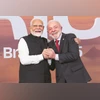
PM Narendra Modi with Brazil President Luiz Inacio Lula da Silva at Brics Summit (Photo: PTI)
Listen to This Article
In his speech at the Brics Summits’ session on ‘reform for global governance’ on Sunday evening (India time), Prime Minister Narendra Modi said the Global South has been a victim of double standards, including on security-related issues, or those of development, distribution of resources.
The PM, who landed in Rio de Janeiro in the early hours of Sunday to attend the Brics Summit, said the Global South’s interests do not get priority, and often gets “token gestures” on climate finance, sustainable development, and technology access.
Modi spoke of Global South’s lack of representation on the high table of international institutions, which he said was not only a question of representation but also of credibility and effectiveness of these institutions. He likened these institutions, which do not reflect the changed reality of the world, as akin to mobile phones which have sim cards but no network.
These institutions are incapable of meeting the challenges of the 21st Cenutyr, whether armed conflicts that are taking place across the world, or pandemic, economic crises, these institutions have no solutions to offer, the PM said. He said the world needed a multipolar, inclusive world order. He said such a world order should start with reforming international institutions, which should not merely be symbolic but change their governance structures, voting rights and leadership positions.
Also Read

 "Modi, Narendra Modi")
 "Brics, BRICS")
 "PM Modi Javier Milei")
 "PM Modi, Brazil, Brics")
 "Congress MP Rahul Gandhi and PM Narendra Modi")
The PM said the expansion of Brics is evidence that the grouping has the gumption to change with the times, and similar will power is needed to reform the UN Security Council, the World Trade Organisation, and multilateral banks. In the context of reforms of these institutions, he said 21st Century softwares cannot be run using 20th Century typewriters.
After visits to Ghana, Trinidad and Tobago, and Argentina — where he sought greater access for India’s pharmaceutical sector and discussed increased cooperation in exploration, processing, and supply of critical minerals — the PM landed in Rio de Janeiro early Sunday morning (India time) to attend the two-day Brics Summit.
The Brics Summit, which will conclude on Monday, is set to discuss issues like Israel’s attack on Iran, the humanitarian crisis in Gaza, and trade tariffs imposed by US President Donald Trump. Not all members of the grouping are on the same page on some of these topics.
India, for example, has a nuanced position on the Iran-Israel conflict. Sources said some of the other member countries want more aggressive language on the situation in Gaza and Israel’s attack on Iran. Tehran joined Brics in 2024, along with Egypt, Ethiopia, and the United Arab Emirates (UAE), with Indonesia becoming a member in this year.
India and Brazil — the latter as host of this year’s summit — are also wary of American tariffs. US President Donald Trump has threatened to impose 100 per cent tariffs against the bloc if they take any steps to undermine the dollar.
A Bloomberg report on Saturday said that, according to the draft statement it had accessed, the Brics leaders have agreed to voice “serious concerns” about the rise of unilateral tariff and non-tariff measures “which distort trade and are inconsistent with World Trade Organization rules”. They have also agreed to “condemn the imposition of unilateral coercive measures that are contrary to international law”, specifically economic sanctions. However, the final wording of the concluding communiqué could still change, the report said. The draft statement does not directly mention the US.
Shot in the arm for Indian pharma
The PM, on a five-nation tour spanning eight days — his longest in a decade — concluded his bilateral visit to Argentina, the first by an Indian PM in 57 years, on Saturday evening. Modi and Argentine President Javier Milei agreed to enhance bilateral cooperation in several sectors, including critical minerals, oil and gas, defence, nuclear energy, pharmaceutical, and space.
Modi sought diversification of the trade basket between the two countries, and in this context, the two discussed expansion of the India-Mercosur Preferential Trade Agreement (PTA), officials said. The PM requested Argentina’s support in expanding the India-Mercosur PTA, P Kumaran, Secretary (East) in the Ministry of External Affairs (MEA), said in Buenos Aires. The PTA aims to expand economic ties between India and the Mercosur bloc, which includes Argentina, Brazil, Paraguay, and Uruguay.
India-Argentina bilateral trade has been on an upswing. The trade volume more than doubled in three years, from 2019 to 2022, peaking at $6.4 billion in 2022. In 2021 and 2022, India was Argentina’s fourth-largest trading partner. In 2024, total annual bilateral trade between India and Argentina was $5.23 billion, positioning India as Argentina’s fifth-largest trading partner and export destination.
The PM discussed the possibility of India being moved from Annex II to Annex I of Argentina’s pharmaceutical regulatory framework, which would facilitate smoother entry of Indian pharmaceutical products into the Argentine market.
The Argentine side informed the Indian delegation of the fast-track approval process available for importing Indian medicines into Argentina, especially those that have US Food and Drug Administration (FDA) or European Medical Authority (EMA) clearances. “We have a separate dialogue ongoing on how we would like to move from Category II to Category I, or Annex II to Annex I. For that, some process compliances are still required. But wherever we have FDA or EMA approval, we were told that the medicines can come directly into Argentina,” Kumaran said.
Modi and Milei also discussed cooperation in the energy and critical mineral sectors. Argentina possesses the world’s second-largest shale gas and fourth-largest shale oil reserves, along with substantial conventional oil and gas deposits. Argentina’s rich reserves of critical minerals — including lithium, copper, and rare earth elements — align with India’s need for secure and sustainable resources to drive its clean energy transition and industrial growth, Kumaran said. ALSO READ: Price hikes and improved demand to aid cement firms' Q1 FY26 profit
On energy investments, there is a memorandum of understanding (MoU) between YPF Energia Argentina and India’s Indian Oil Corporation and Bharat Petroleum Corporation. Kumaran said India is seeking concessions on oil exploration and production. “So, this is an ongoing dialogue. We hope to be able to reach some conclusion and our investments can start in such a way that we can also enter production sharing agreements, or any other format that Argentina would like,” the MEA official said.
An MoU on cooperation in the field of mineral resources was signed in August 2022. The first meeting of the joint working group set up under the framework of the MoU was held in January.
On critical minerals, Argentina is part of the lithium triangle, along with Chile and Bolivia. “It is of great interest to us,” Kumaran said. Coal India and Khanij Bidesh India, or KABIL, have signed five concession agreements and are working on how to finalise investments and implement them in such a way that minerals can be produced in Argentina, refined, and taken to India for various purposes, Kumaran said.
Two private sector companies — Greenko and an Indian-owned company based in the UAE called World Metals & Alloys — have also invested in lithium concessions in Argentina, he said. “Hopefully, we will have more cooperation in the coming years,” Kumaran said.
Officials said the Argentine President showed a lot of interest in the applications of drones in India, especially in agriculture, animal husbandry, and monitoring transmission lines. “He absorbed a lot of the uses we have for drones in India very keenly and said he would like to understand more,” Kumaran said. ALSO READ: Streaming platforms tap micro dramas, creator-led content to lure audiences
A large Argentine business delegation will be going to India in the next couple of months and will interact with startup founders, exploring ways to use drones for various purposes, Kumaran said.
The Indian delegation also pitched to assist Argentina in the maintenance, repair, and overhaul of helicopters. Argentina has a fleet of helicopters. The India-Argentina relationship was elevated to a strategic partnership during the visit to India of then Argentine President Mauricio Macri in February 2019.
At the conclusion of the PM’s visit to Trinidad and Tobago on Saturday, the two sides signed several MoUs, including one for greater cooperation on Indian Pharmacopoeia. The PM announced the extension of the Overseas Citizenship of India card facility to the sixth generation of Indian diaspora members in Trinidad and Tobago. Earlier, this facility was available up to the fourth generation. Modi said closer collaboration in the pharmaceutical sector would help improve access for the people of Trinidad and Tobago to quality and affordable generic medicines from India, as well as provide access to medical treatment in India.
More From This Section
 "rafale, defence, air force")
 "Indian army, security forces")
 "India-Maldives trade, India Maldives")
 "Sub-Lieutenant Astha Poonia, indian navy")
 "Narendra Modi")
Don't miss the most important news and views of the day. Get them on our Telegram channel
First Published: Jul 06 2025 | 4:31 PM IST