


China's new stealth subs may carry nuclear firepower, target US defences
The new conventional vessels could take on key wartime roles of nuclear submarines, including saturation attacks on aircraft carriers and long-range precision strikes on land targets
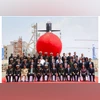 "Hangor class submarine Pakistan Navy")
Launching ceremony of first HANGOR-class submarine constructed for Pakistan Navy held at Shuangliu Base in Wuhan, China, on April 26, 2024. Image credit: Pakistan Navy
Listen to This Article
China is developing a new class of stealthy, conventional attack submarines equipped with air-independent propulsion (AIP) and designed to carry advanced hypersonic missiles. These submarines, with long-range strike capabilities approaching those of nuclear-powered counterparts, could be used to target the Typhon missile system deployed by the US in the Philippines, serving as a deterrent, according to a Chinese semi-official magazine.
A report in Naval & Merchant Ships—a publication owned by China State Shipbuilding Corporation, a key supplier to the PLA Navy—offers details on the vessel’s design and capabilities, indirectly confirming its existence and strategic purpose. According to the report, China’s new submarine is designed to carry advanced hypersonic missiles, enabling the PLA to "launch covert strikes from beyond enemy defences," with the option of deploying nuclear warheads if necessary. The submarine was first identified in mid-2024 through satellite imagery at a shipyard in Wuhan, Hubei. It appears to incorporate several advanced technologies, including a vertical-launch system (VLS) for cruise and anti-ship ballistic missiles, as well as an X-shaped tail fin to enhance agility and safety.
The new submarine could reportedly be used to target medium-range missile systems deployed in the Philippines. It is also expected to feature an air-independent propulsion (AIP) system, enhancing its stealth capabilities and extending underwater endurance.
How will China use its new attack submarines, and who’s the target?
The People’s Liberation Army has yet to confirm the development of this larger submarine class. However, a report published earlier this month suggests the vessel is intended to enhance China’s naval capabilities in response to the increasing foreign military presence in the region. It specifically references the Typhon launchers deployed by the US on Luzon Island, Philippines, during a joint training exercise last April. These launchers can fire multipurpose missiles with ranges spanning thousands of kilometres, making targets in China, Russia, and North Korea vulnerable from Luzon.
Also Read

 "Taiwan flag, Taiwan")
 "china Flag, China")

 "China Taiwan")
The report also indicates that the submarine could assume some operational roles of nuclear submarines in wartime, such as saturation attacks on surface vessels and long-range precision strikes on land targets, including US-installed medium-range missile defence systems in northern Philippines, near China. Beijing has repeatedly condemned the US deployment of Typhon launchers on Luzon, calling for their removal and describing the system as "a strategic asset and an offensive weapon."
The report states that the new submarine, operating alongside other military forces, will strengthen strategic deterrence against enemy carrier strike groups and military bases within the first island chain. This island chain, extending from Japan to the Philippines, plays a crucial role in US foreign policy and serves as a key defensive barrier against the PLA.
The report highlights that equipping the submarine with a vertical-launch system (VLS) represents "a significant departure from traditional torpedo-tube missile launch methods." It adds that "this innovation allows for a greater number of missiles to be carried, provides faster response times, and eliminates blind spots during launches."
As tensions in the South China Sea escalate, experts cited in the report suggest the submarine’s long-range strike capabilities could soon rival those of nuclear-powered counterparts. The vessel is also expected to serve as a deterrent, not only against regional adversaries but also external powers operating in the region.
The US is also reportedly in discussions to deploy Typhon systems in Japan, Germany, and Denmark as part of a broader strategy to “deter by denial”—aimed at blocking key access points into and out of the western Pacific to counter China during critical moments.
In response, the Chinese navy has significantly expanded its strategic and tactical weaponry, focusing on systems capable of executing long-range, covert, precise, and intensive strikes against enemy territories and overseas bases to counter military adventurism near China’s borders.
More From This Section
 "Nepali students")
 "S Jaishankar, Jaishankar")
 "VIJAY CHAUTHAIWALE, in charge of BJP's foreign affairs department")
 "crude oil, oil, lng")
 "Deported Indians")
Topics : Indian Navy Chinese navy Indian Naval power Military weapon US China South China Sea BS Web Reports
Don't miss the most important news and views of the day. Get them on our Telegram channel
First Published: Feb 24 2025 | 3:09 PM IST