India's Defence Minister
Rajnath Singh on Thursday evening spoke with his US counterpart Pete Hegseth, their first conversation after the recent terrorist attack in Pahalgam, Jammu & Kashmir that left 26 people dead.
According to a statement from the ministry, US Secretary of Defence Hegseth expressed his deepest sympathies for the tragic loss of innocent lives in the April 22 terror attack, and reiterated that the US stands with India. He also reaffirmed that US supports India's right to defend itself and assured the US government's unwavering backing for India's ongoing battle against terrorism.
"During the conversation, RM told the @SecDef that Pakistan has a history of supporting, training and funding terrorist organisations. He further said that it is important for the global community to explicitly and unequivocally condemn and call out such heinous acts of terrorism," a defence ministry statement posted on social media said.
The call between Singh and Hegseth comes a day after External Affairs Minister S. Jaishankar spoke with his counterpart, US Secretary of State Marco Rubio to discuss the Pahalgam attack. Jaishankar stressed the need for justice, stating, "Discussed the Pahalgam terrorist attack with US @SecRubio yesterday. Its perpetrators, backers and planners must be brought to justice." "Pakistan has been exposed as a rogue state, fuelling global terrorism, and destabilising the region. The world can no longer turn a blind eye to terrorism," the ministry quoted Singh as saying.
Rubio has reportedly encouraged dialogue between India and Pakistan to de-escalate tensions between the two nations, and expressed his condolences for the lives lost in the attack while reassuring India of the US' commitment to strengthening anti-terrorism cooperation between the two countries.
Both conversations comes amid rising tensions between the two neighbours, as both India and Pakistan continue to clash exchange fire across the Line of Control (LoC) in the J&K sector. On Wednesday, both countries' directors general of military operations (DGMOs) spoke over a hotline, addressing Pakistan's repeated ceasefire violations. India also reportedly warned Pakistan about the unprovoked breaches along the LoC and the International Border (IB).
The Pakistan army has so far violated a ceasefire agreement between both countries at least seven times, including on Thursday. The Indian Army has responded appropriately to the firing across the LoC.
Following the Pahalgam attack, India has taken a series of diplomatic measures against Pakistan, such as suspending the Indus Water Treaty, closing the Attari Integrated Check Post, and reducing the number of staff at Pakistan's High Commission in New Delhi. On Thursday, it also closed Indian airspace for Pakistani carriers
Earlier, Pakistan had closed overflight rights for Indian carriers, and had threatened to 'exercise its right' to suspend the Simla agreement as well as other bilateral treaties. It has also offered to conduct a neutral investigation into the Pahalgam terror attack, a position backed by China, which has called upon both sides to exercise restraint.
On April 29, PM Narendra Modi chaired a high-level meeting with Defence Minister Rajnath Singh, Chief of Defence Staff General Anil Chauhan, service chiefs, and National Security Advisor Ajit Doval, where it was decided that the Indian defence services would be given full operational freedom to respond to the ongoing terrorist threat, including the time, place, and scale of retaliation.
Meanwhile, the international community is closely monitoring the situation as tensions continue to rise. At least three West Asian nations - Saudi Arabia, Qatar, and Kuwait - have also urged restraint and dialogue between the two nuclear-armed neighbours.


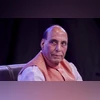 "Rajnath Singh, Defence Minister")

 "Rajnath Singh, Defence Minister")
 "Rajnath Singh, Defence Minister")
 "Colombian rebels, Guerilla warfare, colombia")
 "Ashutosh Dixit, Air Marshal")
 "Oman")
 "S Jaishankar, Jaishankar")
 "lt gen muhammad asim malik")
 "flights, planes")