


PM Modi highlights 'spirit of 1971 war' in letter to Bangladesh's Yunus
Prime Minister Narendra Modi pens letter to Bangladesh's Chief Adviser Muhammad Yunus, speaks about shared history, bilateral ties, and Liberation War of 1971
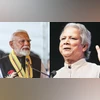 "Muhammad Yunus, Prime Minister Narendra Modi, PM Modi")
Indian Prime Minister Narendra Modi (left) Bangladesh's Chief Adviser Professor Muhammad Yunus (right)
Listen to This Article
Prime Minister Narendra Modi wrote to Bangladesh's Chief Adviser Professor Muhammad Yunus on the country's National Day, saying the spirit of the 1971 Liberation War "continues to remain a guiding light for our relationship." The Prime Minister also said that India remains committed to advancing their partnership based on "mutual sensitivity to each other's interests and concerns."
The letter was shared by the Indian High Commission in Bangladesh on Wednesday. Speaking about the Liberation War, PM Modi said,“This day stands as a testament to our shared history and sacrifices, which have laid the foundation of our bilateral partnership."
Bangladesh (formerly East Pakistan) became independent on March 26, 1971, under the leadership of Sheikh Mujibur Rahman, the founder of Awami League. During the war, the Indian Army aided the Muktijoddhas (liberation warriors) in defeating the Pakistani forces and securing Bangladesh’s independence.
India-Bangladesh ties
The letter comes amid strained ties between New Delhi and Dhaka. The relation between New Delhi and Dhaka came under stress following the collapse of Sheikh Hasina’s Awami League government on August 5, 2024, in the wake of violent student-led protests. Hasina, seen as an ally of India, fled to New Delhi amid protests.
Also Read

 "Adani, Gautam Adani")
 "Sheikh Hasina")
 "Yunus, Muhammad Yunus")
 "Pakistan, India, Bangladesh flags")
 "Parliament, New Parliament, Lok sabha, Rajya sabha")
After the fall of the Hasina government, Nobel laureate Muhammad Yunus took over as the chief advisor of an interim government in Bangladesh. Under Yunus' watch, Bangladesh has seen increased attacks on Awami League workers and offices. The protesters also vandalised statues of Mujibur Rahman and even set his historic residence on fire.
In a tearful video, Hasina responded to the attacks by saying that the protesters "can't erase history." Hasina continues to stay in India despite repeated extradition requests by Bangladesh.
Attacks on minorities
In his letter, PM Modi also sent out a reminder. "We remain committed to advancing this partnership, driven by our common aspirations for peace, stability, and prosperity, and based on mutual sensitivity to each other's interests and concerns," he said.
Notably, India has consistently shared its concerns with Bangladesh over a rise in attacks on minorities, especially Hindus, after the fall of the Sheikh Hasina government. In response, Bangladesh's Foreign Affairs Adviser Md Touhid Hossain stated that incidents of violence against minorities in the country should not be a concern for India, emphasising mutual respect and non-interference in internal matters.
President Murmu's message to Bangladesh
Meanwhile, President Droupadi Murmu also extended greetings to her Bangladeshi counterpart President Mohammed Shahabuddin. She called Bangladesh a vital partner in India's regional diplomacy.
In her message, Murmu emphasised the multifaceted nature of India-Bangladesh relations, which span trade, connectivity, development, energy, education, cultural exchanges, and people-to-people interactions. She also reiterated Bangladesh’s strategic importance in India's 'Neighbourhood First' and 'Act East' policies, as well as in the broader Indo-Pacific Vision and SAGAR (Security and Growth for All in the Region) doctrine.
"India reiterates its support for a democratic, stable, inclusive, peaceful, and progressive Bangladesh," Murmu said.
More From This Section
 "Navy chief, Dinesh K Tripathi")
 "Security forces, police")
 "Fishermen, Indian fishermen")
 "F404-IN20 engine")
 "S Jaishankar, Jaishankar")
Topics : Narendra Modi Independence Day Bangladesh India-Bangladesh India-Bangladesh ties Muhammad Yunus BS Web Reports
Don't miss the most important news and views of the day. Get them on our Telegram channel
First Published: Mar 27 2025 | 12:23 PM IST