


Pakistan vacating PoK will solve Kashmir issue, says S Jaishankar
S Jaishankar said revoking Article 370, boosting growth, ensuring social justice, and holding high-turnout elections were key steps, but Kashmir issue will be solved only when PoK is vacated
 "S Jaishankar, Jaishankar, Bronwen Maddox")
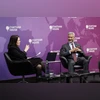
External Affairs Minister S Jaishankar during a conversation with Director and CEO of Bronwen Maddox at Chatham House, in the UK. (Photo: PTI)


Listen to This Article
External Affairs Minister S Jaishankar said that the complete resolution of the Kashmir issue would be achieved if Pakistan were to vacate Pakistan-Occupied Kashmir (PoK).
During a session at the Chatham House in London, Jaishankar responded to the question on whether Prime Minister Narendra Modi could leverage his relationship with US President Donald Trump to “solve” the Kashmir issue.
“Removing Article 370 was step number one,” Jaishankar said, referencing the Indian government's 2019 decision to revoke Jammu and Kashmir's special status.
Also Read

 "Official Spokesperson of the Ministry of External Affairs Randhir Jaiswal")
 "S Jaishankar, Jaishankar")
 "S Jaishankar, Jaishankar")
VIDEO | External Affairs Minister S Jaishankar (@DrSJaishankar) has said that the Kashmir issue will be solved once the "stolen part of Kashmir" returns to the Indian fold. "In Kashmir, we have done a good job solving most of it. I think removing Article 370 was one step. Then,… pic.twitter.com/qFx0sJG2da
— Press Trust of India (@PTI_News) March 6, 2025
“Then restoring growth and economic activity and social justice in Kashmir was step number two,” he continued.
Jaishankar further elaborated, “Holding elections, which were done with a very high turnout, was step number three. I think the part we are waiting for is the return of the stolen part of Kashmir, which is under illegal Pakistani occupation. When that’s done, I assure you, Kashmir [is] solved.”
Chatham House chief executive Bronwen Maddox, who moderated the discussion, pointed out that several questions were being raised about Kashmir and human rights. Earlier that day, the UK’s House of Commons had conducted a debate titled “Government support for human rights in Jammu and Kashmir," led by Labour MP Sarah Smith. READ: Peace, tranquility in border areas essential for growing ties: EAM on China
When asked if the Indian government acknowledges any shortcomings in its human rights record, Jaishankar responded by saying that politically motivated campaigns had often targeted India on this issue.
“There can be situations which require redressal and remedy,” he said, emphasising that India’s human rights record stood strong when compared globally.
“I think any sort of sweeping concern on human rights is really misplaced. I don’t see justification for it at all,” he added.
During the discussion, Jaishankar reiterated the importance of ensuring equal benefits for all Indian citizens — an argument he has previously used to defend the government’s human rights record.
He also remarked that in some parts of the world, politics was driven by “creating” and “pandering to” identity-based narratives. However, he maintained that good governance should focus on “treating your citizens equally”.
Jaishankar on India-US ties
Jaishankar, beyond discussing Kashmir, addressed India's evolving global stance, covering aspects such as economic policies, trade agreements, and the country's geopolitical perspective.
He pointed to the strengthening ties between India and the United States during President Donald Trump’s tenure, emphasising that both nations recognise the advantages of a multipolar world. READ: Khalistani extremists attempt to breach Jaishankar's security in London
“We see a president and an administration which, in our parlance, is moving towards multipolarity and that is something that suits India,” he said.
Jaishankar also highlighted the significance of the Quad alliance, comprising the US, India, Australia, and Japan. “From President Trump’s perspective, the one big shared enterprise that we have is the Quad, which is an understanding where everybody pays their fair share... There are no free riders involved. So that’s a good model which works,” he said.
Regarding trade, he mentioned that commerce and industry minister Piyush Goyal held talks with US officials in Washington, following Prime Minister Narendra Modi’s talks with Trump at the White House. “We had a very open conversation about it (tariffs) and the result of that conversation was that we agreed on the need for a bilateral trade agreement,” Jaishankar said.
(With agency inputs)
More From This Section
 "Sri Lanka, India")
 "Defence Secretary Rajesh Kumar Singh")
 "Tesla")
 "Muhammad Yunus, Yunus")
 "US President Donald Trump")
Don't miss the most important news and views of the day. Get them on our Telegram channel
First Published: Mar 06 2025 | 10:04 AM IST