


'No such letter issued': Government on claim of Rs five lakh Mudra loan
The government warns against a viral scam promising Rs 5 lakh under the Mudra Yojana for a Rs 2,100 fee
 "Mudra loan scam")
Photo by PIB fact check


Listen to This Article
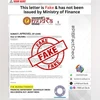
The government has rejected a viral message promising Rs 5 lakh under the Pradhan Mantri Mudra Yojana (PMMY) in exchange for a fee of Rs 2,100, saying that no such letter has been issued.
The Press Information Bureau (PIB), through its official fact-checking handle on X, issued a clarification debunking the fraudulent message, which has been widely circulating on social media and messaging platforms.
What’s the viral Mudra loan claim?
A false loan approval letter, bearing a forged government stamp and signature, claims that applicants can receive Rs 5 lakh under the PM Mudra Yojana, provided they deposit Rs 2,100 as a processing or registration fee.
The misleading message has raised concerns among unsuspecting citizens who may fall prey to such scams in the hope of easy credit.
ALSO READ: PM Modi arrives in Canada for G7 Summit today amid hopes of diplomatic thaw
What does the government say?
According to a post by PIB Fact Check on X, no such letter or offer has been issued by any authorised government agency.
Also Read

 "Mudra loans, MSME lending, economic growth")
 "MUDRA loan.")
 "Swarup Kumar Saha, Managing Director and Chief Executive Officer, Punjab & Sind Bank")
 "The limit of loans under the Pradhan Mantri Mudra Yojana (PMMY) was doubled to Rs 20 lakh recently, inserting a new category—Tarun Plus. Launched 10 years ago, the scheme intended to provide microfinance to small entrepreneurs. However, the number of")
“A viral message claims that a loan of Rs 5 lakh under PM Mudra Yojana can be availed by depositing Rs 2,100. This claim is fake. No such letter has been issued by the Government of India,” PIB said in its post.
The bureau further urged citizens to avoid responding to such messages and rely only on official sources for information related to government schemes.
What is PM Mudra Yojana?
Launched in 2015, the Pradhan Mantri Mudra Yojana provides collateral-free loans of up to Rs 10 lakh to micro and small enterprises. These loans are offered by commercial banks, regional rural banks, small finance banks, NBFCs, and microfinance institutions.
Key points to remember:
· There is no processing fee required directly from the applicant to receive Mudra loans.
· Loans under this scheme must be applied through registered financial institutions.
· Loan approval letters are not issued over WhatsApp or email.
What should borrowers do?
· Ignore messages asking for upfront payments.
· Verify any government-related information through official websites like https://mudra.org.in or https://pib.gov.in.
· Report suspicious communications to cybercrime portals or helplines.
In an age of digital misinformation, borrowers should be vigilant and avoid offers that sound “too good to be true.”
“Do not share personal or banking information with unverified sources,” PIB emphasised.
More From This Section
 "Crypto")
 "DLF")
 "separation, divorce, alimony")
 "FoF")
 "Air India, plane crash")
Topics : PIB Press Releases Mudra loans BS Web Reports
Don't miss the most important news and views of the day. Get them on our Telegram channel
First Published: Jun 16 2025 | 11:57 AM IST