


134-year US green card wait for Indian H-1Bs: Why backlog keeps growing
Green card delays for Indians can stretch to 134 years due to US country caps and rising demand in EB-2 and EB-3 categories
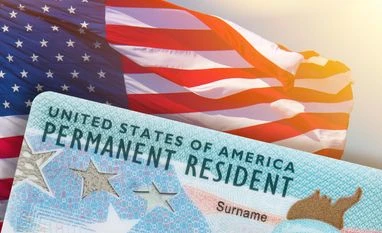 "US green card, US Passport, US immigration")
Photo: Shutterstock
Listen to This Article
Waiting time for Indians applying for employment-based green cards can stretch up to 134 years, drawing renewed attention to long-standing delays in the US immigration system.
The issue was recently flagged by Indian-American immigration advocate Sidharth, founder of the American Advocacy Council, who pointed to structural gaps that affect skilled Indian workers.
In a post on X, he said many Indians remain on the H-1B programme for years out of compulsion rather than choice.
“It is not because Indians love being on temporary visas,” he wrote. “It is because the Green Card system will not let them leave the temp visa programme,” he added.
He also pointed out that applicants from countries such as Pakistan and Somalia, which send fewer skilled workers, often face waiting periods of two years or less as they do not breach the 7 per cent country quota.
Also Read

 "head injuries")
 "LPG carrier, LPG, LPG tanker, Shivalik")
 "New zealand, New Zealand flag")
 "Stock market crash, stock markets, stock market fall")
 "toll plaza, fastag, fast tag, tolling fee")
What is a green card
A green card grants permanent residency in the United States, allowing holders to live and work there with rights similar to citizens, except the right to vote.
The system includes:
• Diversity visa lottery, from which Indians are excluded
• Employment-based categories such as EB-1, EB-2 and EB-3
• Family-sponsored visas
Among these, employment-based routes are widely used by Indian professionals, particularly in technology, healthcare and engineering.
Why Indians face longer waits
At the centre of the delay is Section 202 of the Immigration and Nationality Act, which places a 7 per cent per-country cap on employment-based and family-sponsored green cards.
This means no country can receive more than 7 per cent of the total annual quota, translating to roughly 25,620 employment-based green cards per country across all categories.
While this cap applies equally to all countries, demand is not equal. India sends far more skilled workers, especially under EB-2 and EB-3 categories:
• EB-2 covers applicants with advanced degrees
• EB-3 includes skilled professionals with required certification
As applications exceed the cap, Indian applicants are pushed into a growing queue.
According to a report by the US-based Cato Institute, of the 1.8 million employment-based backlog in 2023, around 1.1 million, or 68 per cent, were from India. The report also said the backlog could take up to 134 years to clear.
How the backlog builds
The system runs on a priority date mechanism. Each applicant is assigned a place in line based on when their petition is filed, and green cards are issued in that order.
The US Department of State publishes a monthly Visa Bulletin showing which priority dates are being processed.
For Indian applicants, especially in EB-2 and EB-3, movement has been slow. Each year, more people enter the queue than exit it, adding to the backlog.
Sidharth pointed to this imbalance, writing that despite sending more skilled workers, India “gets the same quota as Iceland”.
Why Indians remain on H-1B visas
Because of these delays, many Indian professionals continue on temporary visas such as H-1B for extended periods.
“Indians are not ‘stuck’ on H-1B visas by choice,” Sidharth wrote. “They are trapped by a system that punishes demand from one country while granting green cards liberally to others.”
To qualify under EB-2 and EB-3, applicants must hold a permanent job offer and labour certification, making it necessary to remain employed under H-1B status while waiting.
Human impact of long waits
The backlog carries long-term consequences beyond immigration status.
A study by David J Bier of the Cato Institute estimated that more than 400,000 Indian applicants could die before receiving a green card.
“About 424,000 employment-based applicants will die waiting, and over 90 per cent of them will be Indians,” the study said.
Professionals remain tied to employers for years, spouses may face limited work rights, and children risk losing dependent status when they turn 21, a process known as ageing out.
Bhargav Baisoya, associate at Jotwani Associates, described how this plays out in real life.
“Let’s say a young engineer from Bengaluru secures a role in Silicon Valley. A doctor from Delhi joins a respected hospital in New York. A finance professional from Mumbai steps into a global firm on Wall Street. They work, pay taxes, build families, and contribute meaningfully to the American economy. By all visible measures, they belong. And yet, in the eyes of the law, many of them remain temporary year after year, sometimes decade after decade,” Baisoya told Business Standard.
He explained that the backlog continues to grow because the system does not adjust to demand.
“The excess does not disappear, it simply rolls over into a growing backlog. Each applicant is assigned a place in line based on when their petition is filed, and green cards are issued strictly in that order,” he said.
Attempts to change the system fail
There have been legislative efforts to address the imbalance. In 2023, lawmakers including Raja Krishnamoorthi, Pramila Jayapal and Rich McCormick introduced the Immigration Visa Efficiency and Security Act.
The proposal sought to phase out the 7 per cent per-country cap for employment-based visas while increasing the cap for family-sponsored visas to 15 per cent.
However, the proposal has not progressed, leaving the existing structure unchanged.
Baisoya said the issue reflects a broader policy question.
“Should immigration be allocated evenly across countries, or should it respond to actual demand and contribution?” he said.
Until that question is resolved, the current framework continues to produce long waiting periods for Indian applicants seeking permanent residency in the United States.
More From This Section
 "h1b visa")
 "US visa, US immigration, green card")
 "India stock market market cap fall 2026, West Asia conflict impact Indian equities, global market capitalisation decline oil price shock, Brent crude surge market volatility, Nifty PE valuation drop 2026, FPI outflows India equities March 2026, Strai")
 "greece")
Don't miss the most important news and views of the day. Get them on our Telegram channel
First Published: Mar 19 2026 | 3:51 PM IST