


26/11 anniversary: Revisiting three days of terror that shook Mumbai
For three days, the city's fast-paced rhythm was brought to a halt due to the assaults and the massive security response that followed
 "Mumbai terror attack, 26/11 attack")
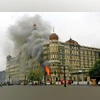
Following the Mumbai terror attack, parts of the Taj Mahal Palace catch fire, and the main dome was damaged.
Listen to This Article
Mumbai, India’s financial capital, was shaken to its core nearly 17 years ago by one of the deadliest coordinated terror strikes in the country’s history. On November 26, 2008, 10 heavily armed, transnational terrorists launched a series of attacks across the city, targeting crowded public spaces such as the bustling Chhatrapati Shivaji Terminus (CST) during peak hours, luxury five-star hotels, a popular café, and even hospitals.
For three days, the city’s fast-paced rhythm was brought to a halt due to the assaults and the massive security response that followed. The incident left more than 150 people dead and over 500 injured, including civilians, foreign nationals, security personnel, and hospital staff.
Nearly 17 years later, the events of those nights remain etched in India’s memory for the scale of violence, the prolonged siege, and the heroic rescue operations that followed.
The attackers and their route to Mumbai
The attackers were part of a transnational Lashkar-e-Taiba group divided into four teams. They set off from Karachi on November 21, hijacked the Indian fishing boat Kuber on November 23, and killed the crew. Forcing the captain to navigate toward Mumbai, they later murdered him too, before approaching the city in inflatable boats.
November 26: The night the siege began
- Evening: Around 7 km off the coast, the terrorists abandoned Kuber and moved into the city.
- 8:00 pm: They split into groups and landed at Badhwar Park and Sassoon Docks in south Mumbai.
- 9:20 pm: The first wave of attacks began. Crowded Chhatrapati Shivaji Terminus, Nariman House, Leopold Café and the Oberoi Trident were hit. Two gunmen stormed the Taj Mahal Palace hotel and opened fire on guests and staff.
- 10:30 pm: Violence intensified near Cama and Albless Hospital, where Ajmal Kasab and Abu Ismail Khan attacked police officers responding to the situation.
November 27: Fire, gunfights and rescues
- 12:00 am: Police arrested Kasab, while Khan was killed. Fires erupted at the Taj, damaging its famed dome.
- 1:00 am: Army personnel reached the hotel as firefighters worked to control the flames. Police cordoned off the Oberoi Trident.
- 6:00 am: National Security Guard (NSG) commandos arrived and launched operations at both hotels, rescuing several hostages.
- 4:00 pm: Fighting continued across the Taj and Oberoi. At Nariman House, rescue efforts began amid explosions and gunfire.
November 28: Key breakthroughs
- 7:00 am: NSG commandos landed on the roof of Nariman House from a helicopter. The operation became more intense.
- 11:00 am: The siege at the Oberoi Trident ended, with the remaining hostages freed and both gunmen killed.
- 4:00 pm: The standoff at Nariman House concluded, and surviving hostages were rescued.
November 29: The Taj retaken
- 6:00 am: After a fierce overnight battle, NSG commandos secured the Taj Mahal Palace hotel. The last attackers were neutralised, ending the 60-hour siege and freeing the remaining hostages.
Why 26/11 remains unforgettable
The attacks marked a turning point in India’s internal security apparatus, prompting reforms in coastal surveillance, counterterror readiness and inter-agency response. They also left an emotional and cultural imprint on Mumbai and the country at large, a reminder of extraordinary resilience in the face of overwhelming violence.
More From This Section

 "Smog, Delhi Pollution, Delhi Air Quality, Pollution")
 "Vote, Voter, Voting, Bihar Election, Election")
 "a")
 "Prime Minister Narendra Modi during the Dhwajarohan ceremony at the Ram Temple in Ayodhya, Uttar Pradesh, on Tuesday")
 "V Narayanan, ISRO Chairman")
Don't miss the most important news and views of the day. Get them on our Telegram channel
First Published: Nov 26 2025 | 10:00 AM IST