


Extreme weather events claim 80K lives, cause $180 bn loss in India
Over the long term, the ranking shows that extreme weather events particularly affect Global South countries
 "floods, Delhi floods")
Listen to This Article
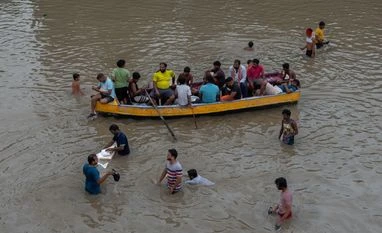
Extreme weather events claimed at least 80,000 lives in India and caused $180 billion (inflation-adjusted) in economic loss in the past three decades (1993-2022), according to a new report.
The report, published on Wednesday by Germanwatch, a Germany-based non-profit, non-governmental organisation, ranked India as the sixth most affected country, recording 400 extreme weather events from 1993 to 2022.
The extreme weather events include the 1998 Gujarat and 1999 Odisha cyclones, cyclones Hudhud and Amphan in 2014 and 2020, the 1993 floods in northern India, the Uttarakhand floods in 2013, severe floods in 2019, and recurring and unusually intense heat waves, with temperatures shooting up to 50 degrees Celsius, claiming lives in 1998, 2002, 2003, and 2015, and affecting agriculture.
According to a recent report by the Asian Development Bank, India could face a potential 24.7 per cent loss in GDP by 2070 due to climate change, with rising sea levels and decreased labour productivity being key contributors to this potential economic decline.
Meanwhile, the report reveals that the world lost 765,000 lives and $4.2 trillion of its GDP due to 9,400 extreme weather events in the same period, with countries like China, Myanmar, and the Philippines among the ten most affected, along with India.
Also Read

 "Vedanta")
 "High temperatures")
 "Delhi weather, fog")
 "unicef")
Floods (27 per cent), storms (35 per cent), heat waves (30 per cent), and drought were the most prominent impacts from short- and long-term perspectives. Floods were responsible for half of the people affected. Storms caused the most significant economic losses (56 per cent or $2.33 trillion, inflation-adjusted), followed by floods (32 per cent or $1.33 trillion), the report said, highlighting the consequences of globally increasing climate risks and the need for adaptation finance.
The new edition of the Climate Risk Index shows that extreme weather events particularly affect Global South countries. With five countries, the lower middle-income group is the largest country group among the ten most affected countries, including three small island developing states or least developed countries, where coping capacities are significantly lower.
The report is based on extreme weather event data from the International Disaster Database (Em-Dat) and socio-economic data from the International Monetary Fund (IMF).
Extreme weather events and their impacts are often underreported in Global South countries because of data quality, coverage challenges, and data gaps. As a result, this ranking may less accurately capture these impacts and how Global South countries are affected.
“There are increasing signs that we are entering a critical and unpredictable phase of the climate crisis, which will also increasingly change social developments and security for mankind all across the globe,” said Laura Schaefer, co-author of the Climate Risk Index and head of the International Climate Policy Division at Germanwatch.
The World Economic Forum ranked extreme weather events amplified by climate change as the second most considerable global risk after armed conflict and war.
COP29 failed to deliver an ambitious New Collective Quantified Goal (NCQG) on climate finance. Considering the identified needs and the great urgency of the climate challenges that developing countries face, the $300 billion annually by 2035 can only be seen as the bare minimum response to the escalating climate crisis. The NCQG also failed to include measures to address loss and damage.
“This gap must be filled as soon as possible. This situation is even more worrying given the extensive gaps in adaptation finance compared with the needs and commitments (even if progress was made). Substantially increased support by high-emitting countries and other polluters is needed for the most vulnerable in addressing climate impacts,” the report suggested.
Furthermore, CRI shows that a lack of ambition and action in mitigation leads to being strongly affected, even in high-income countries. It is in the interest of high-income and highly emitting countries to ramp up mitigation action, including higher climate targets and the implementation of such actions, with new nationally determined contributions (NDCs), to stay below (or as close as possible to) 1.5°C warming and keep impacts at a manageable scale.
More From This Section
 "West bengal assembly, budget, amit mitra")
 "Modi, Narendra Modi, Emmanuel Macron, Emmanuel")
 "Yogi Adityanath, yogi, UP CM, Osada Kou Osada")
 "Sarojini Naidu Birth Anniversary")
 "gavel law cases")
Topics : Climate Change weather
Don't miss the most important news and views of the day. Get them on our Telegram channel
First Published: Feb 12 2025 | 7:03 PM IST