


West Bengal Budget 2025-26: Rs 3.89 trn earmarked to push growth, welfare
West Bengal Budget 2025: Increase in dearness allowance and welfare schemes among key highlights of Budget speech
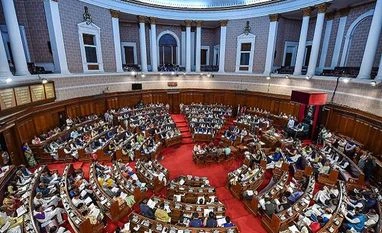 "West bengal assembly, budget, amit mitra")
West Bengal Assembly in Kolkata
Listen to This Article
West Bengal’s Minister of State for Finance (Independent Charge), Chandrima Bhattacharya, on Wednesday presented the state Budget for the financial year 2025-26 in the Assembly, outlining a total expenditure of Rs 3.89 trillion. The Budget, which comes ahead of the state elections next year, focuses on economic growth and extensive welfare measures.
Economic growth outpaces national average
Bhattacharya highlighted that West Bengal’s Gross State Domestic Product (GSDP) grew by 6.8 per cent in 2024-25, surpassing India’s overall economic growth rate of 6.37 per cent. She credited this expansion to the resilience of the state’s economy across all three major sectors: Agriculture, industry, and services.
The industrial sector recorded a growth of 7.3 per cent, exceeding the national figure of 6.2 per cent. The agricultural sector, including allied activities, saw a rise of 4.2 per cent, compared to India’s 3.8 per cent. Meanwhile, the services sector led the economic surge with a growth of 7.8 per cent, outpacing the country’s 7.2 per cent.
Bhattacharya also drew attention to the state’s unemployment rate, which stood at 4.14 per cent as of January 2025 – considerably lower than India’s overall rate of 7.93 per cent. She attributed this to Chief Minister Mamata Banerjee’s emphasis on “job-centric growth”.
Fiscal performance and revenue growth
On the fiscal front, the state’s own revenues have shown a steady growth, with a 10 per cent increase over the last financial year. The successful implementation of the Settlement of Disputes (SoD) Scheme in Commercial Taxes has resulted in the settlement of 20,738 cases, garnering more than Rs 900 crore in additional revenue.
Also Read

 "Budget 2025: Charting a new growth path amid excess capacity, FDI concerns")
 "IPO rush, market")
 "online gaming")
 "India vs England 3rd ODI live score updates and full scorecard")
 "pharma medicine drugs")
The budget underscores the state’s commitment to fiscal discipline, with the Debt to GSDP ratio decreasing from 40.65 per cent in 2010-11 to 37.49 per cent in 2022-23. The Revenue Deficit to GSDP ratio has also improved, reducing from 3.75 per cent in 2010-11 to 1.78 per cent in 2022-23.
Dearness allowance for govt employees
Bhattacharya announced a four per cent increase in dearness allowance (DA) for government employees, including teaching and non-teaching staff, as well as pensioners. Effective from April 1, 2025, this increase will raise the total DA to 18 per cent, aligning with the recommendations of the 6th Pay Commission. The move is expected to benefit thousands of state government employees.
Welfare measures of govt
The Budget prioritised social welfare schemes, with a notable allocation of Rs 38,762.03 crore to the Women and Child Development and Social Welfare Department.
Although not mentioned explicitly in Bhattacharya’s speech, the Budget document emphasised the success of several flagship schemes that have benefited a significant portion of the population. These include:
Sabuj Saathi Project: Approximately 12.6 million students have received assistance under this initiative, which provides bicycles to school students, with an expenditure of Rs 4,600 crore.
Lakshmi Bhandar Scheme: Financial support of Rs 1,000 per month is provided to women, while those from Scheduled Castes, Scheduled Tribes, and Other Backward Classes receive Rs 1,200 per month.
Kanyashree, Sabuj Saathi, Aikyaashree: Various schemes aimed at supporting girls’ education, minority welfare, and other social initiatives were also highlighted in the budget document.
Media reports suggest that Chief Minister Mamata Banerjee may make an announcement about the Lakshmi Bhandar Scheme a few months before the state Assembly elections.
Last full Budget before state Assembly elections
With West Bengal set to hold assembly elections in 2026, this Budget marks the last full budget of Mamata Banerjee’s third term as Chief Minister. Given the upcoming polls, the government will present a ‘Vote on Account’ next year instead of a full-fledged budget to ensure continuity in spending until a new government is formed.
More From This Section
 "Modi, Narendra Modi, Emmanuel Macron, Emmanuel")
 "Yogi Adityanath, yogi, UP CM, Osada Kou Osada")
 "Sarojini Naidu Birth Anniversary")
 "gavel law cases")
 "Pankaj Tripathi")
Topics : West Bengal Budget West Bengal BS Web Reports
Don't miss the most important news and views of the day. Get them on our Telegram channel
First Published: Feb 12 2025 | 6:59 PM IST