


'Seen us engaged' in resolving India-Pak conflict: US Secy of State Rubio
Rubio said that the US remains engaged around the world, including in conflicts that perhaps are not central to everyday life in America
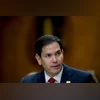 "Marco Rubio")
He said that some of the conflicts resolved by the US have deep roots that go back many, many years, but we are prepared to be engaged and helpful


Listen to This Article
US Secretary of State Marco Rubio referred to the conflict between India and Pakistan that US President Donald Trump claims he resolved along with several others this year, saying the American leader has made it a priority to be a peacemaker.
Trump has repeated the claim of stopping the conflict between India and Pakistan nearly 70 times so far.
Rubio said that the US remains engaged around the world, including in conflicts that perhaps are not central to everyday life in America.
The President has made it a priority to be a peacemaker and so you've seen us engaged whether it's Russia, Ukraine, or India and Pakistan or Thailand and Cambodia, which is an ongoing challenge, Rubio said Friday at a year-end news conference.
He said that some of the conflicts resolved by the US have deep roots that go back many, many years, but we are prepared to be engaged and helpful.
Also Read

 "Donald Trump, Trump")
 "Donald Trump, Trump")
 "Tiktok")
 "US flag, US, united states")
In ways that perhaps other nations can't, we've been viewed as indispensable in that regard, and it's a role the President takes great pride in, in the promotion of peace around the world and something he deserves a lot of credit for. He has personally engaged in all of this, he added.
India launched Operation Sindoor on May 7, targeting terror infrastructure in Pakistan and Pakistan-occupied Kashmir in retaliation for the April 22 Pahalgam attack that killed 26 civilians.
India and Pakistan reached an understanding on May 10 to end the conflict after four days of intense cross-border drone and missile strikes.
India has consistently denied any third-party intervention in resolving the conflict.
Responding to a question on China and Japan, Rubio said we understand that's one of the dynamics that has to be balanced in that region, and I believe that we feel very strongly that we can continue with our strong, firm partnership and alliance with Japan and do so in a way that continues to allow us to find productive ways to work together with the Chinese Communist Party and the Chinese government.
He said that at the end of the day, China will continue to be a rich and powerful country and a factor in geopolitics.
We have to have relations with them, we have to deal with them. We have to find the things we are able to work together on, and I think both sides are mature enough to recognise that there will be points of tension now and for the foreseeable future, he added.
He said that China and the US need to find opportunities to work together.
I think we can do that without imperilling or in any way undermining our very firm commitment to our partners in the Indo-Pacific, that includes not just Japan but South Korea, and obviously, if you extend further out, I don't want to leave anybody out but India and Australia and New Zealand and all the other countries, he added.
Responding to a question on whether the US has got consent from Pakistan that they will be sending troops in Gaza for peace building and peacemaking, Rubio said all the countries Washington has talked to about being and having a presence on the ground, I think they want to know specifically, what the mandate, what the specific mandate, funding mechanism looks like.
We're very grateful to Pakistan for their offer to be a part of it, or at least their offer to consider being a part of it. I think we owe them a few more answers before we can ask anybody to firmly commit, he added.
Rubio added that Pakistan is key if they agree to do so. But I think we owe them a few more answers before we get there.
(Only the headline and picture of this report may have been reworked by the Business Standard staff; the rest of the content is auto-generated from a syndicated feed.)
More From This Section
 "Fog, New Delhi Fog, Winter, Delhi Fog")
 "MGNREGA, MGNREGA wages, labour market, MGNREGA job scheme")
 "Modi, Narendra Modi")
 "Election commission, voting, SIR")
 "lynching in India, Bihar lynching case, mob violence India, anti-lynching laws India, religious violence India, lynching statistics India, mob lynching cases, hate crimes India, lynching law states India, Manipur anti-lynching law")
Don't miss the most important news and views of the day. Get them on our Telegram channel
First Published: Dec 20 2025 | 7:22 AM IST