


'Should leaders run govt from jail?': Shah defends PM, CM removal bills
Shah said the bills were introduced "on account of the Modi government's commitment to restoring moral standards in politics and in view of the public resentment towards the menace"
 "Amit Shah")
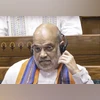
Amit Shah said that the proposals would prevent anyone from functioning as Prime Minister (PM), Chief Minister (CM), or Union or State Minister while in jail.Photo: PTI
Listen to This Article
Home Minister Amit Shah on Wednesday defended three bills tabled by the Centre seeking to bar arrested politicians from holding constitutional posts, saying the public must decide whether leaders should be allowed to run governments from jail.
“Now the people of the country need to decide: Is it right for a minister, chief minister, or prime minister to run a government from jail?” Shah asked in a series of posts on X.
The bills include:
- The Constitution (One Hundred and Thirtieth Amendment) Bill, 2025
- The Government of Union Territories (Amendment) Bill, 2025
- The Jammu and Kashmir Reorganisation (Amendment) Bill, 2025
In his posts, Shah said the bills were introduced “on account of the Modi government’s commitment to restoring moral standards in politics and in view of the public resentment towards the menace”.
Also Read

 "Amit Shah")
 "Home Minister Amit Shah")
 "Amit Shah")
 "Parliament")
 "Amit Shah, Home Minister")
“When the Constitution was framed, its makers could not have imagined that political leaders in future would refuse to resign on moral grounds even after being arrested. In recent years, the country has witnessed shocking instances where chief ministers or ministers continued to run governments from jail without resigning,” Shah said.
He noted that the proposals would prevent anyone from functioning as Prime Minister (PM), Chief Minister (CM), or Union or State Minister while in jail.
The bills stipulate that an arrested politician must secure bail within 30 days. If not, they would be removed from office on the 31st day. Leaders may be reinstated once granted bail through due legal process.
Opposition criticism
Shah criticised the Opposition for opposing the bills, saying, “On one hand, PM Narendra Modi has introduced a Constitutional amendment to bring himself into the ambit of law. On the other hand, under the leadership of Congress, the entire Opposition has opposed it in order to remain above the law, run governments from jail, and cling to power.”
“The nation also remembers the time when, in this very House, then PM Indira Gandhi granted special privilege to the prime minister, ensuring that no legal action could be taken against her,” he added, arguing that Congress’s policy has been to place the prime minister above the law through amendments.
‘I resigned’: Amit Shah’s rebuttal
Earlier in the day, Congress leader KC Venugopal alleged that the bills sabotaged the federal system, questioning Shah: “When he was the home minister of Gujarat, he was arrested. Did he uphold morality at that time?”
Shah replied: “Today in the House, a Congress leader made a personal remark against me, saying that when the Congress trapped me in a fabricated case and had me arrested, I did not resign. I want to remind Congress that I had resigned even before being arrested. I did not hold any constitutional position, even after being released on bail, until the court fully acquitted me.”
He added that the court eventually dismissed the case against him, observing that it was politically motivated.
What the bills propose
The legislation states that if a PM, CM, or other minister is arrested on charges carrying a potential jail term of five years or more, and remains in custody for 30 days, they would automatically lose their position on the 31st day.
The responsibility for formal removal would rest with the President in the case of the PM, the governor for CMs, the CM for state ministers, and the lieutenant governor in Union Territories.
The Lok Sabha has referred all three bills to a parliamentary joint committee for scrutiny.
More From This Section
 "Shashi Tharoor, Shashi, Tharoor")
 "Parliament")
 "opposition protest, parliament, opposition in parliament")
 "Parliament, Budget session, Lok Sabha")
 "B Sudershan Reddy")
Topics : Amit Shah Lok Sabha Opposition Bills BS Web Reports
Don't miss the most important news and views of the day. Get them on our Telegram channel
First Published: Aug 20 2025 | 8:17 PM IST