


Disqualification of MPs, MLAs: What Constitution, Supreme Court rulings say
As Home Minister Amit Shah tabled the 130th Constitution Amendment Bill, questions resurface on how MPs and MLAs can be disqualified
 "Amit Shah")
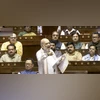
Union Home Minister Amit Shah on Wednesday tabled three Bills in the Lok Sabha, namely the Constitution (130th Amendment) Bill, 2025, the Government of Union Territories (Amendment) Bill, 2025, and the Jammu and Kashmir Reorganisation (Amendment) Bil
Listen to This Article
Union Home Minister Amit Shah on Wednesday tabled three Bills in the Lok Sabha, namely the Constitution (130th Amendment) Bill, 2025, the Government of Union Territories (Amendment) Bill, 2025, and the Jammu and Kashmir Reorganisation (Amendment) Bill, 2025. The Bills were introduced amid protests by the Opposition, which called the move an "attack on federalism" and a potential tool for "political misuse".
At the centre of the debate is the 130th Amendment Bill, which proposes that the prime minister, chief ministers or ministers would automatically lose office if they remain in judicial custody for 30 consecutive days in a case carrying a punishment of five years or more. In effect, it brings elected leaders on par with civil servants, who are suspended automatically upon arrest.
Context from recent political cases
When seen in light of recent events, especially before the 2024 Lok Sabha elections, the proposed Bill has raised concern among the Opposition.
Last year, then Delhi chief minister Arvind Kejriwal spent six months in jail in the liquor policy case, while Tamil Nadu minister V Senthil Balaji was kept in custody in a money laundering probe. In both cases, the leaders technically remained in office. Jharkhand’s Hemant Soren, meanwhile, resigned as the chief minister hours before his arrest in a land scam case and resumed his post after getting out on bail.
Adding to the storm, the Supreme Court has in recent months criticised the Enforcement Directorate for “crossing all limits” and cautioned against the agency being drawn into political battles.
Also Read

 "online gaming")
 "Sleep habits")
 "Fatty Liver")
 "blood pressure measuring")
 "Siddaramaiah, Karnataka CM")
What do Articles 102 and 191 of the Constitution say?
The proposed Bill has been positioned as plugging a gap in the current law: the Representation of the People Act (RPA), 1951, disqualifies MPs and MLAs only upon conviction, and only if the sentence is two years or more. At present, there is no bar on ministers holding office while under arrest.
Article 102 lists grounds for disqualification for membership of either House of Parliament, while Article 191 mirrors this for state legislatures. Disqualifications include holding an office of profit under government, being of unsound mind (so declared by a court), being an undischarged insolvent, not being a citizen of India, or being disqualified by or under any law made by Parliament. That last clause is the hook on which Parliament has hung detailed disqualification rules in the RPA.
Where do Articles 75 and 164 fit in?
Articles 75 (Union) and 164 (States) govern appointment of ministers: they are appointed by the President/governor on the advice of the prime minister/chief minister and hold office during their pleasure. The Constitution does not itself bar a person with pending criminal cases from being made a minister.
In Manoj Narula v. Union of India (2014), the Supreme Court read these articles with “constitutional morality” but stopped short of laying down a hard bar. Although it said that the PM/CM is expected to avoid inducting persons with serious criminal antecedents. In effect, Articles 75 and 164 give the political executive discretion, but the court has urged restraint.
What does Section 8 of the RPA do?
Section 8 of the RPA details disqualification on the basis of a conviction for particular offences. Subsections (1) and (2) set out specific offences such as corruption, offences relating to elections, and serious penal offences, and specify disqualification periods. Subsection (3) provides a catch-all, stating that conviction with a sentence of not less than two years disqualifies from the date of conviction and continues for six years after release.
The Indian debate around allowing people with criminal cases to sit in legislatures or act as ministers has repeatedly gone to the Supreme Court. Over the last two decades, a spate of decisions has clarified when MPs and MLAs are disqualified, what happens on conviction, and how far courts can intervene when Parliament has not legislated.
What did Lily Thomas v. Union of India (2013) case change?
For a long time, Section 8(4) allowed sitting MPs/MLAs who were convicted to avoid disqualification if they filed an appeal within three months. In 2005, lawyer Lily Thomas from Kerala and the NGO Lok Prahari moved the Supreme Court with a public interest litigation petition on Section 8(4) of the RPA.
They argued that the section violated the Constitution because convicted legislators were permitted to retain their office while their appeal was pending in a higher court. They sought to rid Indian politics of criminals and ensure that convicted persons could not contest elections or occupy a legislative office.
On July 10, 2013, the bench headed by Justice A K Patnaik and Justice SJ Mukhopadhaya struck down the provision, holding that Parliament had gone beyond its power. The provision was declared "ultra vires" the Constitution, and disqualification would occur immediately "by virtue of such conviction and/or sentence" upon the conviction of a sitting MP or MLA under subsection (1), (2) or (3) of Section 8 of the RPA.
The judgment categorically stated that membership of convicted legislators could no longer be protected under Section 8(4). It also underlined that the Constitution explicitly bars Parliament from postponing the point at which disqualification comes into force.
Did the SC ever ban candidates with serious charges from contesting?
On September 25, 2018, the Supreme Court delivered a unanimous verdict making it clear that it did not have the authority to disqualify candidates or sitting legislators merely on the basis of charges being framed against them.
The case had its origins in 2011, when the NGO Public Interest Foundation filed a writ petition under Article 32 of the Constitution, urging the court to broaden the grounds for disqualification under the RPA. The petition sought to bar candidates and lawmakers facing serious criminal charges, as well as those who submitted false affidavits under Section 33A of the RPA, from contesting elections or retaining their seats.
At the heart of the matter was whether disqualification should kick in at the stage of framing charges for grave offences, instead of only after conviction, as the law currently prescribes.
In its ruling, the Court held that it could not expand the scope of disqualification laid down by Parliament in Section 8 of the RPA and Articles 102 and 191 of the Constitution. The disqualification provisions, the bench reiterated, apply strictly upon conviction, not at the stage of charges being framed.
While acknowledging the “rising trend of criminalisation of politics” and the large number of legislators facing serious cases, the bench stressed that it was bound by the doctrine of separation of powers. It was Parliament, not the judiciary, that had the authority to create new grounds for disqualification.
Have there been recent attempts to tighten the law?
Consistent with its earlier stance in cases like Public Interest Foundation v. Union of India (2018) and Manoj Narula v. Union of India (2014), the Supreme Court has continued to maintain judicial restraint in this area. The Court has emphasised that:
The power to legislate stricter disqualification provisions, including automatic bans on those facing serious charges, rests with Parliament, not the judiciary.
The judiciary cannot legislate from the bench or expand disqualification grounds beyond what is currently stipulated in the Constitution and the Representation of the People Act, 1951.
The Supreme Court has repeatedly urged Parliament to enact more stringent laws to curb criminalisation in politics while respecting the separation of powers.
Why these rulings matter in practice
Because criminality in politics is not marginal. In the 2024 Lok Sabha elections, a record 251 out of 543 newly elected MPs (46 per cent) were reported to have criminal cases registered against them, according to an ADR report. Among these, 170 MPs (31 per cent) face serious criminal charges such as rape, murder, attempt to murder, kidnapping, and crimes against women.
Additionally, 27 of the newly elected MPs have been convicted in criminal cases. This marks a significant rise compared to previous elections, with 43 per cent of MPs facing criminal cases in 2019 and 34 per cent in 2014.
On the introduction of this new Bill, the Opposition has reacted sharply, calling the move “draconian” and politically motivated. Its core worry is that provisions could be misused to unseat governments in opposition-ruled states by ensuring ministers and chief ministers cross the 30-day custody threshold.
More From This Section
 "Home Minister Amit Shah")
 "Shashi Tharoor, Shashi, Tharoor")
 "Parliament")
 "opposition protest, parliament, opposition in parliament")
 "Parliament, Budget session, Lok Sabha")
Don't miss the most important news and views of the day. Get them on our Telegram channel
First Published: Aug 20 2025 | 6:59 PM IST