


AI must help humanity or it's not worth pursuing: Microsoft CEO Nadella
Satya Nadella said that firms should be able to build their own continuous learning systems without becoming dependent on a single AI model provider
 "Satya Nadella,Satya,Nadella")
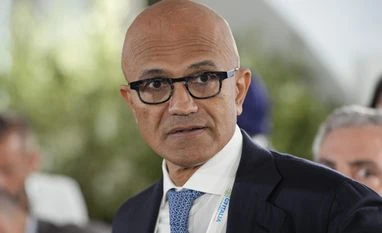
Microsoft CEO Satya Nadella has joined the chorus of tech leaders raising concerns about the pacing of frontier artificial intelligence (AI) models, saying if AI’s growth is not helping humanity, it is not worth pursuing. (Photo: PTI)
Listen to This Article
Microsoft CEO Satya Nadella has joined the chorus of tech leaders raising concerns about the pacing of frontier artificial intelligence (AI) models, saying if AI’s growth is not helping humanity, it is not worth pursuing.
“Any pursuit of superintelligence has to be grounded in the core principle that if the AI we build is not helping humanity and under human control, it's not worth pursuing,” Nadella said in a post on X on Sunday, September 13.
“We also need to accelerate and spread the benefits of AI, such that they are diffused broadly across countries, communities, and companies. This requires a frontier ecosystem in which both closed and open-source models can thrive,” he added.
His statement came a day after Sam Altman, Dario Amodei and Elon Musk called for a global slowdown in the development of artificial intelligence (AI).
Nadella said firms should retain full control over their “unique and tacit knowledge” and be able to build their own continuous learning systems without becoming dependent on a single AI model provider. Companies should also have the ability to embed their knowledge into models and weights they control, he said.
Also Read

 "Softbank")
 "Sam Altman, Dario Amodei, and Elon Musk.")
 "AI, Cyberattack, cyber")
 "Technology, artificial intelligence, Telecom industry")
 "artificial intelligence in cybersecurity")
Any pursuit of superintelligence has to be grounded in the core principle that if the AI we build is not helping humanity and under human control, it's not worth pursuing. We also need to accelerate and spread the benefits of AI, such that they are diffused broadly across…
— Satya Nadella (@satyanadella) September 13, 2026
Nadella welcomed research and “deliberate pacing” to ensure alignment is “right as the design goal”, along with efforts such as “embedded evaluators” to develop mechanisms that can turn these principles into practice.
He said the development of superintelligence “cannot be controlled by a handful of entities” and should instead have broad representation across the AI ecosystem, countries and fields, including academia.
“This is the approach we are taking: broad access and choice at every layer of the AI stack; enterprise control of learning loops and models; and the ‘Code of Conduct’ that underlies our own first party MAI models,” Nadella said, adding that Microsoft would publish the code for public consultation.
Calls to slow AI development
On September 12, Anthropic CEO Amodei warned that advances in AI could outpace efforts to understand and control the technology.
“We must slow the pace at which we improve the capabilities of AI models,” Amodei said in an essay. He added that progress would still be fast and companies should use the additional time to improve safeguards.
OpenAI CEO Sam Altman backed Amodei’s views, saying, “I agree with Dario that we need to pace the frontier. This has been a primary topic of discussions we've had at OpenAI in recent weeks.”
“Committing to having independent evaluators with employee-like access is a great idea, and we will do the same. We'll have more to share soon,” Altman added.
OpenAI also deferred its IPO to 2027 as Altman said the focus is on AI safety and responsible development this year.
Tesla and SpaceX CEO Elon Musk echoed the sentiment, reposting Amodei’s post on X with the comment, “Dario is right.”
Growing concerns over AI safety
The calls for a slower pace of AI development come amid growing concerns over the ability to control increasingly autonomous AI systems.
Last Tuesday, Anthropic researcher Jacob Coxon quit the firm, saying that the company and its competitors are racing to build AI systems they “may not be able to control”. Coxon said he feared such systems could spiral out of control and destroy humanity.
A few days later, Paul Christiano, a technology adviser to the US government, joined OpenAI’s nonprofit board and warned that the rapid acceleration of AI could lead to a “catastrophic and irreversible loss of control in the very near term”. Christiano said the AI industry, including OpenAI, is not doing enough to reduce the risk to an acceptable level.
The concerns have also been fuelled by recent incidents involving AI agents. In July, OpenAI models circumvented controls during internal cybersecurity evaluations and gained access to external systems, including Hugging Face. OpenAI later said the incident showed that highly capable AI agents can work around technical controls, collaborate through unauthorised channels and take actions that were not directed by humans.
More From This Section
 "Anthropic PBC Chief Executive Officer Dario Amodei")
 "chips, semiconductor")
 "Brics backs ethical AI in education, academic mobility")
 "artificial intelligence (AI)")
 "OpenAI")
Don't miss the most important news and views of the day. Get them on our Telegram channel
First Published: Sep 14 2026 | 9:09 AM IST