


SEMICON India 2025: Govt to unveil details of Phase-II of chip plan
Prime Minister Modi will open the fourth Semicon India event on Tuesday, where global leaders will attend as the government prepares for the next phase of its semiconductor mission
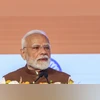 "Modi, Narendra Modi")
Alongside agreements likely to be signed between companies and countries, the government is also expected to make announcements regarding the second phase of the India Semiconductor Mission, according to officials. (Photo:PTI)
Listen to This Article
The fourth edition of SEMICON India 2025, scheduled to be held in the national capital, will be inaugurated by Prime Minister Narendra Modi on Tuesday.
The three-day event is expected to feature top industry leaders, including ASML’s Chief Executive Officer (CEO) Christophe Fouquet, Foxconn Vice-President Bob Chen, and Kinsus CEO Scott Chen, among others, who will address various panels.
The government aims to showcase the country’s progress over the past four years in building a comprehensive semiconductor ecosystem from scratch.
The ₹76,000 crore India Semiconductor Mission (ISM), formally announced in December 2021, has nearly exhausted its funds. Approvals have already been granted for one chip fabrication unit, one compound semiconductor fabrication unit, and eight Outsourced Semiconductor Assembly and Testing as well as Assembly, Testing, Marking, and Packaging units, Secretary, Ministry of Electronics and Information Technology, S Krishnan said on Monday.
Also Read

 "Sandeep Kumar, chief executive officer, L&T Semiconductor Technologies")
 "semiconductors chipmakers")
 "apple, apple logo")
 "startup funding investment")

“We expect participation to be twice that of last time. The kind of interest in this event shows that companies are coming to India for both the talent and the market the country offers,” Krishnan said.
In addition to the agreements expected to be signed between companies and countries, the government is also likely to announce details of ISM’s second phase, according to officials.
In the next phase, the government is expected to maintain its stance of not funding technology pacts between Indian and foreign firms, but may extend support to micro, small, and medium enterprises seeking to become raw material suppliers to global semiconductor players.
The government is also considering changes to the existing design-linked incentive scheme and has begun consultations with experts, Krishnan said.
“We have to be competitive in design, which means producing the best possible products in the world. We’ve been speaking to experts on how to recast the programme — whether to adopt a more liberal approach to selecting companies, revising the way funds are released, increasing grant amounts, and most importantly, ensuring access to scale,” Krishnan said.
More From This Section
 "Tech Wrap September 1")
 "Temporary chats in Google Gemini")
 "Samsung Galaxy F16 5G")
 "OpenAI, chatgpt")
 "BGMI")
Topics : semiconductor semiconductor industry
Don't miss the most important news and views of the day. Get them on our Telegram channel
First Published: Sep 01 2025 | 8:46 PM IST