


Bangladesh election tests Gen Z uprising, India-China power balance
Bangladesh's first election since Muhammad Yunus took charge as interim leader will test whether Gen Z-led protest movements can convert street momentum into stable, long-term political power
 "Bangladesh, Yunus")
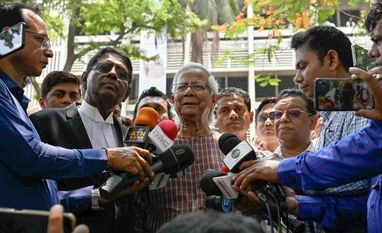
Muhammad Yunus in Dhaka, in 2024. Thursday’s election will be the first since Nobel laureate Muhammad Yunus took over as interim leader following the uprising. Image: Bloomberg
Listen to This Article
By Arun Devnath, Dan Strumpf and Swati Gupta
Two months ago, Tajnuva Jabeen was ready to hit the campaign trail for Bangladesh's parliament. Her mother traveled 250 kilometers from the port city of Chattogram to join Jabeen in Dhaka, packing special sarees for public appearances and a new pair of sneakers to handle the dust and long days of street campaigning.
Jabeen, a first-time candidate and a leader of the National Citizen Party, had hoped to turn the energy of a youth-led uprising into electoral change. She ran on a promise to carry forward the “Gen Z” protest movement that swept Bangladesh a year earlier, ending the 15-year-rule of Prime Minister Sheikh Hasina’s and her Awami League, inspiring similar rebellions across the developing world.
Within a few days, though, she had resigned from the party and withdrawn from the race.
Jabeen, 40, said she could not accept the party’s decision to align with Jamaat-e-Islami, the country’s largest Islamist group — a move she described as a “planned entrapment” that blindsided many young activists. Her goal, she said, remained the creation of a genuine third force capable of breaking Bangladesh’s two-party dominance and pursuing constitutional reform.
Also Read

 "Under the trade agreement, the Donald Trump administration is set to trim US ‘reciprocal' tariffs on Bangladesh products from 20 per cent to 19 per cent")
 "Bangladesh, Bangladesh Flag")
 "negotiating trade deals")
 "Protest, Bangladesh Protest")
 "India US textile trade deal, US tariff cut apparel exports, Indian textile exports growth, Tiruppur knitwear industry, cotton import duty relief, Make in India textiles, MSME apparel sector, US apparel market share India")
“The space for centrist politics is still empty,” she said. “I will keep trying to fill it.”
Thursday’s election, the first since Nobel laureate Muhammad Yunus took over as interim leader following the uprising, marks one of the earliest electoral tests of whether Gen Z–driven protest movements, demanding greater economic opportunities for young people in developing countries around the world, can translate street power into durable governance.
The vote is also a geopolitical inflection point. The outcome will shape how the world’s eighth-most populous country balances ties with India and China at a moment when New Delhi is increasingly wary of Beijing’s expanding footprint along the Bay of Bengal, and Washington is recalibrating its South Asia strategy amid trade tensions and supply-chain shifts.
For global investors and policymakers, the election will signal whether Bangladesh can restore stability, revive growth in its garment-led economy and remain a predictable partner in an increasingly fractured global order.
“Across the neighborhood, leaderships are coming to power and generally understanding…their own political survival is premised on economic growth, giving young people jobs,” said Constantino Xavier, a foreign policy fellow at Brookings India. “And to do that, they need to attract foreign investment. Among those solutions, there are many — China, Asean and US — but first and foremost India. But of course selling this to the people is not easy.”
During Sheikh Hasina’s decade and a half in power, Bangladesh maintained close ties with India while also managing relations with China. But her flight to India after a violent crackdown on protesters — which observers say left hundreds dead — strained relations between the two nations. Since then, signs of warmer ties between the interim government led by Yunus and Beijing have alarmed officials in New Delhi.
For India, a win by the Bangladesh Nationalist Party, which represents the old-guard, will likely be the most stable outcome, according to Harsh Pant, professor of international relations at King’s College London. The BNP, which was banned during Hasina's rule and is now led by the son of former leader Khaleda Zia, is widely seen as emerging as the largest bloc in the country's 300-member parliament.
"If the BNP comes to power, in full majority, it won't be very worrying. BNP understands the compulsions of the geopolitics and the importance India holds in the region and for the country itself,” said Pant. "If it is a coalition government, it will be a problem for India. It will become a battle for the spoils of power. For Delhi, it will become difficult.”
At home, the student-led movement that helped topple Hasina has fractured. As idealism collided with electoral realpolitik, defections and internal rifts weakened the push for a centrist alternative. With the Awami League barred from the race, voters on Feb. 12 will choose largely between the once-banned Islamist Jamaat-e-Islami and the Bangladesh Nationalist Party.
The moment highlights the broader challenges facing youth-led movements globally: converting protests against soaring living costs and authoritarian regimes into political power. Bangladesh was among the first countries shaken by such unrest in mid-2024, when demonstrations over the abolition of a popular job-quota system exploded into a nationwide revolt in the Muslim-majority nation of 176 million where about 40% of people are under the age of 25.
"If it is a coalition government, it will be a problem for India.”
“If it's a weaker BNP, there's a greater chance that the BNP will have less capital to invest in normalizing relations with India,” said Xavier, who is also a senior fellow at the Centre for Social and Economic Progress. “Which means a weaker BNP is more beholden to the Jamaat, opposition and the sentiments on the streets, which are obviously deeply anti-India today.”
China, meanwhile, has emerged as one of Bangladesh’s most important external partners, and any government in Dhaka is likely to keep deepening that relationship to protect long-term economic security, Xavier said. “The real question is when does that clash with Indian interests,” he added, describing it as a familiar balancing act across South Asia — one that has played out in countries such as Sri Lanka and the Maldives.
China has quietly built economic, political and social capital in Bangladesh over time, creating leverage that New Delhi has struggled to counter, he said, adding that India, by contrast, has lost ground over the past year and a half, a deficit that could take years to rebuild.
The political uncertainty comes as Bangladesh grapples with a deepening cost-of-living crisis and supply-chain upheavals that have damaged the country’s critically important garment industry. Inflation accelerated to 8.58% in January, driven by food prices, while non-food inflation remains close to 9%. Weak state investment has further strained the economy as more than 2.7 million people remain unemployed, nearly a million of whom hold university degrees, according to official data.
Some relief may be on the horizon. The White House said Monday it would cut tariffs on Bangladeshi goods to 19% from 20%, with exemptions for certain textile products, and signaled expectations of new commercial deals, including purchases of US aircraft and billions of dollars of US energy and agricultural goods.
Thursday’s vote has also drawn allegations of unfairness following the interim government’s decision last year to bar Hasina’s Awami League from participating. The BNP, led by Tarique Rahman has sought to cast itself as a centrist bulwark against what it describes as the radical agenda of its rivals. Analysts say its central challenge will be expanding support beyond party loyalists to include younger voters and former Awami League backers.
“The BNP’s prospects will depend on whether he can bring the party together and enhance its appeal to disillusioned younger voters,” Thomas Kean, a senior consultant at the International Crisis Group, wrote in a February report.
NCP chief Nahid Islam has defended the alliance with Jamaat as a tactical necessity, insisting it does not dilute the party’s founding ideals. “The struggle and demands for a new political settlement that we started with remain unchanged,” he said at a Jan. 30 media briefing.
But the tie-up has further eroded the NCP’s credibility, said Navine Murshid, an associate professor of political science at Colgate University. “NCP was a new entity that people hoped would be a centrist formation,” Murshid said. “People now say the NCP is just a pawn of Jamaat.”
All sides have sought to court younger voters. In a speech Monday, Rahman outlined a proposed $10 billion social welfare program that would prioritize female heads of households, provide temporary unemployment allowances for educated youth and expand support for farmers.
Jamaat leaders, too, have sharpened their outreach. In a televised address, party chief Shafiqur Rahman pledged education and economic reforms. “We want to place our youth in the cockpit of society,” he said. “They will fly the aircraft named Bangladesh.”
For many voters, however, the choice remains unsettled. Mohammad Dulal Miah, a 55-year-old rickshaw puller in Dhaka’s Segunbagicha neighborhood, said the absence of the Awami League has left him unsure whether to vote at all, as competition from battery-powered rickshaws eats into his income.
“I don’t even know if I will go to the polling center,” he said.
More From This Section
 "Karoline Leavitt, US press secretary")
 "Donald Trump, Trump")
 "Donald Trump, Trump, Benjamin Netanyahu")
 "migrants, immigrants")
 "social media apps, facebook, meta instagram")
Topics : India-Bangladesh Bangladesh Elections
Don't miss the most important news and views of the day. Get them on our Telegram channel
First Published: Feb 11 2026 | 8:19 AM IST