


'Not seeking trade imbalance': China releases white paper on trade with US
Beijing highlights mutual gains in US-China trade relations, warns against Trump's protectionist policies, and more in white paper
 "us china")
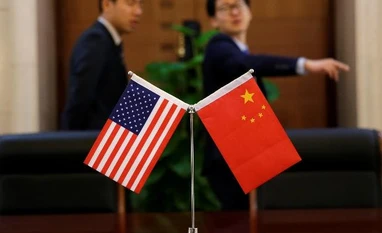
US China trade relations | File Photo
Listen to This Article
China has released a white paper outlining its stance on economic and trade relations with the United States, calling for cooperation while criticising Washington’s growing protectionist measures under President Donald Trump. The document, titled ‘China’s Position on Some Issues Concerning China-US Economic and Trade Relations’, was issued by the State Council Information Office on Wednesday. It highlights the benefits of bilateral trade, China’s compliance with global trade norms, and what it describes as unfair trade practices by the US.
The white paper comes amid escalating trade war between the two nations. Trump recently imposed tariffs on all of its trading partners. In response to Trump’s reciprocal tariff, China also imposed a 34 per cent tariff on US goods. In retaliation Washington imposed an additional 50 per cent tariff. US’ tariffs against China have now surged to 104 per cent, escalating the trade dispute. China retaliated by increase tariffs on US goods from 34 to 84 per cent, to go into effect on Thursday.
The US has justified its tariffs by pointing to the trade deficit between the two countries. In response, China has called for dialogue and has now released its white paper on trade ties.
US-China: Key trade partners
The white paper emphasised that China and the United States have enjoyed mutually beneficial trade relations for decades. According to the document, bilateral trade in goods reached $688.28 billion in 2024 – 275 times the volume recorded in 1979, when the two nations established diplomatic relations.
Also Read

 "White House")
 "Apple iPhone 16e")
 "Tariffs")
 "Congress MP Manish Tewari")
 "china Flag, China")
The US is a key market for Chinese exports, while China is a major buyer of American agricultural products, semiconductors, and other goods. China remains the top export destination for several key US products, including soybeans and cotton, and is a major buyer of American integrated circuits, coal, automobiles, agricultural products, semiconductors, medical devices, and other goods.
China does not seek trade imbalance with US
Despite persistent US concerns over China’s trade surplus, the paper asserts that Beijing does not deliberately seek such imbalances. It points to China’s declining current account surplus, which fell from 9.9 per cent of GDP in 2007 to 2.2 per cent in 2024, as evidence of this claim.
China pointed out that US companies have profited significantly from operations within China, earning nearly $490.52 billion from local sales in 2022, far exceeding Chinese firms’ earnings in the US. Additionally, Beijing noted that its current account surplus has decreased over the years, countering allegations that it deliberately maintains a trade imbalance.
The paper highlights that US exports to China have surged by over 648 per cent since 2001, far exceeding the overall US export growth rate of 183 per cent during the same period.
In addition to trade in goods, the services sector has also witnessed significant growth. Bilateral services trade expanded sevenfold between 2001 and 2023, with the US maintaining a $26.57 billion surplus – driven by sectors such as travel, intellectual property royalties, and transportation.
China has complied to 2020 trade agreement with US
The Chinese government insists that it has fully adhered to the Phase One trade agreement, a deal struck in early 2020 aimed at easing trade tensions. The document highlights Beijing’s steps to enhance intellectual property protection, reform trademark and patent laws, and combat cyber-related intellectual property infringements.
The white paper further notes that China has expanded market access for various US agricultural products, including beef, poultry, and dairy. Additionally, foreign ownership limits in the financial sector have been removed, allowing major US firms such as Goldman Sachs, BlackRock, and American Express to strengthen their presence in China.
China accuses the US of not honouring trade commitment
Beijing strongly criticised Washington for failing to uphold its commitments under the previous trade agreement. It accused the US of imposing arbitrary export restrictions on Chinese firms, pressuring companies like TikTok, and using national security concerns as a pretext to block investments.
The document also accused the US of failing to cooperate on key trade matters, such as poultry exports and pesticide regulations, while continuing to impose tariffs under Section 301 – a US trade law that allows tariffs on countries deemed to be engaging in unfair trade practices.
China further condemned US export controls on semiconductors and artificial intelligence (AI) technologies, arguing that these restrictions harm both nations' economies and disrupt global supply chains. It claimed that such measures had already led to an estimated $130 billion loss in market value for US firms.
US protectionism threatens global trade: China
The white paper reiterated China’s earlier comment, describing US trade policies as a threat to global economic stability. Beijing criticised the revocation of China’s ‘Most Favoured Nation’ (MFN) trade status, which had provided preferential tariff treatment, arguing that this move violates World Trade Organisation (WTO) principles.
It also took issue with US tariff hikes and anti-subsidy investigations, claiming these policies artificially inflate trade barriers and drive up costs for US consumers.
The Chinese government also dismissed allegations linking China to the fentanyl crisis, stating that it enforces strict controls on such substances and has no record of exporting them to North America.
China calls for dialogue
Despite the escalating tensions, China’s white paper calls for renewed diplomatic engagement to resolve trade disputes, just as Chinese leaders have done since Trump first announced tariffs. China emphasised that cooperation between the two largest economies is crucial for maintaining global economic stability, supporting supply chains, and fostering innovation.
Elsewhere, China has also engaged with neighbouring countries as well as the European Union to strengthen ties as the Trump administration doubles down on its aggressive trade policies.
China also asserted that it has remained committed to WTO regulations and continues to promote free trade. The country has steadily reduced tariffs, from an average of 15.3 per cent in 2001 to 7.3 per cent in 2024, and has fully complied with its WTO commitments since 2010.
More From This Section
 "US China trade war, US , China, tariff hike, donald trump, Chinese goods, wto, world trade organisation, US tariff hikes, global trade war, American goods")
 "Xi Jinping, Donald Trump")
 "Japan 3D printer, 3D printed train station")
 "China Russia flag")
 "pakistan Flag")
Don't miss the most important news and views of the day. Get them on our Telegram channel
First Published: Apr 09 2025 | 5:29 PM IST