


From tariff flip-flops to power plays: Donald Trump's art of making a deal
From real estate to trade wars, Donald Trump's deal-making thrives on chaos, intimidation, and theatrics-a playbook he described in his 1987 bestseller
 "Donald Trump, Trump")
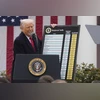
US President Donald Trump speaks during an event to announce new tariffs in the Rose Garden at the White House, Wednesday, April 2, 2025, in Washington. (Photo: AP)
Listen to This Article
On April 2, 2025, US President Donald Trump stood behind a podium, flanked by American flags, and declared a “Liberation Day” for American trade. With his trademark bravado, he slapped a 10 per cent tariff on all imports—no country spared. “We’re taking back control,” he said. “America first.”
Notably, tariffs on Chinese imports surged to an unprecedented 145 per cent. The move sent shockwaves through global markets, erasing over $6 trillion in value and igniting fears of a deepening global recession.
However, just days later, the Trump administration made a U-turn. Facing mounting pressure from tech giants and consumer groups, Trump exempted key electronics—including smartphones, laptops, and semiconductors—from the harshest tariffs.
To Trump critics, it was reckless. To supporters, it was classic Trump. But to anyone who has read The Art of the Deal—his 1987 best-seller—it was entirely predictable.
Trump doesn’t just make deals. He wages psychological warfare. From real estate and football to geopolitics and tariffs, his methods have remained remarkably consistent over the decades: start big, create chaos, and force the other side to blink first.
Also Read

 "Donald Trump, Trump")
 "Xi Jinping, Donald Trump")
 "Donald Trump, Trump")
 "US, Iran")
 "Donald Trump's fist-pump portrait at White House")
A method in madness
“I aim very high,” Trump writes early in The Art of the Deal, “and then I just keep pushing and pushing and pushing to get what I’m after.” He means it. His idea of negotiation isn’t rooted in collaboration—it’s closer to a mafia-style takeover. Bluffing is strategy. Pressure is a tool. Theatrics are part of the deal.
The latest tariff blitz, especially with China, is a proof. By invoking emergency powers meant for wartime, Trump bypassed Congress and stunned both Wall Street and Washington. The fallout was swift—markets plunged, toy prices threatened to double, and businesses braced for supply shocks.
“I think this is the end of days,” Rick Woldenberg, CEO of Learning Resources, told the Associated Press. Woldenberg said his tariff bill is projected to jump from $2.3 million last year to over $100 million in 2025 - thanks to Trump's tariff warfare with China.
But for Trump, sometimes it pays to be a "little wild.” He wrote in his book recalling a time he threatened to sue a bank for “murder” during a farm foreclosure. The bank relented.
Hostile flirtation with Holiday Inns
Back in the mid-1980s, Trump quietly bought a five per cent stake in Holiday Inns while negotiating a casino partnership with them. Once news leaked, panic swept through Holiday Inns' boardroom. Executives scrambled to enact “poison pill” clauses to ward off a takeover.
"No poison pill is going to keep me from going after Holiday Inn, if that’s what I decide I want to do," Trump wrote in his book.
He played coy in public, but privately he revelled in their fear. “They may offer to buy back my shares at a premium just to get rid of me,” he predicted. And if they did? He’d happily take the profit and move on.
Decades have passed but this remains Trump’s favourite trick: create uncertainty, then monetise it. Whether or not he ever intended a hostile takeover didn’t matter. The mere threat gave him the upper hand.
Beating the system at its own game
By the mid-1980s, New York City had spent seven fruitless years trying to renovate Central Park’s Wollman Rink. Then Trump stepped in. He offered to fix it in under six months. He delivered—ahead of schedule and under budget.
But there was an ulterior motive—to prove that government was incompetent and that Trump was the saviour. When the cameras rolled and concrete was poured, Trump stood centre stage, shovel in hand. “It’s like watching the world’s biggest cake get iced,” he quipped to reporters.
The rink wasn’t just a win—it was a statement. That Trump could beat the system at its own game.
Suing New York City twice
Another classic example is Trump’s battle for a 421-A tax exemption for Trump Tower. Though almost every applicant was granted the exemption, Trump’s was denied—likely due to then mayor Ed Koch’s political posturing.
Trump sued the city. Not once, but twice. He went from the state Supreme Court to the appellate court to the court of appeals—twice—and won both times.
For Trump, it wasn’t about the money. It was about not being seen as weak. “You’ve got to take a stand, or people will walk all over you,” he wrote.
The case reveals Trump’s mafia-style insistence on dominance: never walk away from a slight, never settle for less, and always win, even if it takes years.
The Mar-a-Lago deal
In Palm Beach, Trump’s eye fell on Mar-a-Lago—a 118-room Mediterranean revival mansion built by the Post cereal heiress. Priced at $25 million, Trump initially bid $15 million, which was rejected.
Over several years, he watched deals with other buyers fall through. Then, in 1985, he offered $5 million plus $3 million for the furnishings. The exhausted Post Foundation accepted.
“It just goes to show that it pays to move quickly and decisively when the time is right,” Trump wrote. The strategy was part stalking, part attrition. Let the seller get tired, then pounce when no one else is left.
Building the victim narrative
In 1986, Trump led the United States Football League’s (USFL) antitrust lawsuit against the National Football League (NFL), alleging monopoly practices. Despite winning the case, the damages awarded were just $1.
Yet Trump spun it into a moral victory. He then poached NFL talent and carried on the fight in the press. “I still believe he’s our best hope on the appeal,” Trump wrote of his lawyer—long after the ruling.
Losing in court didn’t matter to Trump. It was about convincing people he had been wronged—a similar tactic he used in the 2024 US presidential race.
2025 tariffs: Scaling up the old playbook
Fast forward to today, and the same playbook is in use—just with higher stakes. China, Trump claimed, was flooding the US with fentanyl and cheap goods. He answered back with massive tariffs, up to 145 per cent, on Chinese imports.
The White House insisted the move would protect American jobs. But behind the scenes, it was also about forcing countries like China back to the negotiating table. Trump views confrontation as not merely a risk—but a necessity.
In his 1987 book, Trump put it bluntly: “You can’t be afraid to confront people. The worst thing you can possibly do in a deal is seem desperate to make it.”
Through his tariffs, Trump got what he wanted: leverage. And attention. Suddenly, foreign diplomats, CEOs, and the US Congress were all reacting to his next move.
Trump’s negotiations are not about compromise. They are about dominance. “I do it to do it,” he writes. “Deals are my art form.”
Whether buying a palace, suing a city, or reshaping the global trade order, his method remains consistent: overwhelm, intimidate, and control the story.
With the global economy bracing for the next round of tariff reprisals, it is increasingly clear that the so-called “art” of the deal is really a performance of power.
More From This Section
 "Prime Minister of Hungary Viktor Orban")
 "Moodys")
 "Myanmar Earthquake")
 "US China flag, US-China flag")
 "Yen, Japan Currency")
Topics : Donald Trump Trump tariffs Trump tariffs on Chinese imports Trump tariff threats US China trade war BS Web Reports
Don't miss the most important news and views of the day. Get them on our Telegram channel
First Published: Apr 13 2025 | 1:03 PM IST