


Trump targets foreign drugs: Tariffs in 2 weeks, begins US mfg push
US President Trump has signed executive orders to speed up drug approvals and pharma infrastructure construction in the US
 "Donald Trump, Trump")
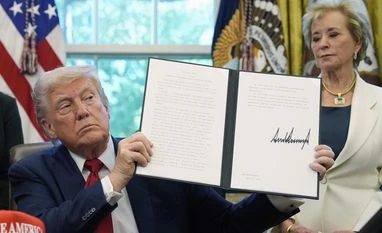
President Donald Trump signs executive order to encourage drug manufacturing in the US. (Photo:PTI)


Listen to This Article
US President Donald Trump said he will announce new tariffs on pharmaceutical imports in the next two weeks, while speaking with reporters on Monday. Earlier, on the same day, the president had signed an executive order to encourage medical manufacturing in the United States and reduce dependence on foreign producers.
Since taking office in January, Trump has announced sweeping tariffs on all US trade partners. In his reciprocal tariff announcement, a move aimed at fixing the balance of trade between the US and its trade partners, Trump had exempted the pharmaceutical industry. This exemption had been met with relief initially, however, the he soon hinted that duties on pharmaceutical imports were still being weighed by his administration.
Speaking at the White House on Monday, Trump said, “Other countries have treated us unfairly when it comes to drug pricing. We’re going to make a big announcement next week.”
US: India’s largest pharma export market
Trump did not specify which countries or products might be targeted. The US imports over $200 billion in prescription drugs annually, with a significant share coming from Europe and Asia.
Also Read

 "pharma medicine drugs")
 "Indian economy, worker, labour, population")
 "Nayab Singh Saini, Nayab Singh, Nayab")
 "mutual fund")
 "Donald Trump, Trump")
The United States remained the largest destination for India’s pharmaceutical exports in the financial year 2023–24 (FY24), accounting for over 31 per cent of the total, according to government data. This amounts to approximately $8.7 billion in exports to the US alone. In comparison, the United Kingdom and the Netherlands were the next largest markets, each representing around 3 per cent of India’s pharma exports.
India’s pharmaceutical industry ranks as the third largest by volume and the 13th largest by value. The sector is also projected to reach $65 billion in exports by 2030.
Trump signs order for FDA to speed up approval
The announcement comes alongside the signing of a sweeping executive order aimed at accelerating domestic pharmaceutical production. The order directs the US Food and Drug Administration (FDA) to speed up the approval process for new pharmaceutical plants and to offer early support to domestic manufacturers preparing to launch operations.
It also calls for stricter oversight of overseas producers. The FDA has been tasked with enhancing enforcement of active pharmaceutical ingredient (API) source reporting by foreign drugmakers and considering public disclosure of facilities that fail to comply.
Eco-agency ordered to speed up construction approvals for drugmakers
Additionally, the Environmental Protection Agency (EPA) has been ordered to fast-track construction approvals for new pharma facilities within the US.
Trump launches probe on imported pharma, semiconductors
These steps follow a probe launched last month by the Trump administration into the national security risks of relying on imported pharmaceuticals and semiconductors. While details remain unclear, the administration has indicated it is willing to impose sector-wide tariffs if the findings support such measures.
According to a report by Reuters, analysts estimate that building a new pharmaceutical facility in the US could take up to five years. However, the White House has rejected such timelines as “unacceptable from a national-security standpoint.”
“As we invest in the future, we will permanently bring our medical supply chains back home,” Trump said in a statement. “We will produce our medical supplies, pharmaceuticals, and treatments right here in the United States.”
Major pharmaceutical companies such as Johnson & Johnson, Novartis, Eli Lilly, and Roche have recently announced large-scale investments in US-based manufacturing, signalling a potential shift in long-term industry strategy.
[With inputs from Reuters]
More From This Section
 "Peng Xiao")
 "Pope Trump")
 "War, Israel-Gaza war")
 "The devastation of the Palisades Fire is seen at sunset in the Pacific Palisades neighborhood of Los Angeles")
 "Donald Trump, Trump")
Topics : Pharamaceutical Industries Pharma sector Indian pharma companies Indian drug makers Trump tariffs trump tariff BS Web Reports Trump administration US President Trump
Don't miss the most important news and views of the day. Get them on our Telegram channel
First Published: May 06 2025 | 11:17 AM IST