


Mideast titans step back from AI model race as US, China dominate
In the Middle East, as in other markets, companies are rethinking whether the cost of building a cutting-edge AI model from scratch is worthwhile
 "Peng Xiao")
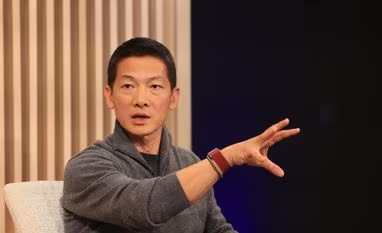
Peng Xiao, chief executive officer of G42. Photo:Bloomberg
Listen to This Article
By Mark Bergen and Omar El Chmouri
Within months of ChatGPT’s release in late 2022, research labs in the United Arab Emirates claimed to have developed credible rivals. At the top of the list was Falcon, a popular open-source artificial intelligence system built with government support, and Jais, a model named for the country’s highest mountain peak.
The “future of AI is not a distant dream, but a present reality,” Peng Xiao, chief executive officer of Emirati tech conglomerate G42, said in a statement in 2023 shortly after the firm launched Jais.
But today, the UAE’s dream of competitive, homegrown AI models remains far off. Falcon is significantly behind leading options from US companies in user numbers and public rankings. G42, meanwhile, recently pulled resources from Jais and is instead focused on building bespoke features on top of AI models from other companies, including OpenAI.
Also Read

 "artificial intelligence, AI, COMPANIES")
 "(L-R) Sabre leadership team, Sushant Mathur, Prasad Parigi, Bharat Kumar,Sriram Gopalswamy, Erika Miller, Roshan Mendis, Bindu Surendran, Bhaskara Rao Guntreddy, Rency Mathew, Sandeep Bhasin")
 "fintech sector")
 "Elon musk, musk, Elon")
 "Vishnu Deo Sai, Chief Minister of Chhattisgarh")
“In the early days, we had no idea how far the foundation models can go and what it takes to get to the next level,” Xiao told Bloomberg News in April. “It’s just not reasonable for us to do as a nation of this size.”
Two-plus years into the generative AI frenzy, the global race to develop ever more sophisticated models increasingly looks like a competition between two countries. A handful of US firms continue to lead in AI development by spending billions on chips, data centers and talent to build the best and biggest models. China, meanwhile, is rapidly catching up and flooding the market with low-cost, open-source models to expand its reach. Most other nations, even wealthy ones like the UAE, are lost somewhere in the middle.
A growing number of once promising AI ventures in the Middle East and Europe have fizzled or all but given up. Germany’s Aleph Alpha, hailed at one time as Europe’s rival to OpenAI, made a similar decision to G42 last year. Britain’s Stability AI, an early AI model pioneer, has petered out after management issues. Even companies like France’s Mistral, backed by significant venture funding and championed by the country’s government, has shown little evidence of strong commercial traction or developer interest.
In the Middle East, as in other markets, companies are rethinking whether the cost of building a cutting-edge AI model from scratch is worthwhile. Jais could be a competitive “frontier model” if G42 continues to invest, said Kiril Evtimov, an executive running its cloud unit, Core42. “But is that the right business strategy for us to capture the market? Probably the answer is no.”
In 2023, the UAE launched a new firm, AI71, touted as a commercial vehicle for Falcon, a model developed by a government research arm. AI71 ended up following G42 and Aleph Alpha in making AI tools for specific business uses relying on multiple models, including Falcon, according to a spokesperson.
While Falcon remains the most competitive offering from the UAE, it has struggled to keep up with advances from open-source alternatives from Meta Platforms Inc. and China’s DeepSeek. In 2023, the Technology Innovation Institute (TII), the entity behind Falcon, touted the AI system’s first-place ranking in open-source models on Hugging Face, a closely-watched barometer for the industry. As of last week, Falcon did not rank in the top 500 on the platform’s leaderboard.
A representative for TII said Falcon now has more than 55 million downloads. That’s a small fraction of Meta’s family of Llama models, which have been downloaded more than 1 billion times. The representative said integrations with cybersecurity, robotics and cloud companies will be announced soon. “The value of a model lies not only in its initial benchmark performance, but in how it contributes to and enables broader innovation over time,” the representative said in a statement.
G42, meanwhile, has pursued other ways to get into the current AI boom beyond model development. Its data center business is expanding in the Gulf region and MGX, an investing fund the company co-formed, has backed US AI developers OpenAI and xAI.
Some countries are still trying to challenge the US and China on AI development. In January, India’s government said it would support 18 different proposals to build foundational AI models, which a minister pledged would “compete with the best of the best.” Saudi Arabia’s AI agency also paired with International Business Machines Corp. last year to offer its homegrown national model, ALLaM, via the tech company’s cloud services.
Nations pursue these so-called sovereign models to have more control over how the AI systems are trained, either to influence how they work or lessen dependence on foreign tech, Michael Bronstein, a professor of AI at the University of Oxford, said at the Machines Can See conference in Dubai. But he said the prevalence of open-source models means these approaches have little odds of remaining competitive.
Some of these models were also pitched as ways to better represent languages and populations unmet by Silicon Valley. OpenAI and its peers trained their models mostly on the internet, which heavily skews toward English. But an effective tool for Arabic doesn’t require making a large language model from scratch, said Nour Al Hassan, CEO of Tarjama, a translation provider based in Dubai.
A new startup her company incubated, Arabic.AI, recently released an AI system that Al Hassan said was created by fine-tuning a range of large models, an approach she said is better suited for price-sensitive corporate clients. “You don’t need such massive models to do a specific task for a bank,” she said.
G42’s Jais was also designed to power chatbots in Arabic. In September, G42 released Nanda, a Hindi language model, as part of its expansion efforts in India. The company and its research partners will continue to update these two models, according to Andrew Jackson, who runs G42’s AI unit, Inception.
“But it’s not the focus commercially,” he said. “We have to make money.”
More From This Section
 "Pope Trump")
 "War, Israel-Gaza war")
 "The devastation of the Palisades Fire is seen at sunset in the Pacific Palisades neighborhood of Los Angeles")
 "Donald Trump, Trump")
 "china Flag, China")
Topics : Artificial intelligence ChatGPT United States China
Don't miss the most important news and views of the day. Get them on our Telegram channel
First Published: May 06 2025 | 11:03 AM IST