


'Not bad': Trump praises billionaire gains after tariff pause sparks rally
Billionaires earned $304 billion in a day after Trump paused tariffs; Musk up $36 billion. Critics allege market manipulation over his bullish post before the surprise move
 "Donald Trump, Trump")
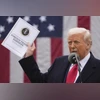
US President Donald Trump (Photo: PTI)
Listen to This Article
In a recent statement, President Donald Trump suggested that the latest market fluctuations have significantly increased the wealth of several prominent billionaires. Trump’s comments come after his announcement of a 90-day pause on proposed tariff hikes for most countries, which led to a substantial surge in the stock market.
Musk made the highest jump
Tesla CEO and Trump-ally Elon Musk, the world’s wealthiest individual, saw his fortune swell by $36 billion as the automaker’s shares jumped 23 per cent amid the ongoing market swings. According to the Bloomberg Billionaires Index, Musk’s net worth climbed to an estimated $311 billion — marking one of the most substantial individual gains.
Billionaires who gained amid the chaos
Charles Robert Schwab earned an additional $2.5 billion in a single day, taking his net worth to approximately $12.9 billion. He is a US investor and founder of The Charles Schwab Corporation and its banking arm, and is known for his influence in financial services.
Roger Searle Penske also saw a significant boost, with Forbes estimating a $900 million gain, lifting his net worth from $5.6 billion. Nicknamed ‘the Captain’, Penske is a former racer turned businessman who owns Team Penske, IndyCar, and the Indianapolis Motor Speedway.
April 9 proved historic for the world’s richest as they collectively gained $304 billion in one day, Bloomberg reported — making it ‘the best day ever’ for billionaires. “He made two-and-a-half billion today, and he made nine hundred million, that's not bad!” Trump exclaimed, referring to Schwab and Penske.
Also Read

 "Lt Gen John D Caine")
 "Elon Musk, Donald Trump")
 "Elon Musk")
 "US Senate")
 "Donald Trump, Trump")
Accusations of market manipulation
Trump is facing criticism over potential market manipulation after he posted a bullish message on social media just before pausing tariff hikes. On Truth Social, he posted, ‘THIS IS A GREAT TIME TO BUY!!! DJT’, just hours before announcing the tariff pause. This sequence of events has raised questions about whether his actions were intended to manipulate the market to benefit certain investors.
Some Republican lawmakers defended Trump’s actions. Congressman Troy Nehls told Sky News, “Insider trading regarding tariffs, I don’t care what they are saying, I care, Donald Trump is a smart guy, he is a businessman. I don’t know if people got rich.”
Meanwhile, Republican Congressman John Mc Gurie acknowledged Trump’s tactics without directly addressing the manipulation claims, stating that his “methods are working”.
Demand for transparency over insider trading
Democrats, however, accused Trump of enabling insider trading. Senator Chris Murphy raised concerns on X, writing: “An insider trading scandal is brewing. Trump's 9:30 am tweet makes it clear he was eager for his people to make money off the private info only he knew. So who knew ahead of time and how much money did they make? [sic]”
An insider trading scandal is brewing. Trump's 9:30am tweet makes it clear he was eager for his people to make money off the private info only he knew. So who knew ahead of time and how much money did they make? pic.twitter.com/AJbtEq372n
— Chris Murphy ???? (@ChrisMurphyCT) April 10, 2025
Representative Alexandria Ocasio-Cortez also called for transparency from lawmakers. “Any member of Congress who purchased stocks in the last 48 hours should probably disclose that now. I’ve been hearing some interesting chatter on the floor. Disclosure deadline is May 15th. We’re about to learn a few things. It’s time to ban insider trading in Congress [sic],” she posted.
Any member of Congress who purchased stocks in the last 48 hours should probably disclose that now. I’ve been hearing some interesting chatter on the floor. Disclosure deadline is May 15th. We’re about to learn a few things. It’s time to ban insider trading in Congress. https://t.co/YBKMGbraAu
— Alexandria Ocasio-Cortez (@AOC) April 10, 2025
What triggered the stock market crash?
Trump’s announcement of sweeping tariffs on key trade partners — including China, India, the EU, Canada, and Mexico — sparked heightened market uncertainty.
Major indices such as the S&P 500 and Nasdaq registered steep declines, with the Nasdaq falling into bear market territory. A short-lived rebound followed Trump’s pause on tariff hikes, but the optimism quickly faded.
On Thursday, markets slid again:
- The S&P 500 fell 3.46 per cent to 5,268.05
- The Nasdaq Composite dropped 4.31 per cent to 16,387.31
- The Dow Jones Industrial Average plunged 1,014.79 points (2.5 per cent) to close at 39,593.66, Mint reported.
Among major tech players, Tesla lost 7.3 per cent, Apple dropped 4.2 per cent, Nvidia slid nearly 6 per cent, and Meta declined by almost 7 per cent.
Trump’s reciprocal tariff moves
On April 2, President Trump announced a new wave of tariffs, dubbing the day ‘Liberation Day’ as part of his ‘America First Trade Policy’. These tariffs targeted sectors like cars, steel, and aluminium and introduced reciprocal tariffs to match levies imposed by other nations on US goods. This announcement escalated the ongoing US-China tariff war that began during his presidency, with China facing significant tariff increases over time.
By April 9, Trump raised tariffs on Chinese imports to an unprecedented 125 per cent, citing China's alleged disrespect for global markets. Simultaneously, he enacted a 90-day pause on most new tariffs for other countries, maintaining the 10 per cent universal rate to facilitate negotiations with trading partners while maintaining pressure on China.
[With agency inputs]
More From This Section
 "US Secretary of Defense Pete Hegseth")
 "london")
 "tesla, tesla cars")
 "illegal immigration, immigrants in US, Indian immigrants, Dunki")
Topics : Donald Trump Elon Musk Trump tariffs US stock market US China trade war US China Billionaires wealth The Billionaire Club BS Web Reports
Don't miss the most important news and views of the day. Get them on our Telegram channel
First Published: Apr 11 2025 | 12:58 PM IST