


Trump tariffs go before Supreme Court: Why $150 billion hangs in balance
This is the first time the US Supreme Court will directly rule on the legality of President Donald Trump's tariff programme
 "Trump tariffs")
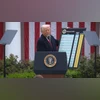
US President Donald Trump (Photo: Screengrab from video by White House)
Listen to This Article
US President Donald Trump’s sweeping global tariffs are set to face a major legal challenge on Friday, as the Supreme Court prepares to rule on whether the duties were imposed lawfully. The decision could reshape US trade policy and open the door to as much as $150 billion in refunds for importers.
For company executives, customs brokers, and trade lawyers, the ruling could determine whether businesses can recover billions of dollars already paid to the US government in import duties.
This is the first time the US Supreme Court will directly rule on the legality of Trump’s tariff programme. The case focuses on the “Liberation Day” tariffs announced on April 2 last year, which slapped duties ranging from 10 per cent to 50 per cent on most imports.
More than 1,000 lawsuits have been filed by businesses seeking refunds for tariffs already paid, according to a Bloomberg tally. Many of these cases hinge on whether Trump had the authority to use a national emergency law to impose the duties.
Judges raise doubts over legal authority
The tariffs were imposed under the International Emergency Economic Powers Act (IEEPA) of 1977, a law traditionally used to impose sanctions on foreign adversaries or freeze assets during national emergencies.
Also Read

 "Taiwan flag, Taiwan")
 "IDFC FIRST Bank")
 "home loan")
 "prenatal genetic testing")
 "Germany")
During arguments heard by the court on November 5, both conservative and liberal justices questioned whether the law actually gave the president the power to impose such sweeping trade duties.
Lower courts had already ruled that Trump’s use of IEEPA went beyond what the law allows, prompting appeals from his administration.
Trump warns of fallout if tariffs are struck down
Trump has publicly expressed concern about the possibility of losing the case. In a social media post on Friday, he said a ruling against the tariffs would be a “terrible blow” to the United States.
"Because of Tariffs, our Country is financially, AND FROM A NATIONAL SECURITY STANDPOINT, FAR STRONGER AND MORE RESPECTED THAN EVER BEFORE," Trump said in another post on Monday.
Why $150 billion is at stake
According to data from US Customs and Border Protection (CBP), these tariffs generated about $133.5 billion between February 4 and December 14, news agency Reuters reported.
Based on average daily collections in recent months, the total is now estimated to be nearing $150 billion, according to Reuters calculations. If the Supreme Court rules the tariffs illegal, the government could face massive refund claims.
Trump imposed IEEPA-based tariffs in two main phases. In April, he announced “reciprocal” tariffs on most US trading partners, citing trade deficits as a national emergency. Earlier, in February and March, he imposed duties on China, Canada and Mexico, linking them to fentanyl and drug trafficking concerns.
Uncertainty over refund process
Even if the court strikes down the tariffs, getting refunds may not be automatic. Much will depend on whether the Supreme Court gives clear instructions on refunds or sends the issue back to a lower court, likely the Court of International Trade.
“Any refund process would heavily depend upon whether the Supreme Court provides instructions on refunds,” said Joseph Spraragen, a New York customs lawyer.
Importers generally have 314 days to correct import entries before they are finalised. Once that deadline passes, refunds are usually not allowed. For imports from China hit with tariffs in February 2025, that window has already closed.
Could tariffs return as licensing fees?
Trump has hinted that even a loss in court may not end his tariff push. In an interview with The New York Times on Thursday, he suggested judges can limit his domestic agenda -- including tariffs -- only “under certain circumstances".
He also floated the idea that if emergency-based tariffs are struck down, his administration could reintroduce them in another form, such as licensing fees.
(With agency inputs)
More From This Section
 "Rio Tinto's Gudai-Darri iron ore mine")
 "China, Japan, Taiwan, Sanae Takaichi, Xi Jinping")
 "Rubble lies at the site of Thursday's Israeli strike on a house, in the central Gaza Strip | Reuters")
 "Syria, Syrians celebrate new govt, Syria flag")
 "Minneapolis protest")
Topics : Donald Trump Trump tariffs US Supreme Court import tariffs US import tariffs BS Web Reports
Don't miss the most important news and views of the day. Get them on our Telegram channel
First Published: Jan 09 2026 | 2:54 PM IST