


What to know about the US, Israel strikes on Iran and regional fallout
The strikes came two days after the latest US-Iran talks as Trump had pressured Tehran for a deal to constrain its nuclear programme
 "Iran, US Israel attacks on Iran, Israel Iran conflict, US Iran, Israel Iran")
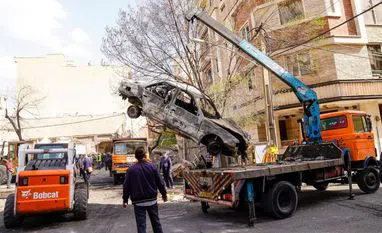
A view shows the aftermath of an Israel and the U.S. strike on a building in Tehran, Iran, February 28, 2026. | Amir Kholousi/ISNA/WANA (West Asia News Agency) via Reuters


Listen to This Article
The US and Israel attacked Iran on Saturday in what President Donald Trump said was a massive operation to destroy the country's military capabilities and eliminate the threat of it creating a nuclear weapon. Two Israeli officials told The Associated Press that Supreme Leader Ayatollah Ali Khamenei was killed.
Iran launched counterattacks, firing drones and missiles at Israel and strikes aimed at US military installations in Bahrain, Kuwait and Qatar. The exchanges of fire continued into the night. Iranian state media, citing the Red Crescent, said on Saturday evening that at least 201 people had been killed and more than 700 injured.
The strikes came two days after the latest US-Iran talks as Trump had pressured Tehran for a deal to constrain its nuclear programme, building up a fleet of American warships in the region. Iran's theocracy also has been struggling with growing dissent following nationwide protests that began over the economy but turned into anti-government ones.
The US military said it was looking into reports of civilians killed in Iran in Saturday's strikes. More than 80 people were reported killed and dozens wounded at a girls' school in the south, the local governor told Iranian state TV.
Supreme leader's compound was one of the first targets
Israel said it had worked with the US for months to plan the attacks. The US military said targets in Iran included Revolutionary Guard command facilities, air defense capabilities, missile and drone launch sites and military airfields.
Also Read

 "US Israel strike Iran")
 "Donald Trump, Trump")
 "IAEA")
 "aviation, plane")
 "aviation, aeroplane, flights, airport")
One of the first strikes hit near Khamenei's offices. The two Israeli officials who said Israel had confirmed his death both spoke on condition of anonymity pending a formal announcement. There was no immediate comment from the US or Iran on his status.
The 86-year-old Khamenei has ruled since 1989 and holds ultimate power.
Earlier, Iranian Foreign Minister Abbas Araghchi told NBC News that Khamenei and President Masoud Pezeshkian are alive "as far as I know." The US and Israel also struck Iran last June during earlier nuclear talks, greatly weakening Iran's air defenses, military leadership and nuclear programme.
The Trump administration has asserted that Iran had been rebuilding its nuclear program, which Tehran has insisted is for peaceful purposes.
Iran strikes back at Israel and US bases
Iran responded Saturday by launching missiles and drones targeting Israel and strikes targeting US military installations in Bahrain, Kuwait and Qatar.
About 12 hours after the attacks began, the US military reported no US casualties and minimal damage at US bases despite "hundreds of Iranian missile and drone attacks." Israel's military said Iran fired "dozens" of missiles at Israel, with many intercepted. Emergency responder Magen David Adom noted 89 "lightly injured" people.
Saudi Arabia said Iran had targeted its capital and eastern region in an attack that was repelled. Bahrain said a missile attack targeted the US Navy's 5th Fleet headquarters in the island kingdom, and three buildings were damaged in the capital, Manama, and Muharraq city by drone strikes and debris from an intercepted missile.
Kuwait's civil aviation authority said a drone targeted the main international airport, injuring several employees. Kuwait's state-run news agency said three troops were injured by shrapnel from strikes that hit Ali Al-Salem air base. Explosions could also be heard in Qatar. Jordan said it "dealt with" 49 drones and ballistic missiles.
Iranian-backed Houthis in Yemen, meanwhile, have vowed to resume attacks on Red Sea shipping routes and on Israel, according to two senior Houthi officials who spoke on condition of anonymity because there was no official announcement from leadership.
Trump tells Iranians it's time to topple their government
In an 8-minute video on social media, Trump announced "major combat operations" and indicated the US was striking for reasons far beyond Iran's nuclear program. He listed grievances stretching back to the beginning of the Islamic Republic following a revolution in 1979 that turned Iran from one of America's closest allies in the West Asia into a foe.
Trump told Iranians to take cover but urged them to later rise up and topple the Islamic leadership.
"When we are finished, take over your government," Trump said. "It will be yours to take. This will be probably your only chance for generations." The attacks came a day after Trump voiced frustration over lack of progress in negotiations to stop Iran's ability to develop nuclear weapons.
US military has been building up in the region
The US had assembled a vast fleet of fighter jets and warships in the region to try to pressure Iran into a deal over its nuclear programme.
The aircraft carrier USS Abraham Lincoln and three guided-missile destroyers arrived in January to bolster the number of warships. The world's largest aircraft carrier, the USS Gerald R. Ford, and four accompanying destroyers later were dispatched from the Caribbean to head to the West Asia and are now in the Mediterranean.
The fleet has added more than 10,000 US troops to the region.
Fighting disrupts commercial air travel
The fighting disrupted air travel in the region. Tens of thousands of travelers around the globe were stranded.
Israel, Qatar, Syria, Iran, Iraq, Kuwait and Bahrain closed their airspace, while Oman's Muscat International Airport shut down and all flights were restricted over the United Arab Emirates, according to flight tracking website FlightRadar24.
Major airlines based in the West Asia canceled hundreds of flights, while many other travelers were diverted to airports across Europe or flown back to departure airports.
The strikes also could rattle global markets, particularly if Iran makes the Strait of Hormuz unsafe for commercial traffic. A third of worldwide oil exports transported by sea passed through the strait in 2025.
(Only the headline and picture of this report may have been reworked by the Business Standard staff; the rest of the content is auto-generated from a syndicated feed.)
More From This Section
 "OpenAI, Amazon, investment")
 "Antonio Guterres")
 "US Israel strike Iran")
 "US President Donald Trump")
 "US Israel strike Iran")
Don't miss the most important news and views of the day. Get them on our Telegram channel
First Published: Mar 01 2026 | 7:16 AM IST