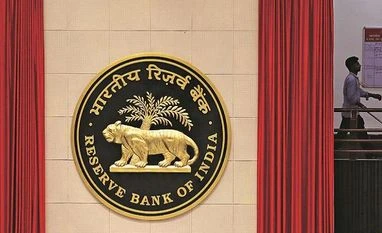
More rate hikes, eye on rupee: How experts interpret RBI's 50-bps rate hike

The reluctance of the RBI to change stance from 'withdrawal of accommodation' indicates that more monetary policy tightening is likely to be in the pipeline, analysts said

More rate hikes, eye on rupee: How experts interpret RBI's 50-bps rate hike
SI Reporter New Delhi
5 min read Last Updated : Sep 30 2022 | 12:04 PM IST
The Reserve Bank of India (RBI) governor, Shaktikanta Das', reiteration that the Indian economy remains resilient in the face of a third global shock, boosted investor sentiment on Dalal Street. Besides, the Monetary Policy Committee’s (MPC’s) 50-basis point (bps) rate hike, in-line with expectations, cheered investors. 
 
The benchmark S&P BSE Sensex soared 552 points soon after the policy announcement, while the Nifty50 gained 149 points. Track LIVE market updates

That said, experts believe the financial markets could be heading towards uncertain times ahead as the strong domestic fundamentals will face headwinds from the global environment, which may have a bearing on growth.

"At this point, we still think that the RBI would not go too restrictive, and terminal rate could hover near the estimated real rates, implying not more than 100bps hikes ahead, including today's decision. However, the extent of global disruption will remain a key to the RBI’s reaction function ahead," said Madhavi Arora, Lead Economist, Emkay Global Financial.
 
Here’s how experts interpret the RBI’s monetary policy decision:
 
Dr. Aurodeep Nandi, India Economist and Vice President, Nomura
The relatively unchanged growth and inflation outlook by the RBI indicates that the policy arithmetic hasn’t materially changed for it, and the reluctance to change stance from 'withdrawal of accommodation' indicates that more monetary policy tightening is likely to be in the pipeline. It is important that the RBI reminded that true interest rate defence of the currency doesn't necessarily comes not from hiking policy rates in response to depreciation, but by adhering to the flexible inflation targeting framework, thereby ensuring macroeconomic stability.
 
Madhavi Arora, Lead Economist, Emkay Global Financial
The MPC delivered a 50bps hike in line with expectations. Clearly, the fast-evolving world order, and consistent re-pricing of Fed’s outsized hikes are strong-arming the emerging markets (Ems). This painful adjustment has not spared the RBI either, which realised the net cost of a supposed soft signalling via shallow hike could be higher than a larger hike of 50bps. 
 
This exposes the instability inherent with the classic EM central bank trilemma: one cannot have a stable currency, unfettered capital flows, and independent monetary policy all at the same time.

This conscious front-loading could give them some breather next year on shallow hikes ahead. With inflation likely to be largely in line with RBI’s estimates, this week’s 50bps hike will make the ex-post forward real repo rate positive, albeit still lower than the RBI’s estimated real neutral rate of 0.8-1 per cent. At this point, we still think that the RBI would not go too restrictive and terminal rate could hover near the estimated real rates, implying not more than 100bps hikes ahead, including today’s decision. However, the extent of global disruption will remain a key to the RBI’s reaction function ahead.
 
Upasna Bhardwaj, Chief Economist, Kotak Mahindra Bank
Given the global adverse conditions, we remain wary of the pressure on the rupee, and hence the need for continued rate hikes. We expect the MPC to hike 35bps in the December policy. However, with inflation expected to fall within 6 per cent threshold in Q4FY23, we expect the MPC to probably pause and assess the lagged impact of monetary tightening.
 
Prasenjit Basu, Chief Economist, ICICI Securities
We expect a further increase of 25bp at the December MPC meeting, by which time CPI inflation will likely moderate to 6 per cent YoY as the strong kharif crop is harvested. Once real interest rates are positive, the MPC can pause its rate hikes. 
 
The current account deficit widened to 2.8 per cent of GDP in Q1FY23, but India’s external debt declined $617 billion (19.4 per cent of GDP) in June 2022. We expect the balance of payment (BoP) current account deficit to widen to 3.3 per cent of GDP in Q2FY23, but to then moderate to 1.6 per cent of GDP in H2FY23 as crude oil prices recede.
 
Ritika Chhabra, Economist and Quant Analyst, Prabhudas Lilladher
The outcome of the MPC meeting is on expected lines as RBI raised the repo rate by 50bps. The central bank gave a very balanced guidance emphasizing on continuing resilient domestic economic growth with risks being rising instability in the global economic and financial environment. Overall the markets have reacted positively to the policy announcement.

Garima Kapoor, Economist, Elara Capital
Going forward, the domestic monetary policy may continue to be driven by the global monetary tightening cycle with aggressive stance of Federal Reserve reducing our degrees of freedom. Assuming indicated trajectory of fed funds rate of 4.4 per cent by December, 2022, we may see another 50 bps hike in remaining part of the current financial year, despite recent correction in commodity prices offering tailwinds and rural demand remaining subdued.
 
Dr. V K Vijayakumar, Chief Investment Strategist, Geojit Financial Services
The RBI governor's comments are a reaffirmation of India's resilience. It was this positive commentary on India's growth impulses and projection of 7 per cent GDP growth with 6.7 per cent inflation for FY23 that has come as a positive surprise for the markets. The Governor's confident statement that the current account deficit (CAD) can be financed comfortably even with crude at $100 for the rest of the year is reassuring. 
 
Sameer Kaul – MD & CEO, TrustPlutus Wealth
As the governor has noted, global economy is in turmoil and India needs to be watchful both on the external account as well as in terms of the domestic fiscal situation. We expect the RBI to remain prudent in terms of balancing between growth and inflation.

One subscription. Two world-class reads.

Already subscribed? Log in

Subscribe to read the full story →
*Subscribe to Business Standard digital and get complimentary access to The New York Times

Smart Quarterly

₹900

3 Months

₹300/Month

SAVE 25%

Smart Essential

₹2,700

1 Year

₹225/Month

SAVE 46%
*Complimentary New York Times access for the 2nd year will be given after 12 months

Super Saver

₹3,900

2 Years

₹162/Month

Subscribe

Renews automatically, cancel anytime

Here’s what’s included in our digital subscription plans

Exclusive premium stories online

  • Over 30 premium stories daily, handpicked by our editors

Complimentary Access to The New York Times

  • News, Games, Cooking, Audio, Wirecutter & The Athletic

Business Standard Epaper

  • Digital replica of our daily newspaper — with options to read, save, and share

Curated Newsletters

  • Insights on markets, finance, politics, tech, and more delivered to your inbox

Market Analysis & Investment Insights

  • In-depth market analysis & insights with access to The Smart Investor

Archives

  • Repository of articles and publications dating back to 1997

Ad-free Reading

  • Uninterrupted reading experience with no advertisements

Seamless Access Across All Devices

  • Access Business Standard across devices — mobile, tablet, or PC, via web or app

Topics :InflationRBI PolicyRBI monetary policyMarketsInterest Ratesrepo rateUS Federal ReserveUS Fed rate hike

Next Story