Raise demand via govt spending

As demand rises, supply would increase correspondingly and so would employment and overall growth
government spending, demand, stimulus
Illustration: Binay Sinha
Jaimini Bhagwati
6 min read Last Updated : Sep 24 2020 | 12:50 AM IST
There are three significant negatives arrayed against the Indian economy currently. The first is due to faulty central government decisions in the three years from 2016 to 2019, compounded by a refusal to accept that economic growth was slowing down. For fiscal 2019-20, the official figure for gross domestic product (GDP) growth was an abysmal 4.2 per cent. The second is the ongoing Covid-19 pandemic and the third is the eyeball-to-eyeball confrontation between Indian and Chinese armed forces in Ladakh. India has to be prepared for continued low-intensity armed confrontation with China-Pakistan and simmering insurgency in Kashmir.       

US president Franklin D Roosevelt’s inaugural address on March 4, 1933, during the Great Depression included that famous line, “…the only thing we have to fear is… fear itself — nameless, unreasoning, unjustified terror which paralyzes efforts to convert retreat into advance”. That kind of positive exhortation should have been at the core of Prime Minister Narendra Modi’s declaration of a national lockdown for 21 days starting midnight March 24-25. Instead a sense of excessive foreboding has been allowed to grow. This has led to a propensity to save as informal employment opportunities have shrunk sharply. 

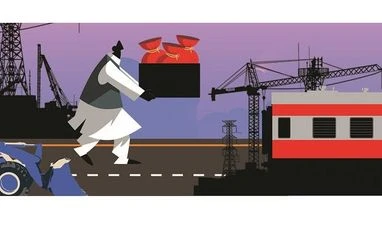
There are no other viable short-term options to boost income for the least skilled among migrant and rural labour but for the government to spend directly on infrastructure. The unskilled poor could be employed to build new highways, rural roads, railway tracks, bridges and ports. For the next two years, government revenues are likely to remain way inadequate. Further relaxations in the Reserve Bank of India’s (RBI’s) monetary and credit policies are not feasible or likely to be effective. Several major development finance institutions (DFIs) which provided long-term capital have been assimilated into banks through reverse mergers. For reasons elaborated later in this article, the commercial banking sector has been systematically weakened and is incapable of bulk lending for longer maturities. It follows that the central government needs to borrow and spend an additional 5-7 per cent of GDP. The central government should pay goods and services tax (GST) dues to states but given its straitened circumstances not the full 14 per cent annual hike as was agreed to earlier. 

On September 11, 2020, investor appetite was extremely low at an auction of Rs 18,000 crore of 10-year government bonds. Effectively, direct monetisation of government borrowings via the RBI is the only way out. The maturity of such borrowings could be indefinite and the cost could be the reverse repo rate of 3.35 per cent. As for concerns about fiscal discipline, if the unemployed are asked, they would say they are struggling to survive and not worried about a downgrading of India’s sovereign credit rating. 

As distinct from the shortage of financial resources, the government probably does not have many infrastructure projects in the pipeline ready for bidding. Further, significant coordination has to be done with state governments. Therefore, the central government needs to identify projects in Bharatiya Janata Party-ruled states which could be quick picks for execution. Priority should be given to projects in which land acquisition is not a major issue. Key individuals need to be identified as team leaders to take ownership for time-bound completion so that funds raised by monetisation are utilised for projects not handouts. 

In an article in this newspaper (“Is IBC in ICU?”, December 26, 2019) I had argued that the government’s practice of pressuring the RBI for regulatory forbearance in favour of high-net worth borrowers has weakened the efficacy of the Insolvency & Bankruptcy Code legislation. On September 16, the RBI finally spoke up that it is depositors who provide the funds that banks lend. Banks may not be able to meet their obligations to depositors and shareholders if the cost of the interest payment moratorium, for six months from March to August 2020, were to be passed on them. 

Illustration: Binay Sinha
In the above context, a Supreme Court ruling that accounts which were not declared as non-performing assets as of end August 2020 should not be classified as such till further orders of the Supreme Court made little financial sense. A three-judge Supreme Court Bench is to review this issue on September 28. If the Supreme Court is concerned about wrongdoing by banks, it should take suo motu cognisance of what former RBI governor Urjit Patel has pointed out in his book, Overdraft: Saving the Indian Saver, published in July. Namely, that the central government pressures the RBI to observe regulatory forbearance for borrowers with outsized debt obligations. On a related note, to bolster credibility in its judgments, the Supreme Court needs to revive the RBI circular of February 12, 2018, which stipulated firm deadlines for creditors to take instances of large size defaults to National Company Law Tribunals.

On September 17, 2020, the Supreme Court upheld a Delhi High Court judgment to dismiss the State Bank of India’s (SBI) claim of Rs 1,200 crore from Anil Ambani, based on his personal guarantees for loans taken by Reliance Communications and Infratel (RCom & RTIL). An RBI deputy governor is a member of SBI’s board. SBI would have taken this case to court only after painstaking examination of its claim. Earlier, on May 23, a London court had directed Anil Ambani to pay $700 million to three Chinese banks. These Chinese banks had provided loans to RCom in 2012 against personal guarantees. The shamelessness of defaulting high-net worth Indian borrowers is deeply galling. And, at times I get an “Alice in Wonderland” feeling about the government’s apparent complicity with it all. 

Since 2014, the Modi government has come up with a steady stream of innovative schemes with catchy acronyms and strikingly bold legislative changes. However, the Modi administration has been evasive about cleaning up the banking sector and currently is too timid about raising government spending to counter falling demand. To that extent, the economic performance of the Modi government is beginning to look more and more like that of the Indira Gandhi period. Namely, a refusal to acknowledge shortcomings in implementation, protectionism about foreign trade and over centralisation of decision-making. 

j.bhagwati@gmail.com | The writer is a former Indian ambassador and World Bank finance professional

One subscription. Two world-class reads.

Already subscribed? Log in

Subscribe to read the full story →
*Subscribe to Business Standard digital and get complimentary access to The New York Times

Smart Quarterly

₹900

3 Months

₹300/Month

SAVE 25%

Smart Essential

₹2,700

1 Year

₹225/Month

SAVE 46%
*Complimentary New York Times access for the 2nd year will be given after 12 months

Super Saver

₹3,900

2 Years

₹162/Month

Subscribe

Renews automatically, cancel anytime

Here’s what’s included in our digital subscription plans

Exclusive premium stories online

  • Over 30 premium stories daily, handpicked by our editors

Complimentary Access to The New York Times

  • News, Games, Cooking, Audio, Wirecutter & The Athletic

Business Standard Epaper

  • Digital replica of our daily newspaper — with options to read, save, and share

Curated Newsletters

  • Insights on markets, finance, politics, tech, and more delivered to your inbox

Market Analysis & Investment Insights

  • In-depth market analysis & insights with access to The Smart Investor

Archives

  • Repository of articles and publications dating back to 1997

Ad-free Reading

  • Uninterrupted reading experience with no advertisements

Seamless Access Across All Devices

  • Access Business Standard across devices — mobile, tablet, or PC, via web or app

More From This Section

Disclaimer: These are personal views of the writer. They do not necessarily reflect the opinion of www.business-standard.com or the Business Standard newspaper

Topics :CoronavirusLockdownIndian EconomyIndia GDP growthGovernment spendingRural consumption

Next Story



