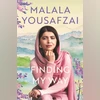
Finding My Way
by Malala Yousafzai
Published by
Weidenfeld & Nicolson
305 pages ₹699
For more than a decade, Malala Yousafzai has existed in the public imagination as a symbol rather than a person. She has been described as heroic, an icon of girls’ education, even saintly. Just as often, she has been dismissed as a carefully crafted narrative. Finding My Way, her latest book and her most revealing, sets out to answer a quieter question: Who is Malala to herself?
Ms Yousafzai, now 28, writes from a distance that her earlier books did not afford her. I Am Malala, co-written with journalist Christina Lamb and published in 2013 (a year before her Nobel Peace Prize at age 17), was the testimony of a teenager who had survived being shot in the head by the Taliban. We Are Displaced (2019) explored the state of refugees and statelessness. Finding My Way is something else entirely. It is a coming-of-age memoir that insists on the legitimacy of ordinariness. It is about wanting to fit in at school in Birmingham, at Oxford, and in friendships not defined by a Nobel. It is about girlhood, campus life, first love, and the uncomfortable truth that living fully can feel like a betrayal.
Much of the book unfolds at Oxford, where Ms Yousafzai studies philosophy, politics and economics at Lady Margaret Hall. The details are often funny, enough to make you laugh out loud, but also reflective: Signing up for cricket and badminton because they remind her of Mingora, her birthplace in Pakistan’s Swat valley; impulsively joining the rowing club because boats drifting down the river look “dreamy”; enrolling herself at the Islamic Society, the Christian Union, and the Hindu Society in a bid to understand religious pluralism from the inside. There is a surreal moment at the Oxford Union when, queuing to sign up, she spots her own photograph on a banner of famous past speakers — Einstein, Malcolm X, Queen Elizabeth II, Ronald Reagan… and Malala. It is unsettling, being fossilised into history when she is barely out of adolescence and trying hard to be just one of the students.
She writes about surveillance, about how a photograph of her walking back to college after rowing practice, wearing jeans and a bomber jacket, exploded on Pakistani social media. The reaction is swift and vicious, with accusations of obscenity, and moral collapse. Even her mother, who once swatted Prince Harry’s hand away when he put his arm around Ms Yousafzai’s shoulders for a photo, calls in distress, alarmed by relatives phoning from back home. What makes this episode stand out is Ms Yousafzai’s refusal to see it as a simple liberation versus conservatism debate. She understands the bind intimately. If she wants to advocate for girls’ education and equality in Pakistan, she has to be “inoffensive in every way”. Clothes become political not because she wants them to be, but because freedom, especially a woman’s freedom, cannot remain private for long.
Equally unwelcome to her are Western critiques of her headscarf as a symbol of oppression. Ms Yousafzai rejects both demands with equal clarity. Her scarves connect her to a home she has lost; they signal to girls in Pakistan that she has not erased them to become acceptable elsewhere. A girl in a scarf, she insists, can walk alone, row a boat, go to university. It is a quiet, considered radicalism.
Finding My Way is also candid about the costs of “sainthood”. Ms Yousafzai writes about PTSD and therapy, about the pressure to be constantly useful — to travel, give persuasive speeches. At Oxford, this tension comes to the fore. She skips tutorials to fly from Lebanon (touring refugee education programmes with Apple CEO Tim Cook) to Switzerland (cornering Justin Trudeau ahead of the G7), only to be gently but firmly reminded by her tutor that activism cannot replace education. It punctures her self-image. For the first time, she is not exemplary. She is a bad student, unfocused, and overwhelmed.
The book, which humanises her, challenges another assumption — that Ms Yousafzai’s activism is born out of privilege. In one chapter, she explains that her speaking fees are not pocket money but the financial backbone of her family’s life in the UK, and of extended obligations in Pakistan. At 20, she is earning more than her family ever had, yet living paycheque to paycheque, funding mortgages, school fees, medical bills, even university education for others.
If the world expects solemnity from Ms Yousafzai, Finding My Way gleefully refuses to comply. There are wisecracks, misadventures, and first love, which leads to a wonderfully absurd episode involving Axe body spray (“Anarchy XL”). She sprays it all over her body as a strategy to neutralise romantic distraction, prompting her friend to remark that her room smells like “patriarchy”. Later, she writes with equal honesty about deeper love and marriage, an institution she once assumed would never include her and which she eventually approaches on her own terms.
Threaded through the fun is the reality of Afghanistan after the US withdrawal and Taliban takeover, and of girls married off at 14 in her grandparents’ village of mud houses in Shangla. It is in this village that she has built a four-storey school, a metaphor for resilience made concrete.