Delhi’s domestic cricket crisis deepened on Tuesday after Jammu & Kashmir registered their first-ever Ranji Trophy victory over Delhi, chasing down 179 with ease to win by seven wickets at the Arun Jaitley Stadium in New Delhi. Riding on opener Qamran Iqbal’s unbeaten 133 off 147 balls, the spirited J&K side scripted a landmark moment in their cricketing history — and a new low for the seven-time champions.
A first in 64 years of Ranji rivalry
Since 1960, Delhi and Jammu & Kashmir had faced each other 43 times, with Delhi claiming 37 outright wins. Never before had J&K managed to beat them. On Tuesday, that record was rewritten.
Chasing 179 for victory, J&K began the final day needing 124 more runs with Iqbal at the crease and nightwatchman Vanshaj Sharma (8 off 55) keeping him company. What began as a tense morning soon turned into a one-sided exhibition as Iqbal unfurled a commanding innings filled with clean drives, slog-swept sixes, and lofted boundaries.
The 25-year-old used his long reach to smother turn and neutralise Delhi’s spinners Hrithik Shokeen and Manan Bhardwaj, who failed to exploit the rough patches, bowling too fast and too wide of the stumps.
J&K eventually reached 179/3, completing the chase in style and sealing a seven-wicket triumph.
Brief Scores:
Delhi 211 and 277; Jammu & Kashmir 310 and 179/3 (Qamran Iqbal 133*).
Why this win matters
For Jammu & Kashmir, the victory marks not just an upset, but a statement — proof that Indian domestic cricket’s balance of power is shifting beyond traditional heavyweights. The side, led by veteran Paras Dogra, played with belief and discipline, showing composure in moments where Delhi faltered.
Dogra, in his 22nd first-class season, continues to be a guiding force. The 40-year-old, second only to Wasim Jaffer in Ranji Trophy runs, struck centuries this season against both Mumbai and Delhi, anchoring the side’s middle order with the calm of experience.
For a team that has often been overlooked in the domestic circuit, this win serves as a breakthrough — symbolic of years of quiet progress and growing competitiveness among smaller cricketing states.
Delhi’s decline: a crisis of leadership and planning
For Delhi, the defeat is symptomatic of a much deeper malaise. Coached by Sarandeep Singh, the side sits sixth in Group D with only seven points from four matches, virtually out of knockout contention.
Insiders point to factionalism, poor selection decisions, and lack of tactical clarity as recurring issues. Skipper Ayush Badoni, despite scoring attractive half-centuries, has failed to assert himself as a leader capable of rallying his team in crunch moments.
Top-order batter Arpit Rana, prolific in the local Delhi Premier League, has struggled against quality pace, with Auqib Nabi’s seaming deliveries repeatedly exposing his technique. Promising youngster Priyansh Arya was benched for the first two matches and later played out of position at No.4.
Meanwhile, experienced wicketkeeper Anuj Rawat continues to feature despite a career average under 30.
What’s next for Delhi cricket
This loss is expected to trigger introspection within the Delhi & District Cricket Association (DDCA).
With three home games yielding just four points, Delhi now needs nothing short of a miracle to stay in the knockout race. But beyond this campaign, the more pressing question is whether the state unit can restore professionalism, accountability, and unity in a team long torn by divisions.


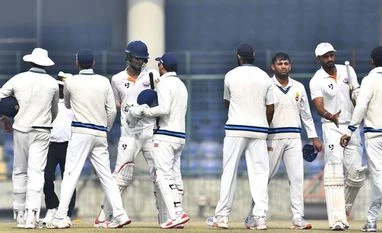 "A first in 64 years: J&K seal historic Ranji Trophy win over Delhi")

