Associate Sponsors

Co-sponsor

Density alone will not make India's cities globally competitive yet

India is economically urban but not productively so. The Economic Survey flags how weak institutions, not density itself, are holding back cities from realising agglomeration gains

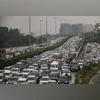
Traffic jam, Traffic, Delhi Gurugram Expressway
Wage elasticity with respect to density appears modest compared to advanced urban systems, suggesting India’s density is not yet fully “productive density”. (Photo: PTI)
Amit Kapoor
5 min read Last Updated : Feb 18 2026 | 10:24 PM IST
The Economic Survey this year makes an unusually blunt admission about the country’s urban trajectory: India is “already deeply urban in economic terms”, yet its urban story is one of “unfinished promise”. The promise, in the Survey’s telling, is agglomeration or the productivity gains that come when people and firms cluster in dense spaces. The unfinished part is that India has achieved population scale in and around its biggest cities without converting it proportionately into productivity and livability. This framing also moves the debate beyond clichés about metros being either “engines of growth” or “urban disasters”. It raises a more technical question: Under what conditions does density translate into productivity? 
Urban economics has long argued that proximity generates value. Alfred Marshall pointed to labour pooling and supplier networks; Jane Jacobs emphasised cross-sector learning; and Edward Glaeser described cities as “idea machines”. Empirically, doubling city size is often associated with productivity gains of 3-8 per cent in advanced economies, sometimes higher in developing ones when infrastructure and institutions align. The Survey cites global meta-analysis, suggesting that in India, doubling city size can increase productivity by nearly 12 per cent under supportive conditions, highlighting how significant unrealised gains may be. 
India should, in theory, be well placed to harness these gains. Its service-sector clusters are globally visible. Gurgaon, once a peripheral extension of Delhi, is now a dense concentration of multinational offices, global capability centres, and fintech firms. It exemplifies localisation economies, where firms cluster to access shared talent, suppliers, and network effects. Yet it also reveals the limits of uncoordinated agglomeration, with high-rises outpacing drainage systems, congestion intensifying, and infrastructure lagging behind. The productivity premium is real, but the erosion of what economists call “effective density” exposes the fragility beneath it. 
Urban India accounts for over 60 per cent of gross domestic product (GDP) and is projected to approach 70 per cent by 2030-36, with the population nearing 600 million. Yet fiscal empowerment has not kept pace. Cities raise less than 0.6 per cent of GDP in own revenues, and property-tax collection remains around 0.15 per cent, far below global benchmarks. This imbalance limits reinvestment in productivity-enhancing infrastructure. The Survey underscores the tension: Cities drive growth but lack fiscal autonomy and coordinated metropolitan governance. Land-use rigidities and restrictive floor-space norms push expansion outward. Infrastructure cannot compensate for weak institutions. 
Wage elasticity with respect to density appears modest compared to advanced urban systems, suggesting India’s density is not yet fully “productive density”. Congestion, informality, fragmented planning, and uneven service delivery weaken the transmission — from clustering to higher wages. This helps explain why, despite India’s scale, its cities struggle to function as hubs of global production, logistics, and knowledge, in the way New York, London, Shanghai, or Singapore do. While global cities compete, those in India often operate within state-led administrative frameworks. 
India’s newer mid-sized cities are urbanising without yet being overwhelmed. Coimbatore, Indore, and Ahmedabad show how diversified manufacturing and service clusters can thrive at lower congestion levels. These cities retain shorter commute times and more flexible land markets. “Ease of living” assessments cited in the Survey show several Tier-II cities outperforming larger metros on service delivery and livability, suggesting agglomeration benefits are internalised more effectively when scale matches planning capacity. Financing mechanisms like the Urban Infrastructure Development Fund and the newly announced Urban Challenge Fund aim to strengthen infrastructure before stress accumulates. 
International experience suggests that once countries reach India’s scale, growth rarely remains concentrated in a single metropolis. Germany’s distributed industrial hubs and China’s cultivated Tier-II clusters illustrate how polycentric systems can sustain agglomeration without overloading one core. The literature on economic geography describes this as networked agglomeration: Productivity sustained across interconnected nodes rather than a single dominant city. For India, this is fundamentally a competitiveness question. National productivity, export dynamism, and innovation intensity are increasingly city-driven. If urban systems underperform, national competitiveness follows suit. 
It is not the policy implication to dilute metros but to deepen and diversify urban systems. Land must be treated as a productivity variable, with housing near jobs raising effective density, while empowered city governance and clearer fiscal authority improve coordination. The Survey recommends statutory spatial plans and a transit-linked floor-space index to reduce discretion, alongside pre-emptive Tier-II investment. There is also a climate dimension: Extreme heat and flooding impose productivity losses, and universal sewerage and service coverage will require investment running into lakhs of crores by 2047. Urban resilience is, therefore, not peripheral to competitiveness; it is central to sustaining the agglomeration premium. 
India’s urban trajectory, then, is not a story of agglomeration failing. It is a story of agglomeration operating below potential. The country has achieved scale. The challenge is converting that scale into sustained productivity and global competitiveness. If policymakers internalise one idea, it should be this: Density does not automatically create dynamism; institutions do. Cities succeed when mobility is reliable, land is flexible, governance is coordinated, fiscal systems are credible, and environmental risk is managed. Where those conditions hold, agglomeration generates innovation and wages, and positions cities as genuine nodes in global economic networks. 
The author is chair, Institute for Competitiveness. X: @kautiliya. With inputs from Meenakshi Ajith

One subscription. Two world-class reads.

Already subscribed? Log in

Subscribe to read the full story →
*Subscribe to Business Standard digital and get complimentary access to The New York Times

Smart Quarterly

₹900

3 Months

₹300/Month

SAVE 25%

Smart Essential

₹2,700

1 Year

₹225/Month

SAVE 46%
*Complimentary New York Times access for the 2nd year will be given after 12 months

Super Saver

₹3,900

2 Years

₹162/Month

Subscribe

Renews automatically, cancel anytime

Here’s what’s included in our digital subscription plans

Exclusive premium stories online

  • Over 30 premium stories daily, handpicked by our editors

Complimentary Access to The New York Times

  • News, Games, Cooking, Audio, Wirecutter & The Athletic

Business Standard Epaper

  • Digital replica of our daily newspaper — with options to read, save, and share

Curated Newsletters

  • Insights on markets, finance, politics, tech, and more delivered to your inbox

Market Analysis & Investment Insights

  • In-depth market analysis & insights with access to The Smart Investor

Archives

  • Repository of articles and publications dating back to 1997

Ad-free Reading

  • Uninterrupted reading experience with no advertisements

Seamless Access Across All Devices

  • Access Business Standard across devices — mobile, tablet, or PC, via web or app

Topics :Economic SurveyUrban governanceTier II - IIIurban developmentUrban IndiaBS OpinionUrbanisation

Next Story