The Nationalist Congress Party (Sharadchandra Pawar), or NCP-SP, has eight Lok Sabha members, one Rajya Sabha member, and 10 members in the Maharashtra Assembly. To dodge disqualification under the anti-defection law and avoid losing their membership, at least two-thirds of the members of Parliament (MPs) need to defect. “Why take six when you can have all nine?” party leader and Maharashtra supremo Sharad Pawar reportedly told interlocutors when asked for support for the passage of the Constitution (131st Amendment) Bill, 2026 — the constitutional centrepiece of a three-Bill package that include the Delimitation Bill, 2026, and the Union Territories Laws (Amendment) Bill, 2026 — that the government introduced but could not pass for want of numbers, in April.
In all likelihood, the NCP-SP will opt to keep its flock — and its dignity — intact, avoiding the fate of the Shiv Sena (Uddhav Thackeray) and the Trinamool Congress (TMC), and vote for the Bills. The TMC in Parliament is a ghost of its former self. If its members haven’t joined the Bharatiya Janata Party (BJP), they’ve banded together as a new party. Sena MPs have abandoned it for the BJP. The bottom line is, none of them now is a member of the party that sent them to Parliament. Mr Pawar has deflected that attempt even if it means betraying alliance partners in the Indian National Developmental Inclusive Alliance (INDIA). To keep face, some “conditions” have been set: The NCP-SP will vote for the Bills only if the number of MPs each state sends is increased by 50 per cent. Given that Union Home Minister Amit Shah has already said he will present an amended Bill that will increase the seats in Parliament per state, this “condition” is frankly spurious.
This is by no means the first time Mr Pawar is in hand-shaking distance of the BJP. In 1978, when he toppled the Congress-led Vasantdada Patil coalition government, walking out with a host of Left-leaning MLAs, and formed the Samanantar (parallel) Congress, becoming chief minister at 38, the Jana Sangh was part of the government. Uttamrao Patil, a prominent Rashtriya Swayamsevak Sangh-Jana Sangh member, became a minister. The admiration is mutual. In 2016, speaking at a public function at the height of their political rivalry, Prime Minister Narendra Modi said: “Pawar has completed 50 years of either being an MLA or MP, which is a legacy in itself in Indian politics. I have no hesitation in accepting that Pawar held my hand and taught me to walk in my early days in Gujarat.” A significant section in the BJP might detest Mr Pawar. But it also acknowledges that he is one of the makers of modern Maharashtra and at this stage in life his political humiliation will not go down well in the state.
And then there’s the issue of the merger after Ajit Pawar walked out of the Sharad Pawar-led NCP, allied with the BJP, and later died in an accident, leaving no clear direction for the growth and development of his faction of the NCP. His wife, Sunetra, anointed president of the group, and mercurial son Parth see themselves as custodians of the group. However, Working President Praful Patel and leader Sunil Tatkare said a few days ago that the “vacuum” left by Ajit Pawar’s death was not easy to fill and “corrective measures” needed to be taken, following resentment at some steps by Parth Pawar. Breaking up is hard to do, especially when overlaid by issues of power and control.
For the moment, Sharad Pawar is just standing by and watching. It would be so much easier for all concerned if he could engineer a merger and steer both groups to the NDA. But playing second fiddle to the BJP would be a significant dilution of Brand Pawar. Brand Shiv Sena is already gone. Sharad Pawar does not want to surrender what remains of his political capital to the BJP.
At this point at 89, Sharad Pawar is like a mature but ageing trapeze artist who is assessing if he will still land on his feet if he jumps from the safe perch of INDIA to the NDA. Can a Great Betrayal be presented as a tactical move? Watch Sharad Pawar do it.

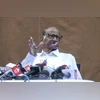 "Sharad Pawar weighs survival against legacy over the delimitation bill")









