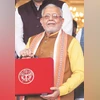
Expect our state's share in tax devolution to rise to 20%: UP FM Khanna

UP's finance minister Suresh Khanna says disciplined spending, revenue surpluses and rising capex have helped India's most populous state maintain fiscal stability while expanding infrastructure

Suresh Khanna, UP finance minister
Virendra Singh RawatSanjeeb Mukherjee Lucknow
5 min read Last Updated : Dec 28 2025 | 11:15 PM IST
Uttar Pradesh has maintained a steady track in managing its finances. Over the past eight years, the state has largely adhered to fiscal consolidation, despite having the country’s largest population. In an interview with Virendra Singh Rawat and Sanjeeb Mukherjee in Lucknow, the state’s Finance Minister Suresh Khanna outlined the measures taken to ensure a revenue surplus and control unnecessary expenditure. Edited excerpts: 
How have you kept the finances of such a large state under control? 
Uttar Pradesh has taken several steps to maintain fiscal discipline, including strict adherence to the Fiscal Responsibility and Budget Management (FRBM) Act and cutting unnecessary expenditures. We also ensure that operational expenses are met from revenue receipts, avoiding borrowings for day-to-day expenses. These measures have consistently resulted in a revenue surplus, except in the Covid-affected year of 2020-21. This surplus has helped us manage our fiscal deficit within the limits set by the FRBM Act.
 
GST collection for UP in the first half of FY26 had been lower than in the corresponding period of FY25. What explains this? 
GST collection depends on the consumption of goods and services. Sometimes consumption is higher than the tax collected. Also, when consumption is low, we receive less tax. This is temporary. The most important objective of tax policy is to raise revenue by minimising tax rates. Lower taxes stimulate demand, which strengthens the economic condition. While reduced GST rates may temporarily affect revenue, higher demand for goods and services should offset this in the long run.
 
UP’s fiscal deficit in FY26 is projected at 3 per cent of gross state domestic product (GSDP), down from 3.4 per cent in FY25. Yet it remains higher than many states. Will capital expenditure be curtailed to meet fiscal targets? 
The FY25 fiscal deficit was estimated at 3.46 per cent of GSDP, within the FRBM limit for 2024-25 (3 per cent plus 0.5 per cent additional loan limit for energy-sector performance). Preliminary accounts show we remain well within the FRBM limit. For FY26, the fiscal deficit is estimated at 2.97 per cent of GSDP, again within the statutory limit. As far as capex is concerned, it has increased from ₹154,747 crore in 2024-25 to ₹165,243 crore in 2025-26. 
Several Bharatiya Janata Party (BJP)-ruled states have launched direct benefit transfer (DBT) schemes for women, such as Ladli Behna Yojna in Madhya Pradesh and Ladki Bahin in Maharashtra. Does UP have plans for a similar programme? 
The schemes mentioned are unconditional cash transfers. In UP, we already run women-centric schemes like Kanya Sumangala, which provides ₹25,000 to a girl child in stages, from birth to graduation.
 
UP has sharply compressed expenditure. How has this been achieved? 
We have not compressed or dissuaded expenditure. Instead, we have set our priorities and avoided unnecessary expenditure. Social sector expenditure remains the highest among all sectors, and development spending exceeds 60 per cent. The quality of expenditure has improved, with Capex exceeding ₹ 1 trillion. Revenue surpluses have been ploughed back into capex. This has enabled the construction of a number of expressways and airports, including Jewar, the largest airport in Asia which is set to open in December 2025. Expressways have provided better connectivity to various important tourist places of the state. We are also developing airstrips and heliports to improve regional connectivity. Under the Pradhan Mantri Gram Sadak Yojana, we have made about 77,000 km of roads.
 
UP’s tax-to-GSDP ratio for FY26 is an estimated 9.6 per cent, higher than the national average of 6.8 per cent. How has the state achieved this? 
We have improved our own tax revenue (OTR) by minimising revenue leakages and implementing policies that facilitate ease of doing business. 
The Centre lowered GST on several items in September. What will be UP’s revenue loss, and will higher consumption offset it? 
UP is a large consumer state. Lower GST rates have boosted demand. In October 2025, GST collections reached ₹6,830.96 crore, surpassing October 2024’s ₹6,799.27 crore.
 
UP’s capital expenditure target for FY26 is over ₹1.6 trillion. Will this target be met despite revenue losses? 
Our focus on capex continues. With a revenue surplus, we expect to meet the FY26 target.
 
The Eighth Central Pay Commission’s recommendations will create additional fiscal pressure on central finances. Will UP face similar strain in revising wages for state employees accordingly? 
Let the recommendations come. We will study and assess the impact on our resources before deciding on a strategy.
 
Non-tax revenue currently forms a small part of the state’s receipts. Is there scope to increase it and reduce dependence on tax revenue? 
UP is not mineral-rich, so non-tax revenue is low. However, we are exploring ways to boost it in the coming years. 
What are your expectations from the 16th Finance Commission? 
Our fiscal discipline should be taken into consideration while devising the tax devolution formula. The 15th Finance Commission reduced UP’s share in central taxes from 19 per cent to 17.94 per cent. We hope our share will increase to 20 per cent.

One subscription. Two world-class reads.

Already subscribed? Log in

Subscribe to read the full story →
*Subscribe to Business Standard digital and get complimentary access to The New York Times

Smart Quarterly

₹900

3 Months

₹300/Month

SAVE 25%

Smart Essential

₹2,700

1 Year

₹225/Month

SAVE 46%
*Complimentary New York Times access for the 2nd year will be given after 12 months

Super Saver

₹3,900

2 Years

₹162/Month

Subscribe

Renews automatically, cancel anytime

Here’s what’s included in our digital subscription plans

Exclusive premium stories online

  • Over 30 premium stories daily, handpicked by our editors

Complimentary Access to The New York Times

  • News, Games, Cooking, Audio, Wirecutter & The Athletic

Business Standard Epaper

  • Digital replica of our daily newspaper — with options to read, save, and share

Curated Newsletters

  • Insights on markets, finance, politics, tech, and more delivered to your inbox

Market Analysis & Investment Insights

  • In-depth market analysis & insights with access to The Smart Investor

Archives

  • Repository of articles and publications dating back to 1997

Ad-free Reading

  • Uninterrupted reading experience with no advertisements

Seamless Access Across All Devices

  • Access Business Standard across devices — mobile, tablet, or PC, via web or app

Topics :Fiscal DeficitCapital ExpenditureUttar PradeshUP governmentGST collectionUP Budget

Next Story