


An economic Iron Curtain
Book review of Superpower Showdown: How the Battle Between Trump and Xi Threatens a New Cold War
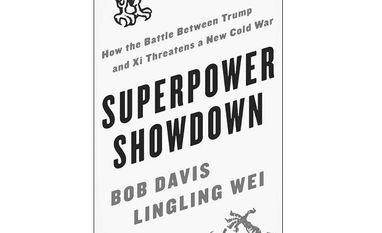 "Book cover")
premium
Book cover of Superpower Showdown: How the Battle Between Trump and Xi Threatens a New Cold War
Hank Paulson, former US treasury secretary and one of the enthusiastic champions of closer US-China economic and commercial relations, is quoted in Superpower Showdown as warning, “An economic Iron Curtain may be descending, one that throws up new walls on each side and unmasks the global economy as we know it.” The book by Bob Davis and Lingling Wei, both journalists with The Wall Street Journal, traces the tortuous journey of how visions of benign symbiosis gave way to an intensifying trade war that has now taken on the character of geopolitical contestation. The book contains 20 short chapters arranged chronologically but with a useful backgrounder in the introduction and an epilogue looking at the possible shape of things to come. While Mr Davis focuses on the Washington end of the story, Ms Wei decodes the Beijing end with some gossipy insights into attitudes harboured by China’s top leaders. The basic contours of the story are fairly well known to China watchers and trade economists but a general reader will find the book informative and full of interesting anecdotes.
While China adopted the Open Door Policy from 1978 onwards, the more significant departure came with its entry into the World Trade Organisation (WTO) in 2001 facilitated by the US. In the decade that followed, the Chinese economy grew four times, its foreign trade by seven times. Foreign direct investment into China increased from $50 billion to $109 billion.
The book reveals how much corporate America acted as powerful lobbyists for China’s entry into the WTO and in expanding both trade and investment relations. Inordinate greed was at work and the Chinese leveraged that skilfully to gain market access and technology transfer. The myth was peddled that China would follow the path of other East Asian countries where economic prosperity had led to democratic freedoms. The book quotes President Clinton as claiming, “By joining the WTO, China is not simply agreeing to buy more of our products; it is agreeing to import one of democracy’s cherished values: economic freedom.” But Chinese leaders, in inner party parleys, saw the West as a source of danger; that China itself could become prey to subversive “colour revolutions” that the West was instigating elsewhere.
Nevertheless, the increasing economic integration continued, with American companies making large profits from the Chinese market and the Chinese obtaining much-needed capital flows, technology and access to the knowledge centres of the West. China amassed more than $3 trillion in foreign currency reserves of which US dollars constituted a major chunk. This phase lasted until the global financial crisis of 2007-08 in which the US as an economic model suffered a severe blow. Wang Qishan, who was Vice-Premier at the time, said to Mr Paulson, “You were my teacher but now I am in my teacher’s domain, and look at your system, Hank. We aren’t sure we should be learning from you anymore.”
While China adopted the Open Door Policy from 1978 onwards, the more significant departure came with its entry into the World Trade Organisation (WTO) in 2001 facilitated by the US. In the decade that followed, the Chinese economy grew four times, its foreign trade by seven times. Foreign direct investment into China increased from $50 billion to $109 billion.
The book reveals how much corporate America acted as powerful lobbyists for China’s entry into the WTO and in expanding both trade and investment relations. Inordinate greed was at work and the Chinese leveraged that skilfully to gain market access and technology transfer. The myth was peddled that China would follow the path of other East Asian countries where economic prosperity had led to democratic freedoms. The book quotes President Clinton as claiming, “By joining the WTO, China is not simply agreeing to buy more of our products; it is agreeing to import one of democracy’s cherished values: economic freedom.” But Chinese leaders, in inner party parleys, saw the West as a source of danger; that China itself could become prey to subversive “colour revolutions” that the West was instigating elsewhere.
Nevertheless, the increasing economic integration continued, with American companies making large profits from the Chinese market and the Chinese obtaining much-needed capital flows, technology and access to the knowledge centres of the West. China amassed more than $3 trillion in foreign currency reserves of which US dollars constituted a major chunk. This phase lasted until the global financial crisis of 2007-08 in which the US as an economic model suffered a severe blow. Wang Qishan, who was Vice-Premier at the time, said to Mr Paulson, “You were my teacher but now I am in my teacher’s domain, and look at your system, Hank. We aren’t sure we should be learning from you anymore.”
Topics : US China Donald Trump Xi Jinping