Younger generations may be removed from the national identity of their forebears, but you’re bound to find a gem or two almost casually hung on their study (rather than living room) walls. The inclination is not so much to show off the art as to relate to it in a manner that is intimate and organic. Art in Bengal is a reflection in the deepest sense of the way its people feel — whether about nature, political troubles or social strife. When the Bengali claims that all Nobel laureates from India have a Kolkata connect, they are not far wrong — Rabindranath Tagore may have got his Nobel for literature but is one of six National Treasure artists from Bengal (from a total of nine).
While the art school in Kolkata (then Calcutta) was one of the earliest to come up, it was not the first. That distinction belonged to Chennai (then Madras), and Mumbai (then Bombay) which started off at almost the same time. Both Kolkata and Mumbai had thriving communities of artists, but in the latter it was associated with glamour and finance while in Kolkata its spirit reflected a national aspiration at par with the stirring poetry of freedom fighters, writers and poets. Perhaps that is the reason that art in Bengal was not considered from a commercial perspective. It was the emotion it evoked and the conversation it generated that was considered important.
Is that a reason why it lagged in the value stakes? To an extent, yes: but there were other factors that played a part too. Most works by the earlier generations of artists were small, on paper, and made with water colours, which overall command lower values than larger oil and acrylic canvas paintings. It is a medium that continues to dominate the market, even though there has been a marked shift, and recognition, of Bengal artists in recent years. Bengal art may appear to command lower prices than their Mumbai counterparts but the comparison is not fair, and if one were to do a value comparison on the basis of the odious per square inch or foot, several Bengal artists may, in fact, lead over modernists elsewhere. Nandalal Bose’s works command great value, and Jamini Roy is no more a laggard in the financial stakes considering the profligacy with which he painted. The Santiniketan artists are highly regarded for the quality of their work and, increasingly, their value too.
A curious case impacts the values of artists such as the three Tagores, all of them, along with Bose, Roy and Sailoz Mookherjea, National Treasure artists. Collectors aspire to their works, but they cannot be exported (or even taken out of the country by their owners), which creates a negative value in the free market. Should this undesirable clause be removed, the prices of the six artists, as well as several of their peers, will skyrocket. At that time, it will feel stupid to not have invested in their works when prices were still relatively affordable.
Kishore Singh is a Delhi-based writer and art critic. These views are personal and do not reflect those of the organisation with which he is associated 


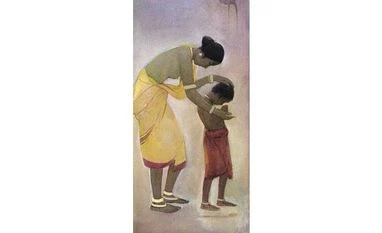 "Art work by Jamini Roy")