


18 top holdco shares gain 40% so far this year, twice that of Sensex
Holding company discount in India could narrow in the long-run, says HDFC Securities
 "shares")
premium
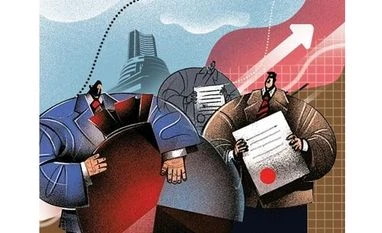
Illustration: Ajay Mohanty


Shares of several holding companies (holdcos) have rallied sharply this year amid overall buoyancy in the market.
A holdco is a company that doesn’t conduct any business operations but holds stakes in other companies, typically belonging to the same group.
Shares of Bajaj Holdings & Investment, which holds stakes in firms such as Bajaj Auto and Bajaj Finserv, have rallied 75 per cent this year.
Meanwhile, RPG Group holding companies — RPSG Ventures and STEL Holdings — have soared over 2.4x.
The average gain posted by 18 leading holdcos this year is 40 per cent — nearly double that of the 20.5-per cent year-to-date gain of the Sensex.
Despite this year’s upmove, most holdcos trade between 60 per cent and 80 per cent discount to their intrinsic value or valuing of investments.
Domestic brokerage HDFC Securities is of the view that investing in holdcos can be a good portfolio diversification option.
“Investing in the stocks of holdcos can be a very efficient and inexpensive way of gaining exposure to the stocks of India’s reputable growing business houses. It can generate consistent returns with a margin of safety over a long period of time, as well as portfolio diversity,” say HDFC Securities analysts Amit Kumar and Varun Lohchab in a note.
The duo has compared long-term returns of 18 holdcos to the Nifty. Fourteen, they say, have outperformed the Nifty over two time frames — FY16-H1FY22 (Nifty returns: 16 per cent compound annual growth rate) and FY11-H1FY22 (Nifty returns: 11 per cent).
Since a holdco doesn’t conduct any business operations, what are the triggers for its stock price to move?
The HDFC Securities note has identified three return drivers — appreciation of underlying investment portfolio, narrowing of discounts with market cycle, and event-driven value unlocking.
The first driver is straightforward. A holdco typically moves lock-in step with the underlying companies while maintaining the holdco discount. The second comes into play, according to HDFC Securities, during bullish market cycles.
“In positive market cycles, when mid-caps rise, holdco discounts narrow and stocks generate returns,” it says.
The third driver pertains to factors such as changes to dividend taxation or one-off events like reverse merger or delisting.
The holdco discount in India is high, when compared to some of the overseas markets like the US and the UK, where it is just between 10 per cent and 25 per cent. HDFC Securities sees the discount narrowing in India as well.
“Over time, Indian holdcos will evolve, attract broader investors, see increased trading volume, and, with increased liquidity and a reduction in promoter holding, discounts will narrow to low levels, comparable to global firms,” it says.
So how does one go about picking the right holdco?
A holdco is a company that doesn’t conduct any business operations but holds stakes in other companies, typically belonging to the same group.
Shares of Bajaj Holdings & Investment, which holds stakes in firms such as Bajaj Auto and Bajaj Finserv, have rallied 75 per cent this year.
Meanwhile, RPG Group holding companies — RPSG Ventures and STEL Holdings — have soared over 2.4x.
The average gain posted by 18 leading holdcos this year is 40 per cent — nearly double that of the 20.5-per cent year-to-date gain of the Sensex.
Despite this year’s upmove, most holdcos trade between 60 per cent and 80 per cent discount to their intrinsic value or valuing of investments.
Domestic brokerage HDFC Securities is of the view that investing in holdcos can be a good portfolio diversification option.
“Investing in the stocks of holdcos can be a very efficient and inexpensive way of gaining exposure to the stocks of India’s reputable growing business houses. It can generate consistent returns with a margin of safety over a long period of time, as well as portfolio diversity,” say HDFC Securities analysts Amit Kumar and Varun Lohchab in a note.
The duo has compared long-term returns of 18 holdcos to the Nifty. Fourteen, they say, have outperformed the Nifty over two time frames — FY16-H1FY22 (Nifty returns: 16 per cent compound annual growth rate) and FY11-H1FY22 (Nifty returns: 11 per cent).
Since a holdco doesn’t conduct any business operations, what are the triggers for its stock price to move?
The HDFC Securities note has identified three return drivers — appreciation of underlying investment portfolio, narrowing of discounts with market cycle, and event-driven value unlocking.
The first driver is straightforward. A holdco typically moves lock-in step with the underlying companies while maintaining the holdco discount. The second comes into play, according to HDFC Securities, during bullish market cycles.
“In positive market cycles, when mid-caps rise, holdco discounts narrow and stocks generate returns,” it says.
The third driver pertains to factors such as changes to dividend taxation or one-off events like reverse merger or delisting.
The holdco discount in India is high, when compared to some of the overseas markets like the US and the UK, where it is just between 10 per cent and 25 per cent. HDFC Securities sees the discount narrowing in India as well.
“Over time, Indian holdcos will evolve, attract broader investors, see increased trading volume, and, with increased liquidity and a reduction in promoter holding, discounts will narrow to low levels, comparable to global firms,” it says.
So how does one go about picking the right holdco?
Topics : stock markets HDFC Securities Bajaj Auto