


Global woes pull down Indian steel sector
Core sector growth data at variance with ground reality in segment
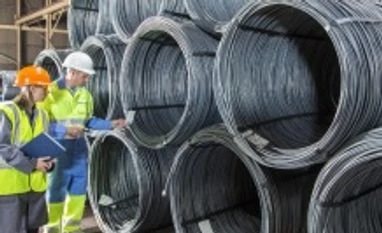)
Wire rod; Photo Courtesy: Tata Steel Europe
Steel production rose marginally in May but company bosses say the industry is far from a turnaround because of the fall in global prices. The main reason for domestic production rising in May is commissioning of new plants.
“Once a unit is commissioned, it has to be kept running. This has nothing to do with increase in demand for the commodity. A commissioned plant cannot be kept idle,” said Ravi Uppal, managing director and chief executive officer of Jindal Steel & Power.
The Delhi-based company produced 1.10 million tonnes (mt) of crude steel in the June quarter, up 38 per cent from the corresponding period last year. Most of the production came from its Angul and Raigarh units, with Oman also contributing a fourth of the total output.
“Once a unit is commissioned, it has to be kept running. This has nothing to do with increase in demand for the commodity. A commissioned plant cannot be kept idle,” said Ravi Uppal, managing director and chief executive officer of Jindal Steel & Power.
The Delhi-based company produced 1.10 million tonnes (mt) of crude steel in the June quarter, up 38 per cent from the corresponding period last year. Most of the production came from its Angul and Raigarh units, with Oman also contributing a fourth of the total output.
ALSO READ: Power generation: More is not merrier
Increased production by other companies like Steel Authority of India, Essar Steel and Rashtriya Ispat Nigam is another reason for the rise in domestic output. According to Joint Plant Committee data, domestic integrated producers together produced nearly 12 mt during April-June, 4.3 per cent more than the corresponding period last year. In May alone, these companies produced 7.5 mt, up 1.7 per cent year on year.
Early this month, Chinese hot-rolled coil prices hit a 16-year low, while the benchmark CIS and China HRC export prices were at 10-year lows. “There is no benchmark price as such for steel because it has several grades, but domestic steel prices are Rs 2,000 more per tonne than imports, making the situation difficult for domestic producers,” said an analyst with a local brokerage.
Each time the gap between imported and domestically produced steel widens, domestic players have to adjust to bring in parity.
ALSO READ: Lack of concrete growth in cement sector
In the quarter ended June, imports rose 53 per cent, year on year, to 2.54 mt. Despite a rise in consumption, domestic producers are unable to tap the opportunity due to cheap imports.
“There is some traction in small infrastructure projects along with medium and heavy vehicles, but the incremental demand is going to imported steel,” said Jayant Acharya, director, commercial and marketing, JSW Steel.
| Steel production for sale data | |
| Jul-14 | 2.97 million tonne |
| Aug-14 | 3.58 million tonne |
| Sep-14 | 4.27 million tonne |
| Oct-14 | 4.94 million tonne |
| Nov-14 | 5.64 million tonne |
| Dec-14 | 6.42 million tonne |
| Jan-15 | 7.20 million tonne |
| Feb-15 | 8.74 million tonne |
| Mar-15 | 8.76 million tonne |
| Apr-15 | 7.25 million tonne |
| May-15 | 7.5 million tonne |
| Jun-15 | 7.36 million tonne |
In the June quarter, India’s steel consumption rose seven per cent, year on year, to 20 mt. Industry executives are hopeful the peak demand season between October and March will bring in some respite. “October-March is an important period as much of planned expenditure is rolled out in this season. How we benefit depends upon the supply scenario,” said Acharya.
With July-September monsoon season being a lean period for construction, industry executives do not expect strong demand for steel. Executives were unable to predict the direction for prices. Some said prices had bottomed out and would only move in a range-bound manner.
“It is difficult to say how prices will behave. The entire sector’s future will depend on that,” Uppal said.

Don't miss the most important news and views of the day. Get them on our Telegram channel
First Published: Jul 11 2015 | 12:30 AM IST