


How Tata Motors used 'GEAR logic' to turn around its passenger vehicle biz
As the company pulls all stops to win over passenger vehicle buyers, the programme wages war on costs and quick implementation of ideas
 "chart")
premium
Mayank Pareek, president of the passenger vehicle (PV) business at Tata Motors, says he's glad to keep his team in a permanent state of paranoia.
An obsession for cost control has helped the maker of the Hexa sports utility vehicle and Tiago hatchback turn on its head, with a steady climb in sales over the past 18 months. From where it plans to start making money.
This new obsession on cost control is powered by the company’s ‘GEAR’ (Generate idea, evaluate, action and realise the idea) programme. Implemented for the PV business at the start of the ongoing financial year, as part of the a second phase of a turnaround strategy scripted by Guenter Butschek, the managing director.
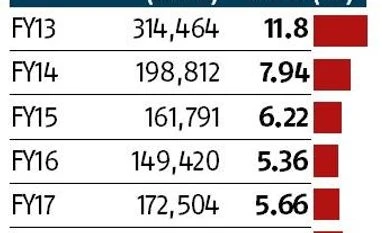
The turnaround has helped the company get back in the reckoning in the PV market. However, it is still to get back to where it was five years earlier, when Tata Motors sold 314,000 units a year and had a market share of 11.8 per cent. The clock, therefore, is ticking fast for Pareek and his team.
“We are still at 6.6 per cent market share and the road ahead is long and winding. The cost-cutting target taken this year is six times more than whatever we had done in the past. Earlier, the time taken to travel from G to R (generating an idea to realising it) was a year; I have squeezed it to three months. We need to do this for three years. After that, we become structurally strong and less vulnerable to external headwinds; it also then becomes a habit,” said Pareek.
He was brought from Maruti Suzuki India, by Cyrus P Mistry, then chairman of Tata Sons, to head the PV business in October 2014. Butschek’s turnaround plan for 2018-19 is based on the principles of ‘win decisively’ in commercial vehicles, ‘win sustainably’ in passenger vehicles and to embed a culture of turnaround deep into the organisation. Having drastically pared its losses at the operating earnings level (earnings before interest, taxes, depreciation and amortisation or Ebitda) to Rs 0.25 billion in the latest, June, quarter from Rs 4.6 bn in the year-ago period, Tata Motors is expecting operational break-even in its PV business in FY19. If so, it would be for the first time in a decade, on the back of expanding volumes and cost-cutting programmes.
An obsession for cost control has helped the maker of the Hexa sports utility vehicle and Tiago hatchback turn on its head, with a steady climb in sales over the past 18 months. From where it plans to start making money.
This new obsession on cost control is powered by the company’s ‘GEAR’ (Generate idea, evaluate, action and realise the idea) programme. Implemented for the PV business at the start of the ongoing financial year, as part of the a second phase of a turnaround strategy scripted by Guenter Butschek, the managing director.
The turnaround has helped the company get back in the reckoning in the PV market. However, it is still to get back to where it was five years earlier, when Tata Motors sold 314,000 units a year and had a market share of 11.8 per cent. The clock, therefore, is ticking fast for Pareek and his team.
“We are still at 6.6 per cent market share and the road ahead is long and winding. The cost-cutting target taken this year is six times more than whatever we had done in the past. Earlier, the time taken to travel from G to R (generating an idea to realising it) was a year; I have squeezed it to three months. We need to do this for three years. After that, we become structurally strong and less vulnerable to external headwinds; it also then becomes a habit,” said Pareek.
He was brought from Maruti Suzuki India, by Cyrus P Mistry, then chairman of Tata Sons, to head the PV business in October 2014. Butschek’s turnaround plan for 2018-19 is based on the principles of ‘win decisively’ in commercial vehicles, ‘win sustainably’ in passenger vehicles and to embed a culture of turnaround deep into the organisation. Having drastically pared its losses at the operating earnings level (earnings before interest, taxes, depreciation and amortisation or Ebitda) to Rs 0.25 billion in the latest, June, quarter from Rs 4.6 bn in the year-ago period, Tata Motors is expecting operational break-even in its PV business in FY19. If so, it would be for the first time in a decade, on the back of expanding volumes and cost-cutting programmes.