


Supreme Court shuts back-door arrangement for defaulting promoters
The SC order barred promoters of Gujarat NRE Coke, a defaulting company, from proposing a revival plan in the event of liquidation under IBC
 "Supreme Court")
premium
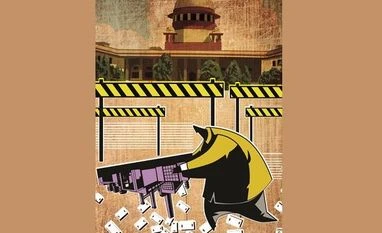
Illustration by Binay Sinha
Defaulting promoters, who are barred from a resolution plan under section 29A of the Insolvency and Bankruptcy Code (IBC), cannot use the scheme of arrangement and compromise to gain control of a company while it’s in liquidation, the Supreme Court said on Monday.
As such, the scheme of arrangement under Section 230 of the Companies Act does not stop anybody from proposing a plan. However, if this provision is used to revive a company which is facing liquidation under IBC, the rules of 29A will apply in keeping with the intent of the law, the top court clarified.
Specifically in this case, the SC order barred promoters of Gujarat NRE Coke, a defaulting company, from proposing a revival plan in the event of liquidation under IBC.
“The stages of submitting a resolution plan, selling assets of a company in liquidation and selling the company as a going concern during liquidation, all indicate that the promoter or those in the management of the company must not be allowed a back-door entry in the company... Proposing a scheme of compromise or arrangement under Section 230 of the Act of 2013, while the company is undergoing liquidation under the provisions of the IBC lies in a similar continuum,” the SC judgment by bench comprising Justices Dhananjaya Y Chandrachud and MR Shah said.
The court was hearing the petition of Gujarat NRE Coke promoter Arun Kumar Jagatramka, who challenged the provision 2B introduced by the Insolvency and Bankruptcy Board of India (IBBI). The provision says that that a party ineligible to propose a resolution plan under the IBC cannot be a party to a compromise or arrangement.
As such, the scheme of arrangement under Section 230 of the Companies Act does not stop anybody from proposing a plan. However, if this provision is used to revive a company which is facing liquidation under IBC, the rules of 29A will apply in keeping with the intent of the law, the top court clarified.
Specifically in this case, the SC order barred promoters of Gujarat NRE Coke, a defaulting company, from proposing a revival plan in the event of liquidation under IBC.
“The stages of submitting a resolution plan, selling assets of a company in liquidation and selling the company as a going concern during liquidation, all indicate that the promoter or those in the management of the company must not be allowed a back-door entry in the company... Proposing a scheme of compromise or arrangement under Section 230 of the Act of 2013, while the company is undergoing liquidation under the provisions of the IBC lies in a similar continuum,” the SC judgment by bench comprising Justices Dhananjaya Y Chandrachud and MR Shah said.
The court was hearing the petition of Gujarat NRE Coke promoter Arun Kumar Jagatramka, who challenged the provision 2B introduced by the Insolvency and Bankruptcy Board of India (IBBI). The provision says that that a party ineligible to propose a resolution plan under the IBC cannot be a party to a compromise or arrangement.