


With Neeraj Chopra, Bajrang Punia win, JSW Sports aims to strike gold
Parth Jindal plans standalone sporting venture by 2025 and an IPO
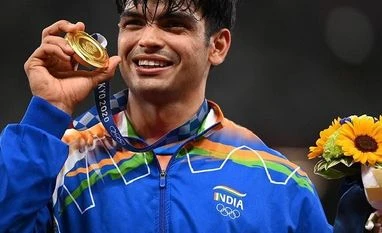 "Neeraj Chopra")
premium
Neeraj Chopra
5 min read Last Updated : Aug 12 2021 | 6:04 AM IST
In the middle of 2019, Neeraj Chopra’s chances of making it to the Olympics looked shaky after he suffered a career-threatening elbow injury. Manisha Malhotra, head of sports excellence and scouting at JSW Sports, promptly got down to working the phones — calling whoever could urgently help. In 24 hours, Chopra was with Dinshaw Pardiwala, one of India’s top orthopaedic surgeons, at the Kokilaben Dhirubhai Ambani Hospital in Mumbai.
The two-hour intensive surgery was followed by four months of rehabilitation at the Inspire Institute of Sports, the only privately funded high-performance training centre located at JSW’s Vijayanagar steel plant in Karnataka.
JSW Sports’ investment in Chopra and the athlete’s single-minded commitment and phenomenal performance have given India its first track and field Olympic gold medal. Chopra’s soaring brand value since is also good news for Parth Jindal, managing director of JSW Cements and founder-director of Inspire Institute of Sport. Jindal is looking to turn JSW Sports into India’s first profitable sports venture.
JSW Sports spotted Chopra in 2015 and has since made use of the $13-billion steel conglomerate’s financial might to provide him with training and facilities. The company will manage endorsement deals for Chopra and Bajrang Punia, who won the Olympic bronze medal in wrestling and who will also be with the JSW system till the 2024 Paris Olympics.
“We have an extensive scouting system for five sports: boxing, wrestling, judo, athletics and swimming. Our scouts are present at all forms of competition — district, state and national level,” Jindal says. “When they spot a potential talent, we get in touch with the athlete’s parents and offer him/her a full scholarship at JSW Sports where the training and education are taken care of.”
Jindal entered the sports business in 2013 when he was trying to figure out how to make JSW a recognisable household brand. He had just graduated from Brown University and one of his first projects was in the marketing department. He was told that rival Tata Steel’s Tiscon brand was able to charge 10 per cent extra only because the company had better visibility, while JSW’s Neosteel (“a better product,” he says) struggled to gain acceptance. “We faced a similar problem in cement where we were competing against a renowned brand like Birla. So, I thought JSW should build an institute and pick up Olympic sports which, besides the national need, can be used as a very good brand-building exercise.”
For the next one year, Jindal and Mustafa Ghouse, CEO of JSW Sports and a former Davis Cup player, went to all the leading sports facilities across the world to build a model for the business. The result was the Inspire Institute of Sport. Spread over 42 acres, it has since 2014 produced multiple Olympic athletes for India.
The academy up and running, Jindal gunned for more. India was to host the Under-17 football World Cup in a few years and the football federation felt that corporate presence would speed up new infrastructure. Jindal bid and got the rights for the Bengaluru franchisee.
“We felt that to build Indian football, it was necessary to have a professionally managed football club. Second was an additional motive of building the JSW brand in Bengaluru and making it a household name,” Jindal says.
Next was the acquisition of Haryana Steelers in 2017 and a year later, they acquired 50 per cent stake in the Indian Premier League’s (IPL’s) Delhi franchise, Delhi Capitals, from the GMR group.
Making money through a sports team in India has never been easy. In fact, most involvement in sport has always incurred loss (see box). Jindal says that while the IPL and Kabaddi League franchises are profitable, the football franchise is yet to make money.
The company has planned three distinct revenue streams. First, from the franchises it owns. Second, the sports management business where JSW Sports manages athletes, which includes names like Rishabh Pant and Neeraj Chopra, many of whom have trained at Inspire Institute of Sports or are part of the company’s sporting franchisee.
Third, Jindal is now planning to expand into the sports content business and make documentaries on famous athletes who are products of the JSW system. The company is also planning to incubate start-ups in the sports business, primarily in e-sports.
“I truly believe that on the commercial side, sports has an incredible future, especially live sports because this, and news, are the two last areas where advertisers have a captive live audience. Through football, cricket and kabaddi, we can make a big sporting company,” Jindal says.
The venture is also looking to sign more athletes who can bring medals in the 2024 Paris and 2028 Los Angeles Olympics. “We have already scouted a few athletes who are potential Olympians. Due to the success of our athletes, we have got a lot of funding, including from JSW,” Jindal says.
While the venture still needs support from the JSW group, Jindal expects that by 2025 it will be a standalone profitable sporting venture. “The dream is to have the first public listing for a sports company in India — that’s the vision,” he says.