


Covid-19 second wave: Delhi, Maharashtra to set up their own oxygen plants
They see it as the only way to have reliable supplies for this and future waves
 "waiting for oxygen")
premium
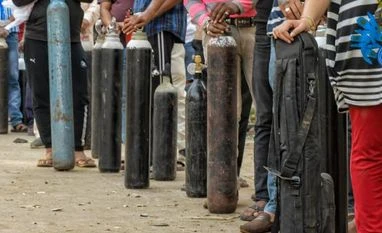
Family members of COVID-19 patients wait outside an oxygen-filling center to refill their empty cylinders, as demand for the gas rises due to spike in coronavirus cases, at Mayapuri in New Delhi (Photo: PTI)
Maharashtra and Delhi are to import their own oxygen for their Covid-19 patients, with the former planning to import 25,000 tonne of liquid medical oxygen (LMO) and Delhi planning to order 18 cryogenic tankers and 21 ready-to-use oxygen plants.
The plans are to help those suffering in the current second wave and to be able to provide for those who will need oxygen in future waves.
While the decision by Maharashtra and New Delhi to import oxygen will help to supplement the efforts being made by the Centre and corporates to increase oxygen supplies, there is a fear that parallel tenders from India could further push up the price at which global purchases will be made. This is because there will be more than one buyer from India and prices are already high in the international market.
The Centre floated a tender for the import of 50,000 tonnes of oxygen on April 16. It received a firm commitment for only 3,500 tonnes up to Sunday. The availability of tankers to get oxygen from the international market is an even bigger challenge. "The price of oxygen, tankers and raw material to build pressure swing absorption (PSA) plants has shot up," said a Central official.
Maharashtra Health Minister Rajesh Tope on Tuesday said the state had floated an expression of interest to procure 40,000 oxygen concentrators, 132 PSA plants, 27 oxygen storage tanks, 25,000 tonnes of liquid oxygen and a million vials of Remdesivir. "Interested parties can submit offers in three days. A committee has been given the authority to take decisions quickly," said Tope.
In New Delhi, Chief Minister Arvind Kejriwal plans to import 18 cryogenic tankers from Thailand and 21 ready-to-use oxygen plants from France.
In addition, the Centre will set up eight oxygen plants in the city. Kejriwal said a total of 44 oxygen plants will be set up at various hospitals, including the 21 that will be imported from France.
Imported tankers from Bangkok will be arriving on an Indian Air Force plane tomorrow. India is also importing tankers from Dubai, Shanghai and Dusseldorf in tie-ups with companies that will continue to own the tankers.
Four tankers from Singapore bought by the Tatas arrived on an Indian Air Force plane a few days ago.
Use of oxygen is also being regulated. Maharashtra consumes over 1,615 tonnes of oxygen. Of this, around 300-350 tonnes comes from outside the state. The state, which has over 670,000 active Covid-19 cases, has issued guidelines for hospitals to ensure no oxygen is wasted such as dedicated nurses to monitor the oxygen flow to patients and hospital audits to check consumption.
Maharashtra is also setting up a 100 bed, Covid-19 facility at the JSW steel plant in Raigad district, Tope said. Oxygen produced at the plant will be made directly available to patients in the facility.
Lack of oxygen has led to many deaths across the country, prompting the Centre’s Empowered Group 2 (EG2) to determine an oxygen quota for each state.
Officials say there was sufficient domestic production of LMO after industrial oxygen was diverted for medical use but the logistical bottlenecks were hampering supply.
The states are in charge of logistics such as arranging tankers, allotting them to individual hospitals and districts, and ensuring their seamless movement within a city.
In an effort to obviate the need for transporting oxygen, on-site oxygen manufacturing facilities or PSAs are being created. Some of these PSAs were awarded as part of a Central government tender floated in October but a majority of them did not come up.
Similarly, oxygen concentrators can be installed by individuals in their homes. These derive oxygen from atmospheric air. While they are currently in short supply in the domestic market, they can reduce the demand burden on the cylinders that are usually used at home for patients with low oxygen levels.
The plans are to help those suffering in the current second wave and to be able to provide for those who will need oxygen in future waves.
While the decision by Maharashtra and New Delhi to import oxygen will help to supplement the efforts being made by the Centre and corporates to increase oxygen supplies, there is a fear that parallel tenders from India could further push up the price at which global purchases will be made. This is because there will be more than one buyer from India and prices are already high in the international market.
The Centre floated a tender for the import of 50,000 tonnes of oxygen on April 16. It received a firm commitment for only 3,500 tonnes up to Sunday. The availability of tankers to get oxygen from the international market is an even bigger challenge. "The price of oxygen, tankers and raw material to build pressure swing absorption (PSA) plants has shot up," said a Central official.
Maharashtra Health Minister Rajesh Tope on Tuesday said the state had floated an expression of interest to procure 40,000 oxygen concentrators, 132 PSA plants, 27 oxygen storage tanks, 25,000 tonnes of liquid oxygen and a million vials of Remdesivir. "Interested parties can submit offers in three days. A committee has been given the authority to take decisions quickly," said Tope.
In New Delhi, Chief Minister Arvind Kejriwal plans to import 18 cryogenic tankers from Thailand and 21 ready-to-use oxygen plants from France.
In addition, the Centre will set up eight oxygen plants in the city. Kejriwal said a total of 44 oxygen plants will be set up at various hospitals, including the 21 that will be imported from France.
Imported tankers from Bangkok will be arriving on an Indian Air Force plane tomorrow. India is also importing tankers from Dubai, Shanghai and Dusseldorf in tie-ups with companies that will continue to own the tankers.
Four tankers from Singapore bought by the Tatas arrived on an Indian Air Force plane a few days ago.
Use of oxygen is also being regulated. Maharashtra consumes over 1,615 tonnes of oxygen. Of this, around 300-350 tonnes comes from outside the state. The state, which has over 670,000 active Covid-19 cases, has issued guidelines for hospitals to ensure no oxygen is wasted such as dedicated nurses to monitor the oxygen flow to patients and hospital audits to check consumption.
Maharashtra is also setting up a 100 bed, Covid-19 facility at the JSW steel plant in Raigad district, Tope said. Oxygen produced at the plant will be made directly available to patients in the facility.
Lack of oxygen has led to many deaths across the country, prompting the Centre’s Empowered Group 2 (EG2) to determine an oxygen quota for each state.
Officials say there was sufficient domestic production of LMO after industrial oxygen was diverted for medical use but the logistical bottlenecks were hampering supply.
The states are in charge of logistics such as arranging tankers, allotting them to individual hospitals and districts, and ensuring their seamless movement within a city.
In an effort to obviate the need for transporting oxygen, on-site oxygen manufacturing facilities or PSAs are being created. Some of these PSAs were awarded as part of a Central government tender floated in October but a majority of them did not come up.
Similarly, oxygen concentrators can be installed by individuals in their homes. These derive oxygen from atmospheric air. While they are currently in short supply in the domestic market, they can reduce the demand burden on the cylinders that are usually used at home for patients with low oxygen levels.