


Review: When RSS icon Golwalkar claimed authorship of G D Savarkar's books
The original Marathi version was published in 1934, but when Golwalkar began translating it, copies of the [original] book were withdrawn and hence unavailable to readers
 "the indian express archive")
premium
he Indian Express archive
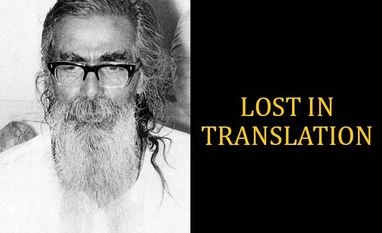
One of the reasons that [Madhav Sadashiv] Golwalkar’s elevation (as RSS general secretary in 1939) was accepted without any demur was because of his image of an ideologue-thinker. Apart from his ascetic-like appearance and various sojourns to ashrams, Golwalkar had taken upon himself to translate G.D. (aka Babarao) Savarkar’s book in Marathi titled, Rashtra Mimansa, into English, which was published in March 1939 as We or Our Nationhood Defined.
Although this proved to be a significant milestone in his career, for some strange reason, Golwalkar denied the authorship to Savarkar [who was Veer Savarkar’s brother] and instead claimed the book to be his ‘maiden attempt’ in the Preface of the first edition. He, however, did acknowledge Rashtra Mimansa as amongst his ‘chief sources of inspiration and help’ and further explained in the Preface that he wrote it, despite it being ‘superfluous.’
The original Marathi version was published in 1934, but when Golwalkar began translating it, copies of the [original] book were withdrawn and hence unavailable to readers. For a period spanning a quarter of a century, Golwalkar had supposedly concealed the fact that the book was not his original work. Yet another observation was that the [translated] book often lapsed ‘into intemperate language here and there,’ and when a second edition was published a few years later, it had been ‘somewhat cleansed of these excesses of language.’
Although this proved to be a significant milestone in his career, for some strange reason, Golwalkar denied the authorship to Savarkar [who was Veer Savarkar’s brother] and instead claimed the book to be his ‘maiden attempt’ in the Preface of the first edition. He, however, did acknowledge Rashtra Mimansa as amongst his ‘chief sources of inspiration and help’ and further explained in the Preface that he wrote it, despite it being ‘superfluous.’
The original Marathi version was published in 1934, but when Golwalkar began translating it, copies of the [original] book were withdrawn and hence unavailable to readers. For a period spanning a quarter of a century, Golwalkar had supposedly concealed the fact that the book was not his original work. Yet another observation was that the [translated] book often lapsed ‘into intemperate language here and there,’ and when a second edition was published a few years later, it had been ‘somewhat cleansed of these excesses of language.’
Photo: Reuters