


World's oldest dock: Lothal set to get National Maritime Heritage Complex
The National Maritime Heritage Complex commenced in March 2022 and is being developed at a cost of Rs 3,500 crore
 "Lothal")
premium
Photo: Harappa.com
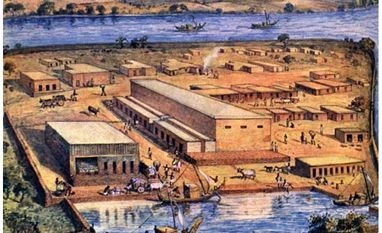
World's oldest dockyard, Lothal, is all set to get heritage complex as Prime Minister Narendra Modi reviewed the construction of the National Maritime Heritage Complex (NMHC) site via video conferencing.
In his address, PM Modi said Lothal was not only a major trading centre of the Indus Valley Civilisation, but was also a symbol of maritime power and prosperity of India.
With NMHC, Lothal will act as a centre for learning and understanding India's maritime history, he added.
Here is a look at the National Maritime Heritage Complex project and its significance:
Where is Lothal situated?
It is one of the southernmost sites of the Indus Valley Civilisation, situated in the Bhal region in the present-day Gujarat. Said to be built in 2,200 BC, this port city was a thriving trade centre in ancient times with its trade of beads, gems and ornaments reaching West Asia and Africa.
The word "Lothal" is a combination of Loth and thal, meaning the mound of the dead in Gujarati. The port city was discovered after a team of archaeologists led by SR Rao started the search for Harappan civilisation post 1947 in the Saurashtra region. According to Archaeological Survey of India (ASI), Lothal had the world's earliest known dock, connecting the city to an ancient course of the Sabarmati river.
The ongoing project
The National Maritime Heritage Complex commenced in March 2022 and is being developed at a cost of Rs 3,500 crore. According to an Indian Express report, the complex will have several innovative features, including the i-recreation, which will recreate Harappan architecture and lifestyle through immersive technology and four theme parks. It will also house the world's tallest lighthouse museum, along with 14 galleries, highlighting India’s maritime heritage starting from the Harappan time till today.
Significance of Lothal
In 2014, Lothal was nominated as a UNESCO World Heritage Site, however, its application is still pending. Its heritage value is comparable to many other ancient port-towns around the world, which includes - Xel Ha (Peru), Ostia (Port of Rome) and Carthage (Port of Tunis) in Italy, Hepu in China, Canopus in Egypt, Gabel (Byblos of the Phoenicians), Jaffa in Israel, Ur in Mesopotamia, Hoi An in Vietnam, as per the dossier. In the region, it can be compared with other Indus port towns of Balakot (Pakistan), Khirasa (in Gujarat’s Kutch) and Kuntasi (in Rajkot).
According to the dossier submitted to UNESCO, the excavated site of Lothal is the only port-town of the Indus Valley Civilisation.
Other Harappan sites
Earlier in September, Haryana Chief Minister Manohar Lal Khattar urged the ASI to expedite the excavation in another Harappan Civilisation site, Rakhigarhi.
The Haryana govt planned to develop the world's largest museum of Harappan culture in Rakhigarhi to showcase about 5,000-year-old Indus Valley artifacts.
During the preliminary excavations, a cluster of seven mounds marked as RGR 1 to RGR 7 were found which together formed the largest settlements of the Harappan civilization.
Other Harappan sites
Earlier in September, Haryana Chief Minister Manohar Lal Khattar urged the ASI to expedite the excavation in another Harappan Civilisation site, Rakhigarhi.
The Haryana govt planned to develop the world's largest museum of Harappan culture in Rakhigarhi to showcase about 5,000-year-old Indus Valley artifacts.
During the preliminary excavations, a cluster of seven mounds marked as RGR 1 to RGR 7 were found which together formed the largest settlements of the Harappan civilization.
In 1963, the ASI for the first time started excavation in a village. Between 1998 and 2001, the ASI team led by Amarendra Nath again started excavation.
Topics : Gujarat Narendra Modi Top 10 headlines