


India turns 71: Talking progress of economies, India beats Pakistan hollow
India only grew stronger after its own bailout from the IMF in 1991, the economic liberalisation opened up the economy
 "Chart")
premium
Last Updated : Aug 16 2018 | 5:30 AM IST


Seventy-one years after Independence, India seems to be in a far better economic shape than Pakistan, which may soon seek a bailout package from the International Monetary Fund (IMF) to tackle its looming balance of payments crisis.
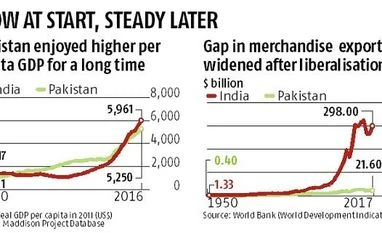
But this wasn’t always the case. Pakistan’s per capita gross domestic product (GDP) was higher than India’s for 44 out of 67 years for which data is available. In other words, the per person value of goods and services produced was higher in the case of Pakistan for most of the time since independence.
When both countries started out, India did have a higher per capita GDP. In 1950, Pakistan had a per capita GDP of $1,211 whereas India’s stood at $1,417. But this changed by 1965, when Pakistan's per capita GDP overtook India's for the first time. It was not until 2009 that India’s per capita GDP once again outstripped that of Pakistan. (see chart).
The figures in Chart 1 are sourced from the Maddison Project Database. Eminent economic historian Angus Maddison put together the database which allows for the comparison of long-term economic trends. Updated in 2018, comparisons of the per capita GDP of India and Pakistan are available from 1950 to 2016. (Bolt, Jutta, Robert Inklaar, Herman de Jong and Jan Luiten van Zanden).
Today, Pakistan has been hit again by higher oil prices and rising imports. Its current account deficit has widened and foreign exchange reserves have fallen sharply. The country has devalued its currency four times since December 2017. This is in sharp contrast to the 1960s — one of the best phases of growth for the Pakistan economy, which was helped along by unfettering private enterprise.
“There have been no grand experiments in nationalisation, no fancy slogans about socialism, no undue intervention in the private sector,” said the foreword to Pakistan’s third five-year plan (1965-70). In fact, the foreword, authored by then President of Pakistan, Mohammed Ayub Khan, mentioned a planned move towards the lifting of administrative and bureaucratic controls on private enterprise.
The US also provided generous aid to Pakistan during this time.
In contrast, India followed a policy of greater state control over private enterprise. The trend intensified as the country stepped into the 1970s, dampening India’s economic growth further.
However, in the aftermath of the war in 1971, a spurt in nationalism led Pakistan to reverse its focus on private enterprise. This, together with oil shocks, are said to have had a negative impact on the country’s growth. Its economy took a number of hits. In fact, Pakistan has had a dozen or more bailouts from the IMF since the 1980s.
India only grew stronger after its own bailout from the IMF in 1991. The economic liberalisation opened up the economy. The gap between India’s merchandise exports and that of Pakistan widened considerably in the years that followed. And strong growth in subsequent years led to India’s vast population achieving a higher per capita GDP than Pakistan in 2009 (see chart).
However, both countries put up a poor show as far as income inequality was concerned. In 2011 the World Bank Gini index value for India was 35.1 while it was 30.9 for Pakistan. (Gini index is a measure of inequality, where the higher the value, the greater the inequality.) Clearly, both India and Pakistan need to work a lot more on improving their social indices to reduce income inequality and reach the level of a developed country like, say, Norway (see chart).