Government sources have, without attribution, corroborated news reports about a proposed Rs 24,000 crore issue of green bonds as part of the Centre's annual borrowing programme. The bonds are slotted to be issued as part of the first half year’s borrowing programme. The immediate incentive is obviously to tap into lower cost funds than would be available for a plain vanilla debt issue. Yields on Indian paper have hardened to 6.821 per cent as on March 16, denoting less earnings for investors. The green bonds issue is expected to reverse the trend.
India is ratcheting up steps towards its renewable energy commitments with several policy announcements coming within the current financial year. In COP26 in November, Prime Minister Narendra Modi announced a higher renewable energy commitment of 500 Gw for 2030. In her budget speech in February, finance minister Nirmala Sitharaman announced the decision on sovereign green bonds. “Issuance of a sovereign green bond would position India as a leader among the major emerging markets, especially among BRICS nations as none have issued such a green bond yet”, wrote Saurabh Trivedi, Research Analyst, at the Institute for Energy Economics and Financial Analysis (IEEFA) in an article.
Government officers have not said if the rapid firming up of plans to bring forward the issuance calendar for the Indian green bonds are a response to the proposed EU papers. There is no doubt whether, clubbed as a continent-wide bond issue or as distinct issues, India has reasons to be concerned about those Euro plans. They would certainly raise the cost of finance for India, impacting the pace of RE additions. India has installed a third of its commitment to set up 500 Gw of renewable power by 2030 (about 158.17 Gw of non-fossil fuel-based power, as on December 31, 2021). New Delhi already allows 100 per cent foreign direct investment under the automatic route to set up renewable capacity, including manufacture of all equipment, so further policy relaxations will need a closer look.
Globally, of the $194 billion of green bonds issued so far, France holds the lions’ share at over a quarter, with $51 billion. Germany with $27 billion and the UK with $21.6 billion come next. Expansion of Euro-denominated bonds will raise the competition for paper issuers like India. The green bonds also overtake earlier plans to push for India’s inclusion in global bond indices. The government reckons that the new papers could make foreign investors subscribe to Indian papers at comparable scale as the inclusion in fund indices would have done. Subscriptions for foreign investors to Indian sovereign debt is allowed within limits. Those limits are announced every year at the end of March. To get over the challenge of limited availability of Indian papers, RBI has floated a new window that lists some issues for higher subscriptions.
To its credit, India has not only opened the door for FDI totally open in RE, but has also taken several overlapping steps to attract investors to the sector (see Box). The latest of those is the green hydrogen policy. The policy was announced by the power ministry this February. It makes a compelling case for domestic manufacturers such as IOC, RIL and others to expand the level of production. Most of them have responded, announcing massive targets to ramp up hydrogen production. The policy has removed interstate charges for RE needed to produce green hydrogen. The waiver will be applicable for all projects set up before 2025 and run for 25 years. Other benefits include land for manufacturers of green hydrogen, to set up bunkers near ports for storage for export. The ministry of new and renewable energy has formed a committee that is continuously upgrading the roadmap to achieve the target of 500 Gw.


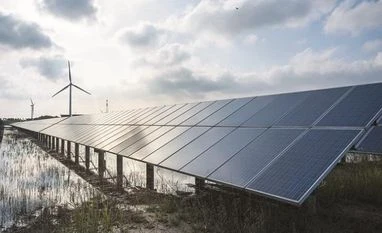 "Solar projects, Green Projects, Solar Energy")

