On March 28, Minister of State for Defence Subhash Bhambre told Parliament: “An agreement between India and France regarding the Exchange and Reciprocal Protection of Classified or Protected Information was signed on March 10, 2018, during the State Visit (sic) of President of France to India. This agreement defines the common security regulations applicable to any exchange of classified and protected information between the two countries.”
Business Standard learns that the 2008 Indo-French agreement had covered exactly the same ground.
Experts say the scope of that pact – i.e. the “exchange of classified and protected information between the two countries” – does not include commercial details and costs. Its scope only extends to tactical and technical details relating to the capability of the platform in question, and its performance and tactics in combat.
The French government statement, issued on Friday, also asserts the confidentiality of “security and operational capabilities”, not price details. Paris said the agreement “legally binds the two States to protect the classified information provided by the partner that could impact security and operational capabilities of the defence equipment of India or France.”
Further, as The Wire reported on Saturday, Macron himself is ambiguous about what France wants to be kept confidential. In an interview to India Today TV on March 9, Macron said: “There are some discussions to be organised by the Indian government, and they will have to consider which details they would want to be revealed to the Opposition and Parliament. I am no one to interfere in such a discussion and you too must realise that we have to consider commercial sensitivities.”
Given that Paris routinely makes public details about what its military pays for each Rafale buy, Macron would be unlikely to restrain New Delhi from doing so. Furthermore, the government is submitting the Rafale contract to a Comptroller and Auditor General audit. There is little reason to withhold those from a privileged parliamentary panel, such as the Standing Committee on Defence.
On Wednesday, Bhambre had told Parliament: “The Comptroller and Auditor General (C&AG) is conducting the audit of the Capital Acquisition System of Indian Air Force including the Rafale aircraft.”
Air Vice Marshal Nirdosh Tyagi (Retired), who handled IAF procurements in 2008-2011, including the aborted tender for 126 medium multi-role combat aircraft (MMRCA), says the government should not shy away from revealing cost details of the 36-Rafale contract. “The is little reason to apprehend that other potential Rafale customers might benefit from knowing details of the Indian contract. Each contract has different components and comparing two contracts like comparing apples to oranges,” says Tyagi.
Further, the defence ministry has already revealed full details of the Rafale purchase. On September 23, 2016 – after then defence minister Manohar Parrikar inked an Inter-Governmental Agreement with his French counterpart, Jean-Yves Le Drian, while officials signed commercial components of the Rafale contract – a top defence ministry official conducted an off-the-record media briefing, giving out minute details of the Rafale contract.
Based on that briefing, the media reported widely the details that the government now calls confidential.
In Business Standard (September 24, 2016 “India signs €7.8-billion deal for 36 Rafale fighters”), it was reported that the average cost of each Rafale was fixed at € 91.7 million (today Rs 7.4 billion). At that price, 36 bare-bones aircraft cost € 3.3 billion (today Rs 266.1 billion).
With € 1.7 billion more (today Rs 137.1 billion) for India-specific enhancements to the fighter, the cost of 36 Rafales added up to € 5 billion (today Rs 403.18 billion). That means each Rafale fighter cost € 138.8 million (today Rs 11.2 billion).
These ministry provided extensive details of the India-specific enhancements, which included “helmet mounted display sights” that allow pilots to aim their weapons merely by looking at a target; a “radar warning receiver” to detect enemy radar and “low band jammers” to foil it; a radio altimeter, Doppler radar and extreme cold weather starting-up devices for airfields like Leh.
The ministry official said another € 2.8 billion were paid for spares worth €1.8 billion (today Rs 145 billion), weaponry worth €700 million (today Rs 56.45 billion), and a logistics package of €350 million (today Rs 28.22 billion) that requires the French to ensure that at least 75 per cent of the Rafale fleet is available at all times for the next five years.
Further details were provided. The defence ministry said the weapons package includes Meteor “air-to-air missiles” that can shoot down aircraft 120-140 kilometres away. Also being provided was the Storm Shadow cruise missile for striking airfields, military headquarters and strategic infrastructure 500 kilometres away.
It was also revealed that the first Rafale must be delivered within 36 months, i.e. in September 2019. Dassault is to execute the entire order within 67 months, which means the last Rafale must join the IAF by April 2022.
The defence ministry also gave out details of the payment schedule. The IAF was required to pay a 15 per cent “signing advance” of about Rs 87 billion today. Another 25 per cent was to be paid in 2017. The balance amount would be paid over the coming years at stipulated delivery milestones.


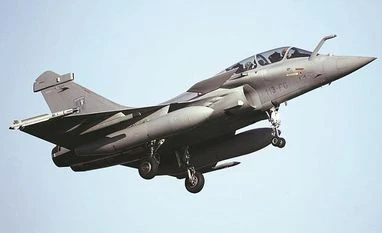 "Rafale, Jet")

