


Shinzo Abe win puts India-Japan trade, defence ties on continuity track
Since 2000, Japan has poured in roughly $26.12 billion in direct investment in India, ranking it third, behind Mauritius and Singapore
 "Japan")
premium
.
Last Updated : Oct 24 2017 | 12:43 AM IST
The emphatic election victory of Japanese Prime Minister Shinzo Abe would not only deepen India-Japan economic and defence cooperation, but is also expected to be a stabilising factor in the uncertain environment in the Indo-Pacific region and East Asia.
Prime Minister Narendra Modi, who has a good personal rapport with Abe, was one of the first world leaders to congratulate the Japanese PM. “Heartiest greetings to my dear friend @AbeShinzo on his big election win. Look forward to further strengthen India-Japan relations with him,” Modi tweeted.
Japan was the first country that Modi had visited beyond South Asia after being elected the PM in May 2014. During his visit to India in December 2015, Abe had visited Varanasi, the PM’s Lok Sabha constituency, where he had taken part in the Ganga aarti. In September 2017, Abe had visited the PM’s home state of Gujarat and participated in the groundbreaking ceremony of the Ahmedabad-Mumbai bullet train project.
The 500-km project, finances by Japanese credit of $17 billion payable in 50 years at an interest of 0.1 per cent, is expected to act as a catalyst of economic growth, exposing the country to state-of-the-art technology.
But arguably, the conclusion of the civil nuclear agreement between the two countries was a landmark event. This is Japan’s first with a country that is a non-signatory to the non-proliferation of nuclear weapons treaty.
Other areas of cooperation between the two countries include the Delhi-Mumbai Industrial Corridor and Mumbai Trans Harbour link project and the ambitious India-Japan Asia Africa growth corridor.
“This personal chemistry between Narendra Modi and Shinzo Abe has been largely responsible for the current state of cooperation between the two countries. With Abe’s victory, this cooperation will continue. The victory will be a stabilising force in the dynamic and uncertain environment in East Asia,” Overseas Friends of Bharatiya Janata Party (OFBJP) Chief Vijay Chauthaiwale said. The OFBJP is the party’s overseas arm.
Since 2000, Japan has poured in roughly $26.12 billion in direct investment in India, ranking it third, behind Mauritius and Singapore.
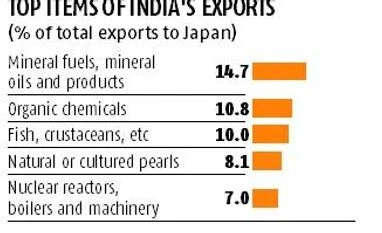
But despite a strengthening of ties, the two countries also signed a trade agreement in 2011, trade between the two countries hasn’t taken off.
India’s exports to Japan have actually declined from $5.38 billion in 2014-15 to $3.84 billion in 2016-17.
Some of the decline reflects a fall in crude prices.
Its imports from Japan have also declined from $10.13 billion to $9.75 billion over the same period.
“India hasn’t really received the incremental market access through the trade agreement,” says Biswajit Dhar, professor at Jawaharlal Nehru University. “It is possible that we simply don’t have the capacity to exploit the market access or that there are issues regarding tariff barriers,” he adds.
“This is a pattern we see with some other countries we have signed trade agreements,” says Sachin Chaturvedi, director general of Research and Information System for Developing Countries. “But we must note that import of intermediate products has increased while that of finished products has declined,” he adds.
Sources: Export Import data bank, Department of Commerce, DIPP
But experts say that the relationship shouldn’t be viewed just in terms of trade. It is a strategic relationship.
The Japanese PM’s victory comes at a time when the US, and several countries in the Indo-Pacific region, have concerns at the growing assertiveness of China. US Secretary of State Rex Tillerson is currently on a visit to Asia, and had criticised China in his speech on October 18.
Tillerson lands in New Delhi on Tuesday, and the situation in Indo-Pacific region, as well as mutual concerns over China’s ‘One Belt, One Road’ infrastructure initiative would be some of the key issues that Tillerson would discuss with the Indian leadership.
In his speech last week, Tillerson had underlined the importance of the trilateral engagement between the US, India and Japan, but advocated including Australia. He had also spoken of a 100-year US and India alliance in the region, purportedly to counter China’s rise.
“We are already capturing the benefits of our important trilateral engagement between the US, India and Japan. As we look ahead, there is room to invite others, including Australia, to build on the shared objectives and initiatives,” Tillerson had said.
Abe has won on a nationalist agenda. He has been keen not only to amend Japan’s pacifist constitution, but also deepen defence cooperation with India. During his visit to India in September, Abe had identified North Korea as a “joint” challenge to both Japan and India. After his election victory on Tuesday, Abe said: “I will pursue decisive and strong diplomacy to tackle North Korea’s missile, nuclear and abduction issues and put further pressure to get it to change its policy.” US President Donald Trump is scheduled to visit Tokyo in the first week of November, and North Korea will feature prominently in his discussions with Abe.