


Home / Specials / Supplements / BS Banking Annual 2017: 'Balance of power shifts from borrower to lender'
BS Banking Annual 2017: 'Balance of power shifts from borrower to lender'
Edited excerpts from a discussion at the Business Standard Banking Round Table held in Mumbai
 "BS Banking Round Table 2017")
premium
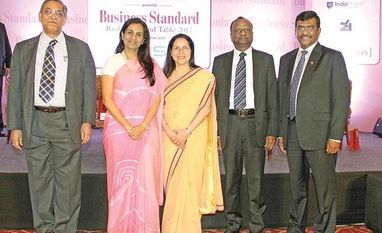
(From left) Former RBI Deputy Governor K C Chakrabarty, ICICI Bank MD & CEO Chanda Kochhar, Standard Chartered India CEO Zarin Daruwala, State Bank of India Chairman Rajnish Kumar and Union Bank of India MD & CEO Rajkiran Rai G at the Business Standa
11 min read Last Updated : Dec 18 2019 | 9:52 PM IST
What is the biggest issue on your minds today, and the change you expect to see in banking in 2018?
KC Chakrabarty: There is only one challenge, which is NPA (non-performing assets). We must focus on this one challenge, and solve it. What is expected as a change is that the bank balance sheet strengthening process should start, which means NPAs go down, bank capital increasies and operating income rises.
Chanda Kochhar: Whenever we think of issues, we think of challenges. Let us not do that. It is important to also have opportunities at the top of our mind. The entire retail credit growth, digitisation and technology innovation are big opportunities, because with the formalisation of financial savings, GST (goods and services tax) and innovation, more people are becoming bankable. While this is happening, one cannot take the eye off NPAs. It is time we all as bankers focus on recovery and resolution rather than only on recognition of NPA.
Rajnish Kumar: NPAs are a transitory problem, although this time the cycle has been very prolonged. To that extent managing NPAs, their recovery and resolution, strengthening the balance sheet and high quality of disclosure are important. For PSBs (public sector banks), there are other challenges around managing talent and skills. The entire ecosystem is changing because of technology and digitisation. The business model of banks has to undergo a change and is undergoing one. The outlook is exciting, promising and at the same time remaining ahead of the curve would be a challenge for everyone.
Rajkiran Rai G: One needs to now look forward for the growth story. GDP growth of seven per cent cannot happen without PSBs engaging in a big way. Can we prepare PSBs to participate in the growth story, without repeating the mistakes of the past? Can we change the way they really work, underwrite and monitor credit? During the current phase where credit growth is slow, we need to prepare ourselves for the growth ahead.
The change in 2018 is going to be for the MSME (micro, small and medium enterprises) sector. Can we repeat what we did in retail in the MSME sector? If we are able to get our model right and enter the MSME sector with the right data analytics, retail has become competitive; MSME is where the profitability is going to come from.
Zarin Daruwala: The tax-to-GDP ratio, which is quite low at 16-17 per cent, clearly will improve going forward, with GST. Other benefits will come in with the informal sector coming into the formal sector. MSMEs today don’t have a track record, but now we will have the GST records that we can bank on. MSMEs provide 40 per cent of employment opportunities. So, these enterprises will provide the next phase of growth.
With the Insolvency and Bankruptcy Code (IBC), we will hopefully see time-bound resolution for the large cases. Japan recovers 90 cents to a dollar because of quick resolution. India recovers 25 cents. Hence, IBC is going to be a big change, and effective implementation is key.
Are banks responding quickly enough to the huge fund inflow into the banking system, for which the RBI had to step in and neutralise the excess liquidity?
Chakrabarty: Banks have missed an opportunity that arose out of demonetisation. They should have reduced their savings bank interest rates to one per cent. Nothing would have happened, because nobody keeps money in a savings bank account for interest. Look, it is a credit- starved economy and our mind-set has to change. The corporate sector is a high-risk, high-profit business and you have taken more risk. So, your future for some more time will be SME, agriculture and partly retail. Simply funding the retail without corporate industry growth will be very dangerous, as it will become an NPA. For SME credit growth, PSBs will not be able to extend loans unless their branch managers start lending. For the last 10 years, branch managers have stopped lending at the branch level, and unless you create an ecosystem you will not be able to capture financial infrastructure and corporate.
SBI led the move to drop the rates of savings deposits. What was the impact? Could you have gone further down the road?
Chakrabarty: That is the most idiotic step. Banks have reduced interest rate for the savings depositor, but [for depositors of] more than Rs 5 million to Rs 10 million, they are not reducing it. A person who keeps that much money in your bank does not bother about interest rate. They are all taking anti-customer measures, anti-poor measures. If we made the savings bank interest rate one per cent nothing will happen.
Kumar: What has to be realised about these Rs 10 million savings deposits (accounts), is that other than the government departments nobody keeps such amounts in the savings deposits. Which individual will keep more than Rs 50,000 or Rs 200,000 in a savings bank account? So, first let us clear the air about this poor vs rich.
A savings bank is a very big franchise for a bank like us. Because savings is a utility type of account, even if we reduced interest rate it was not going to impact the franchise. To that extent, the customers of SBI continue to have faith in us. Even today, SBI opens 100,000 savings accounts per day. But you cannot entirely ignore the system you are operating in, nor the competition.
It is very easy to change the fixed-deposit rates, but can we ignore completely the public dependence, public opinion? Many people, senior citizens, are dependent on interest income alone. So, we have to take care of all segments of customers: poor, rich, not to so rich. So, the role of interest rates in enhancing investment or credit growth does not seem to have as much correlation as is generally thought.
The gap between your cost of funds and lending rates hasn’t really narrowed, so is there a problem with lending rates, which is why credit is not growing as much as it should?
Kochhar: Lending rates are more linked to the cost of funds. So, there is always a debate on how the lending rates moved vis-à-vis the cost of funds and the repo rate, and whether there is enough transmission or not. First of all, we must understand that the repo rate change does not automatically change the deposit cost of banks.
Secondly, even in deposits, part of it is fixed deposits where interest rates can change but part of it is savings banks and current accounts where interest rates don’t change as much. So overall, the cost of funds of banks does not move directly in proportion with repo rate changes. But the data indicates that there is always a transmission of interest rate movement, up or down, maybe with a lag. Over a broader period of time, actually the rates move quite in tandem.
While credit may be expensive, and it is always good for the economy to have lower lending rates, it improves the credit quality. But lower lending rates are just a necessary condition for credit growth, and not a sufficient condition. Credit growth has to come finally out of the inherent requirements.
The longer tenure bond rates have shot up. Is that affecting lending?
Rai: I don’t think it will affect my lending decision. But rising yield on government securities is a disturbing feature when we are talking about the downward interest rate cycle. Banks were lucky in the last few quarters because the NPA provisioning was going up and a lot of our operating profits were contributed to by the downward cycle and the bond yields going down. That has reversed very distinctively this quarter. So this will have an impact on our operating profits, because we are not sitting on any profits and maybe there will be some minor provisioning requirement for the mark-to-market losses also. If you look at our yield on advances and our MCLR (marginal cost of funds-based lending rate), it is over eight per cent, while G-sec yields are seven per cent, so one per cent is a huge difference for me. It will not tempt me to put it in G-Sec.
It is a challenge to really manage the margins, because we need more operating profits due to the provisioning requirements. And the very proactive actions by the RBI has also squeezed margins, particularly on the MCLR.
Globally, interest rates are going up. What does it mean for us in terms of inflows, when you look at 2018?
Daruwala: The foreign direct investment flows will continue. It’s the flows of foreign institutional investors (FIIs) which obviously have the interest arbitrage in play. Clearly, it’s a function of the relative interest rates, and these are opportunistic plays depending on the arbitrage FIIs see between domestic and global rates, and it’s also a function of the exchange rates. It is a very dynamic situation. Also, the RBI is quite conscious of not having too much FII debt flows, so that keeps getting rationed out.
Were banks reluctant to recognise the (NPA) problem, until the RBI left them with no choice? Even today they are not keen to go into the IBC process.
Kumar: There cannot be a uniform approach for IBC. If I look at the government’s reforms, the IBC is one of the biggest reforms. This is what bankers were demanding. So, to say we are not interested is not right. Provisioning will be there and we are ultimately moving to a system where we, when expecting a loss basis, will have to provide. It may happen in 2018 or 2019.
Regarding the NPA recognition problem, between the RBI and banks there has been no divergence of opinion on the stressed nature of assets. The divergence comes on account of certain leeway and policies, which is available. In most of them, the problem is in respect to projects under implementation and there are a lot of issues. When everything is rule-bound, and everyone reads it in a different way, divergences have come.
Provisioning, yes, one way is that you take everything upfront, but then what would be the impact on the banking system? Ultimately, we are talking about a banking system which is strong.
But banks were not in a position, and are even today not in a position, to take the entire hit at one go. There are practical issues that all bankers face. But, recognition should happen in time wherever there is stress and adequate provisioning for expected loss should be provided for.
Is credit culture improving?
Kumar: The balance of power has definitely changed. Earlier the balance of power was in favour of banks till such time as they had not given the money. Once the money was given, the balance of power was in the hands of the borrower.
Kochhar: I would say one thing, something I have said earlier. We do keep debating about recognition, but we all need to realise that we should work on resolutions. We need to arrive at more timely resolutions, part of it can be restructuring, change in management, sales of assets, or whatever it is. The more timely it is, the better is the recovery and we have to remember that many of these are productive assets and we are living in an economy where demand will keep going up because of our demographics and growth. It is not correct for us to just keep sitting on decisions and allow the projects to become unproductive. We should not debate on resolution, but act on resolutions.
Daruwala: Clearly that balance of power is changing. Also, the sense of urgency is on the side of promoters to do resolutions quickly, lest they be pushed to the NCLT (National Company Law Tribunal), also driving good resolutions. From the banker’s side also, and the borrower’s, it’s a good thing.
Topics : BS Banking Annual