


Run for cover will need longer strides: Insurance experts at BS Webinar
At Business Standard webinar on De-risking the Risk Business, they say one can expect a deadline extension for the implementation of IFRS 17, given the Covid pandemic
 "banner")
premium
Insurers will have to take a fundamental relook at the way they do business to align with IFRS 17 — International Financial Reporting Standards-2017 — which are set to kick in from January 1, 2023.
“Insurance firms write policies with specific and exotic risks. It is assumed that they can manage the risk, as well. With IFRS-17, they will have to change the way they go about it,” said Nilesh Sathe, former board member of the Insurance Regulatory and Development Authority.
Sathe explained the accounting standards will combine the current measurement of future cash flows with the recognition of profit over the period of contracts. It calls for the presentation of insurance service results — including the presentation of insurance revenue — separately from insurance finance income or expenses. And insurers will have to make a choice whether to recognise all insurance finance income or expenses in profit or loss; or recognise some of the same in other comprehensive income.
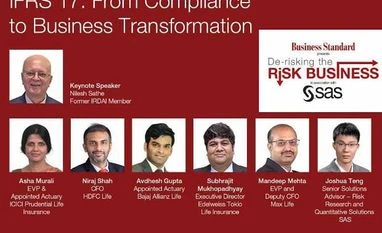
Sathe was part of a panel discussion at Business Standard’s webinar, organised with SaS, on ‘IFRS17: From Compliance to Business Transformation’. Others on the panel were Asha Murali, appointed actuary at ICICI Prudential Life Insurance, Niraj Shah, chief financial officer (CFO) at HDFC Life Insurance, Avdhesh Gupta, appointed actuary and head data sciences at Bajaj Allianz Life, Mandeep Mehta, executive vice-president and deputy CFO at Max Life Insurance, Subhrajit Mukhopadhyay, executive director, Edelweiss Tokio Life Insurance, and Joshua Teng, senior solutions advisor-risk research and quantitative solutions at SAS. The discussion was moderated by Tamal Bandyopadhyay, consulting editor of Business Standard.
“This (shift to IFRS 17) is very complicated and has many nuances. It will give you
more insights into the business. It’s not to suggest we are quite there, but we will get access to more granular information. Rather than just being reactive to market developments,” said Murali.
“There will be a need to better educate customers and shareholders, and the board of directors about the way data is collected and processed,” noted Shah. He felt that given the magnitude of changes that IFRS 17 will entail, “there will be a need for a time-frame to transition and do a dry run of the new framework, as well.”
“Insurance firms write policies with specific and exotic risks. It is assumed that they can manage the risk, as well. With IFRS-17, they will have to change the way they go about it,” said Nilesh Sathe, former board member of the Insurance Regulatory and Development Authority.
Sathe explained the accounting standards will combine the current measurement of future cash flows with the recognition of profit over the period of contracts. It calls for the presentation of insurance service results — including the presentation of insurance revenue — separately from insurance finance income or expenses. And insurers will have to make a choice whether to recognise all insurance finance income or expenses in profit or loss; or recognise some of the same in other comprehensive income.
Sathe was part of a panel discussion at Business Standard’s webinar, organised with SaS, on ‘IFRS17: From Compliance to Business Transformation’. Others on the panel were Asha Murali, appointed actuary at ICICI Prudential Life Insurance, Niraj Shah, chief financial officer (CFO) at HDFC Life Insurance, Avdhesh Gupta, appointed actuary and head data sciences at Bajaj Allianz Life, Mandeep Mehta, executive vice-president and deputy CFO at Max Life Insurance, Subhrajit Mukhopadhyay, executive director, Edelweiss Tokio Life Insurance, and Joshua Teng, senior solutions advisor-risk research and quantitative solutions at SAS. The discussion was moderated by Tamal Bandyopadhyay, consulting editor of Business Standard.
“This (shift to IFRS 17) is very complicated and has many nuances. It will give you
more insights into the business. It’s not to suggest we are quite there, but we will get access to more granular information. Rather than just being reactive to market developments,” said Murali.
“There will be a need to better educate customers and shareholders, and the board of directors about the way data is collected and processed,” noted Shah. He felt that given the magnitude of changes that IFRS 17 will entail, “there will be a need for a time-frame to transition and do a dry run of the new framework, as well.”
Topics : bs events risk business Insurance