


Amazon's drone delivery program is hit by crashes and safety concerns
The company is a long way from launching a drone delivery service
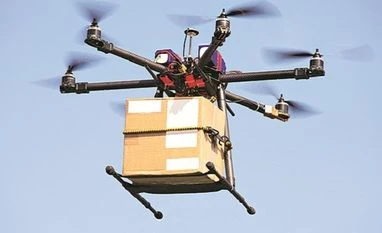 "Drone")
Representative image
Jeff Bezos went on 60 Minutes in 2013 and pledged to fill the skies with a fleet of delivery drones that could zip parcels to customers’ homes in 30 minutes. Asked when this future would arrive, the Amazon.com Inc. founder said he expected drone deliveries to commence in the next five years or thereabouts.
Almost a decade later, despite spending more than $2 billion and assembling a team of more than 1,000 people around the world, Amazon is a long way from launching a drone delivery service.
A Bloomberg investigation based on internal documents, government reports and interviews with 13 current and former employees reveals a program beset by technical challenges, high turnover and safety concerns. A serious crash in June prompted federal regulators to question the drone’s airworthiness because multiple safety features failed and the machine careened out of control, causing a brush fire. While experimental aircraft are expected to crash during test flights, current and former employees say pressure to get the program back on track has prompted some managers to take unnecessary risks that have put personnel in harm’s way.
“With rigorous testing like this, we expect these types of events to occur, and we apply the learnings from each flight towards improving safety,” Amazon spokesman Av Zammit said in an emailed statement. “No one has ever been injured or harmed as a result of these flights, and each test is done in compliance with all applicable regulations.”
Amazon plans to ramp up testing in the coming months. Having missed a goal of conducting 2,500 test flights last year, according to documents reviewed by Bloomberg, the company has set an even loftier target of 12,000 for 2022—although fewer than 200 had been completed as of late February. The company plans to add new testing locations this year in College Station, Texas, about 100 miles northeast of Austin, and Lockeford, California, near Stockton. Amazon also hopes to start testing drones beyond the sight of flight observers, according to documents reviewed by Bloomberg, a key step toward proving their ability to fly autonomously.
It will be years before the Federal Aviation Administration approves commercial drone deliveries, although the agency is letting companies conduct test flights in increasingly populated areas so long as they don’t pose significant safety risks. But the prospect of replacing human drivers with flying robots appeals to online retailers because 30-minute shipping is expected to become standard for certain deliveries, such as medicine, snacks and baby products.
Amazon drones could fan out up to 7 miles (11 km) from a delivery station, breezing above traffic to deliver packages weighing as much as 5 pounds (2.3 kg) within a half-hour of a customer clicking “buy.” The speed would finally make ordering from Amazon as quick as a trip to the store and help offset one of the biggest costs of e-commerce: paying someone to drive packages to homes.
The Seattle-based company is under growing pressure to keep up with deep-pocketed rivals. Just last week, Alphabet Inc.’s Google Wing accelerated its own drone testing program by starting to ferry packages to shoppers from Walgreens in a 90-square-mile suburban area north of Dallas. Walmart Inc. and United Parcel Service have their own drone programs in varying stages of development.
Even Amazon’s toughest internal critics don’t question the technology’s potential, but current and former employees say the company is doing what it has done so many times before: putting speed before safety in the name of beating the competition. “Someone is going to have to get killed or maimed for them to take these safety issues seriously,” said Cheddi Skeete, a former Amazon drone project manager who says he was fired last month for raising concerns to his managers. “How can we bring these tests to more communities when we know we have problems.” Spokesperson Zammit denied Skeete was terminated for speaking up.
The FAA declined to comment on the crashes, but said its testing requirements were designed to protect the public. “Flight testing is a critical part of all aircraft certification projects,” the agency said. “FAA flight-testing approvals contain provisions to ensure it occurs safely, without posing a hazard to people, property or other aircraft.”
In 2013, Amazon tapped aviation buff and software engineer Gur Kimchi to run its nascent drone program, now known as Prime Air. Designing delivery drones promised to be a heavy lift—and Amazon made the challenge all the harder by opting to create a completely new machine itself rather than farming out pieces of the design and building of prototypes to other companies. Kimchi favored a D.I.Y approach because doing so gave the team control over the final design, but former and current employees said the decision slowed development. For example, personnel wound copper wire around electric motor magnets themselves when an outside vendor could have done it faster. Even the prototypes were built in-house by hand.
The machines Bezos revealed on 60 Minutes resembled something you might see in a local park and simply weren’t up to the task; they could barely fly a mile and got tossed around in wind gusts. Amazon wanted a drone that blended the ability of a plane to fly long distances with the maneuverability of a helicopter that can swiftly change direction to avoid trees and power lines and hover over a back yard during inclement weather. The drones also needed to fly and find their destination with no human intervention.
The team went through more than two dozen concepts. The work was tedious and slow. The drones required new software that would allow on-board cameras to recognize and react to obstacles and differentiate between things like swimming pools and driveways. The team ultimately settled on a large 85-pound drone because they wanted it to be capable of carrying a 5-pound parcel—a payload that covers about 85% of the packages Amazon delivers. Extending the range as much as possible was key because every extra mile meant the drone could serve a larger population. Bezos was patient with the team so long as it meant creating a superior machine, according to a senior executive familiar with the program.
With six propellers, Amazon’s drone can shift from flying up and down to flying forward, a difficult engineering feat that had already bedeviled the U.S. military’s notoriously over-budget V-22 Osprey aircraft. The drone’s wings encase the propellers, helping it fly more efficiently over long distances and providing an additional layer of protection around the spinning blades.
Kimchi took safety seriously and gave his team time to fix defects rather than rushing them, according to people who worked for him. Information was shared freely, and employees were allowed to watch video of crashes to assess what went wrong. “The Prime Air group had a pretty strong safety culture,” said one former employee, who requested anonymity to discuss internal matters without authorization. “I remember even just the software meetings, we always had to open our meetings with someone volunteering a safety tip. They definitely weren’t playing fast and loose.”
Yet as the team struggled to get the drone’s various components working seamlessly together, one deadline after another came and went, according to a former employee. Jeff Wilke, who then ran Amazon’s consumer division, wanted to demonstrate the drone at a 2019 tech conference and announce that deliveries would begin by the end of that year. During a meeting with the drone team, he shared the goal to make sure everyone was on the same page. Employees knew the timing was unrealistic but dared not challenge him, according to people who were there.
Wilke showed off the drone at a Las Vegas hotel, playing video of it operating and touting the potential upsides for customers. He didn’t provide a date for the start of deliveries, saying they’d begin in “months.” Several employees watching the presentation recall thinking Kimchi wouldn’t be around much longer. The following year, the drone program became part of Amazon’s operations team, another sign executives wanted to move things along, and Kimchi was out as the boss. He left Amazon later that year.
“He overpromised and underdelivered,” said one former employee, who requested anonymity to discuss an internal matter. “That said, I think if the guy wasn’t so positive, or overambitious about the timelines, I don’t know if Prime Air would exist.” Kimchi declined to comment.
In March 2020, Amazon hired David Carbon to run the drone program. The Boeing Co. veteran arrived with baggage. A New York Times investigation had previously revealed that a Boeing 787 factory that Carbon ran in South Carolina tended to value production over safety. Several employees told the newspaper they’d been retaliated against for raising safety concerns. Though the problems pre-dated Carbon’s arrival, they continued on his watch, the Times reported. Boeing executives defended the plant’s commitment to safety, but a month later Carbon was on his way out.
When Amazon announced his hiring internally the following year, an interim director of the drone program told the team not to believe everything they read in the press, according to current and former employees. That didn’t stop them from googling Carbon on their smartphones during the meeting. Still, these people acknowledge that Carbon brought discipline and focus to the program. His long industry experience helped accelerate development and he began farming out some drone production. He closed facilities in England and France and moved some image-recognition work to lower-cost Costa Rica.
But current and former employees said it wasn’t long before Carbon began pushing speed over safety. Amazon didn’t make the drone chief available for an interview, but spokesperson Zammit said Carbon “has over 25 years of experience bringing aerospace innovations to scale safely and reliably, and we’re excited that he’s leading the next phase of our mission to bring 30-minute delivery by drones to customers.”
Last year, an Amazon team was preparing for a flight at a Crows Landing testing facility in California’s Central Valley about 20 miles south of Modesto. Some of the crew worried they would violate FAA testing guidelines because a farmer was driving a tractor in the flight path. After a debate, according to personnel who were there, a team leader said the test would be safe so long as the drone wasn’t directly above the farmer. They conducted the test without incident, but some employees said the boss had improperly interpreted the FAA rules.
“We always clear the test area before beginning each flight test,” Zammit said in the emailed statement. “In this instance, a farm vehicle entered the field after we launched. The crew safely and quickly landed the drone.”
David Johnson was a drone flight assistant for about a year, mostly at remote testing facilities in rural Oregon. He said Amazon often conducted tests without a full flight team and inadequate equipment, forcing employees to handle more than one role. For example, he said, someone responsible for a pre-flight drone inspection would quickly pivot to flight observer, which requires watching out for potential obstacles. Johnson said he once warned his bosses that his laptop had a broken keyboard but wasn’t given a replacement in time for a test. He went ahead with an external keyboard that made it difficult to complete a pre-flight inspection in time. Johnson said he was still completing his checklist when the drone took off, earning him a reprimand for taking his eyes off the aircraft.